Monday, March 17, 2014
The latest data from EEF (formerly the Engineering Employers' Federation) provide some very encouraging news. Much of the current recovery in the UK economy has come from increased consumer spending, and this has raised doubts about the sustainability of the upturn. But the new EEF data suggest that manufacturers are experiencing a substantial increase in orders for export - and that this increase is expected to accelerate into the next quarter. While the forecasts necessarily have an element of guesswork about them, if the export picture turns out to be close to the mark then it provides real cause for optimism.

Wednesday, March 12, 2014
There has, for some months, been some concern that the full cost of the new regime of tuition fees for undergraduate education in the UK was underestimated by the government at the time that it was introduced. The new regime raised the cap on tuition fees from a little over £3000 per year to £9000, and was designed to compensate universities for a severe fall in public funding - hence reducing the government's budget deficit.
On the surface, it seems obvious that such a change in policy would indeed reduce the deficit. Scratch beneath the surface, however, and things are not so clear. This is because student loans are repaid through the income tax system as a proportion of graduates' incomes. And if, 30 years after graduation, a graduate has not paid off the loan in full, the remainder gets written off. This means that some proportion of the total value of the loan book will never get repaid, and the burden of financing this will fall back onto the taxpayer.
This proportion has come to be known as the Resource Account and Budgeting (or RAB) charge. The RAB is an important figure, partly because it tells us how much of a discount needs to be offered when the government sells parts of the loan book off to the private sector. Estimates of the RAB have risen over time - in 2011, the government estimated a RAB charge of 30%, but the most recent official estimate is 40%.
The most recent estimates are uncomfortably high. The Higher Education Policy Institute has estimated that, if the RAB were to reach 47%, the new fees regime would be no more favourable to the government's finances than was the old. More recent research, published this month by London Economics, suggests a similar figure - between 48 and 49%.
If the RAB turns out to be in the high forties, then clearly the new fees regime will have missed in terms of its goal of bringing down the budget deficit. Even if turns out to be slightly lower, doubts must be raised about whether the current model of undergraduate financing is sustainable beyond the short term. Sadly we are a long way from realising Vince Cable's hope that the 'imaginary black hole will very soon disappear'.
The Confederation of British Industry (CBI) has put forward a set of proposals to strengthen the skills base in Science, Technology, Engineering and Maths (STEM) subjects. It notes that the UK is facing a skills shortage in these areas. One of its proposals is to reduce university tuition fees on some courses in STEM subjects.
Clearly it is important that players in the market for education should be aware of impending skills shortages, and that they should respond to them. Typically this is achieved through the market by employers raising wages for jobs where they face a shortage of labour - thereby attracting more workers into those jobs. Such a market mechanism bypasses the problems that might arise under a system of 'manpower planning' - where government tries to play the role of an omniscient planner, but often seems to lack the requisite information.
The proposal to reduce university tuition fees is problematic for a number of reasons. Not least, the current funding system for undergraduate education in the UK is one where loans are repaid out of future income streams - and crucially involves the writing off of any part of the loan that remains unpaid after 30 years. This means that students do not know how much of their loan they will end up repaying, and are therefore likely to be insensitive even to quite large fee discounts. There is evidence that students are responsive to the award of bursaries, but that is quite a different thing.
The devil is in the detail, and, while the aim of the CBI's proposal is worthy enough, the detail would frustrate that aim if it were ever to be put into practice.
Friday, March 07, 2014
Spring is in the air, and the economy is recovering. How far it will recover after the major shock it has suffered is still open to question. A generation ago, many economists spoke of 'hysteresis' - the tendency for blips in unemployment to become long-lasting owing to the depreciation of skills and the increased potential therefore for unemployed workers' attributes not to match well with those required by firms.
Alfonso Arpaia and Alessandro Turrini have evaluated a measure of such mismatch for some 22 European countries. These results show that the efficiency with which unemployed workers are matched with jobs fell in most of these countries quite soon after the economic crisis hit.
There are some interesting exceptions - efficiency has risen inexorably in Denmark. This may be the result of the 'flexicurity' of the labour market in that country - a system where extremely high degrees of job mobility are accompanied by a robust system of social security and active labour market policies. In Romania, too, matching efficiency has risen with just a bit of a flattening out in recent years. In many countries - especially those in Eastern Europe - the fall in matching efficiency followed a sharp peak, itself probably the result of introducing more liberal labour market policies following transition.
In the UK, the efficiency of matching fell sharply with the recession, and has not recovered since. Arpaia and Turrini's findings suggest that a high incidence of long term unemployment is one of the major factors underpinning this fall in efficiency. And in the UK, long term unemployment has risen markedly since the recession. At the end of 2007, there were 383000 workers who had been unemployed for over a year; although the number fell markedly in the last quarter of last year, there are now some 845000.
It would be easy, but facile, to contend that, with the unemployment rate falling rapidly, the labour market is functioning well. (It is in some respects, and is not in others.) For the market to maintain the flexibility that is needed, the matching of workers to jobs should be as efficient as possible. While long term unemployment rates remain high, this will not happen. Just as in the 1980s - when Richard Layard and others argued in favour of helping the long term unemployed back to work because doing so would not add to inflationary pressure - helping these workers now is an imperative. There is more to Denmark than good TV.
Wednesday, March 05, 2014
The size of the output gap is critical for determining the appropriate stance of fiscal policy, yet it has been the subject of considerable debate amongst economists. Some new data from the Office for National Statistics provide some instructive information.
On most measures the extent of spare capacity in the UK economy has narrowed over the last year. Measures based on qualitative survey data from firms tend to suggest a narrower gap than do quantitative measures such as employment data. The qualitative data are, by their very nature, harder to interpret; while they likely reflect practitioner perceptions quite accurately, it is difficult to explain why they should differ so much from the quantitative indicators.
Of the latter, it is particularly noticeable that the proportion of part-time workers who are unable to find full-time work remains high - as does youth unemployment. To the extent that such indicators reflect spare capacity in the labour market, the constraints (such as they are) appear more likely to be related to capital. Given the low levels of investment in the UK economy in recent years, this should hardly be surprising. As, with the recovery, investment picks up, so should capacity - this means that the potential level of output that is used in calculating the output gap is something of a movable feast.
In a nutshell, the capacity constraints faced by the UK economy are much softer than some observers would have us believe.
Tuesday, March 04, 2014
Redistributive government policies are widely assumed to be costly in terms of their effect on growth. The argument is that redistribution blunts incentives, so that most innovative and diligent people become less so.
That might well be the case, but it is far from being obviously true. The taxes and benefits that are used to redistribute income have both substitution and income effects - they change the return to each hour of work, thus tending to make work less attractive; but they also change the length of time that people need to work in order to achieve a given income, thus tending to make work more attractive. This means that their impact on how hard people work can go either way. While some economists hold doctrinal positions on this matter, in reality it is an empirical issue.
Recent work by Jonathan Ostry, Andrew Berg and Charalambos Tsangarides provides the empirical evidence. They find that, while in extreme cases, redistribution can be harmful (unsurprisingly enough), for the most part 'redistribution appears generally benign in terms of its impact on growth'. In statistical terms, they struggle pretty hard to get any significant results at all on their redistribution variable.
Incentives are no doubt extremely important. But to imagine that they work in only one direction is to ignore some pretty basic lessons from introductory economics courses. Oh, and the evidence.
Friday, February 28, 2014
The output gap has long been the focus of debate amongst economists, with estimates of the magnitude of this key policy-relevant figure varying widely. Sadly, one of the more useful sources of information on this, the English Business Survey, will shortly stop being collected. But the latest data from the survey are out today, and offer some interesting reading.
Across the whole of England, some 7% of firms report their capital as being underutilised. But this figure varies from just 4% in London to 10% in the South West. In two other regions, the North East and the West Midlands, the figure is 9%.
The present recovery is clearly one that has begun in the South East, and its spread to other parts of the country remains slow. The benefits of the upturn should be expected to spread more widely over the coming months. In the meantime, the output gap in large parts of the country remains substantial.
The TUC has released results from an analysis of unpaid overtime. This shows that some 10% more workers are working overtime on an unpaid basis than was the case in 2007. Partly (but only partly) this is the consequence of the recent increase in employment.
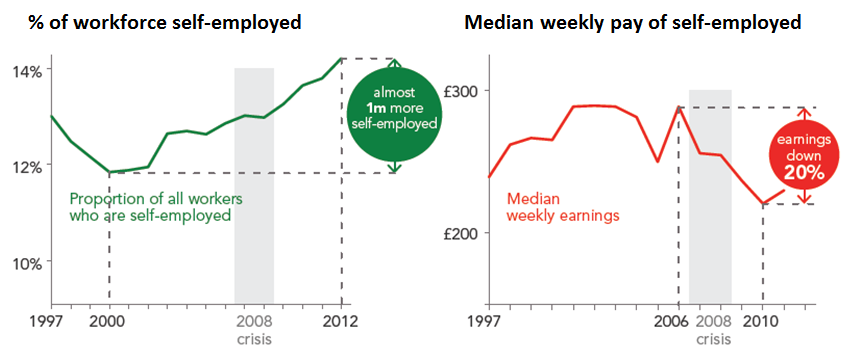
Other factors include the severity of the recession, and the aftermath that that has had on behaviours in the labour market. The increase is coincident with a rise in self-employment - much of which appears to be involuntary, since earnings of the self-employed have been falling. Despite the recent signs of recovery, fear appears to be an important factor, with people feeling they must demonstrate that they are working harder in order to keep their jobs.
An important implication of the figures released by the TUC is that, since the extent to which hours worked are underreported has risen over time, the stagnation of productivity (which is calculated as output divided by hours worked) has been even more pronounced than we had thought heretofore.
Monday, February 24, 2014
The Office for Fair Trading is calling for a full inquiry into competition in the university sector. It has legitimate concerns about applicants to undergraduate programmes being able to apply for only five universities and about the bar on them applying both to Oxford and Cambridge.
A further concern is the level of tuition fees, which are set by most institutions at the maximum of £9000. The OFT considers this to be evidence that universities are operating in collusion with one another. That, however, reflects a lamentable misunderstanding of the way the funding mechanism works.
Students take out loans to pay their fees, and these loans are repaid on an income-contingent basis once the students graduate. Any part of the loan that is not repaid after 30 years gets written off, and is paid by the taxpayer. This means that students do not know how much they will ultimately pay for their tuition - a rise in the 'ticket price' of that tuition is not tantamount to an increase in the amount that they will ultimately pay. Consequently, students prefer the certainty offered by bursaries that they might be offered while they are studying. This means that the best way for universities to attract students is to charge the full fee, and spend as much as they can of the revenues on bursaries. This being so, the fact that universities almost always charge (home undergraduates) £9000 is a million miles away from being evidence of collusion - it is simply the logical outcome of the funding mechanism that is in place.
None of the above is rocket science. If - as newspaper reports suggest - the OFT has indeed failed to grasp it, one wonders whether it is has the competence to advise on the inquiry.
Tuesday, February 11, 2014
Economic forecasters have received a rough ride in the media, often for good reason. The Great Recession was not well predicted by many economists - though there are some notable exceptions. In general GDP growth was overestimated both at the onset of the recession and over subsequent years - only more recently, in the UK, have the forecasts (very markedly) underestimated the extent of growth.
The OECD has produced an evaluation of their own forecasts over this period. Two findings are of particular note. First, forecasts for economies that were particularly open to external shocks were relatively prone to large errors. The impact of contagion of the financial crisis was underestimated. The global interlinkage of financial markets is a feature of the microeconomy that macroeconomic models - even those (maybe particularly those) with strong microfoundations - were not particularly well equipped to handle. This implies that forecasters need to learn a lesson about this aspect of their models (and to some extent they have already done so).
Secondly, forecasts were unusually error prone in economies that, before the recession, had more rigid regulation in their product and labour markets. In such economies, rigidities generate more extreme variations in employment and output than in economies where prices can bear the brunt of economic fluctuations. The modelling of such impediments to the free movement of prices calls for quite detailed understanding of institutional arrangments within the economies under study, and it is clear that this understanding needs to be improved if forecasters are to better their performance.
It should, however, be borne in mind that - while many observers like to judge economists on the basis of their forecasting ability - forecasting is far from the be all and end all of economics. Understanding the past and present is arguably more instructive (and - given the uncertainties that the future inevitably brings - more achievable) than accurately reading the statistical tea leaves.
Friday, February 07, 2014
The latest forecasts from my neural network model, using data to December of last year and forecasts for the next 2 years, are shown below.

The current recovery is starting to look a lot like the recovery of the late 1960s, with a sharp spike in growth followed by more moderate growth over an extended period. In the 1960s, the spike was stimulated by the November 1967 devaluation of the pound. The current increase in output has not been stimulated by such a discrete policy intervention - but the acceleration in consumer spending (that started in the last quarter of 2012 and which has continued since) has been remarkable.
Wednesday, February 05, 2014
The Institute of Fiscal Studies and Oxford Economics document to which I have referred in an earlier post contains an estimate of the magnitude of the output gap - the gap between current levels of output and the levels that would obtain were the economy working at full capacity. This estimate suggests that currently output is running at 5% short of its potential level.
This figure may be contrasted with that produced by the Office for Budget Responsibility - which is just 2.2%. The difference is important. If the output gap is, as the OBR suggests, small, then the economy is already operating near capacity and the bulk of the government's budget deficit is structural. If, on the other hand, the output gap is relatively large, relatively little of the deficit is structural, and so there is less need for austerity to reduce it.
The danger of excessive retrenchment is a theme that I have alluded to frequently in this blog over recent years. Fortunately policy has followed a rather more pragmatic course than the rhetoric would suggest. While the government may still claim that there is no plan B, the speed of austerity has, for the most part, suggested otherwise - and that it has been pursued. Good.
Falling real wages have been the topic of much debate in recent months, but forecasts recently produced by Oxford Economics and the Institute of Fiscal Studies suggest that the corner will soon be turned. Their prediction is that 'the combination of strengthening earnings growth and low inflation should be sufficient to ensure that real wages begin to increase again by the middle of this year'.
There are good reasons to suppose that this forecast is close to the mark - to be sure inflationary pressure is currently low. Moreover the sharp upturn in the economy has brought about increased employment in relatively high wage sectors such as finance.
However, stagnant productivity continues to present a challenge. Structural change was not a primary cause of the collapse of productivity in the first place - it fell in some industries (notably finance and pharmaceuticals) more than others, but it's these falls within industries rather than switching activity between industries that have proved problematic. A lasting cure will require us to address the innovation deficit - exemplified by a startling decline in patents issued in the UK in several key industries over recent years. Successful innovation requires a little luck, but also a lot of design. It is crucial to strike the right balance between beneficial regulation (such as patent protection) and harmful regulation (stifling creativity - might high marginal tax rates be an example?). Successful innovation also requires a context within which thinking big, and capturing the public imagination, is encouraged. In that, there is a role to be played by both private and public sectors.
Wednesday, January 22, 2014
The unemployment rate has been falling fairly steadily since its peak in the last quarter of 2011. Until the last three months of last year, this fall was unspectacular; at its peak the unemployment rate was 8.4%, and as recently as the three month period to last September it was still as high as 7.6%. The latest figures released today show that, in the three month period to November, the rate fell to 7.1%.
The latest data on GDP growth pertain to the third quarter of last year, and suggest a quarter-on-quarter growth of 0.8%. This is high - it suggests an annualised growth rate of 3.2%, well above the consensus forecast. In that quarter, growth within the construction sector was particularly striking. With GDP growth now apparently above the trend rate, it is not altogether surprising that unemployment should fall.
Yet questions remain about the source of this growth. Business investment grew in the third quarter of last year, but this only partially made up for a fall in the previous quarter, and the total level of such investment remained below the figure realised a year earlier. Investments in dwellings and other buildings likewise accelerated in the third quarter, but this only partially made up for recent falls. Consumer expenditure, meanwhile, has been rising steadily since the depths of the recession in 2008, and has accelerated sharply since the beginning of 2013.
The fall in unemployment and rise in output both represent very welcome news. As more people find jobs, the increase in consumption becomes more sustainable and the recovery becomes more secure. A key challenge that remains, however, is to raise productivity back to pre-recession levels and hence to restore real wage growth.
Monday, January 20, 2014
The ITEM (Independent Treasury Economic Model) club (supported by Enrst and Young) have issued their latest forecast for the UK economy. They conclude that growth in 2014 will accelerate to 2.7%, but caution that the recovery is very much led by consumer spending and that, until real wages rise, interest rates should be held at their current low level.
It would be hard to disagree with the ITEM club - at least as a short term forecast. Their predictions for the years beyond 2014 show the reversion to a steady state growth rate of around 2.5% that is characteristic of models of the type that they use - and recent experience suggests that we should be sceptical of that.
But the note of caution that is sounded here, suggesting that the recovery is fragile while it remains so heavily dependent on consumer spending, is well made. If growth does indeed accelerate to 2.7% this year, an outcome in 2015 of 2.4% (which is what the ITEM club is currently predicting) would be a rather better outcome than I would expect.
Wednesday, December 04, 2013
The recent surge in output in the UK has been noted by many commentators. Indeed, it seems quite remarkable.
The latest forecasts produced by my neural network model, using the most recently available data (up to September) suggest that a spike in output growth is likely - though the magnitude of the spike is moot - with the rate of growth falling back quickly to (much) more modest levels as we move into 2015.

Clearly much will depend on policy. Even though the output gap is still substantial, growth of the kind being predicted above is unlikely to last long without a build up of infationary pressure as workers seek to recover the lost ground of recent years. This could provoke an interest rate hike sooner rather than later - and that could bring output growth down sharply.
Thursday, November 21, 2013
Jim Heckman and Tim Kautz have provided an intriguing analysis of ways in which individuals' characters influence their economic outcomes, and of how character can be changed by various interventions. They view character as something that can change over time, something that is shaped by the individual's environment, and something that can be developed by interventions.
Opportunities for such interventions exist at many points over the life cycle, but are particularly rich during the early stages of life. Non-cognitive skills are developed at this stage, but this does not mean that character is fixed thereafter - describing these soft skills as personality traits is therefore misleading, and they are better described as skills. Skills can be honed over time.
The importance of such skills in the labour market is clear. Conscientousness, extraversion, emotional stability, agreeableness and openness - in that order - are known to be positively correlated with job performance. The evidence on the ability of interventions to affect character, and thence subsequent attainment, comes from a variety of sources, but one of the most persuasive concerns the effects of the Perry preschool programme.
These are important findings. The way in which various options affect the characters of stakeholders needs to be addressed in the design and subsequent evluation of policies.
Monday, November 04, 2013
The Confederation of British Industry has estimated that the net benefit of the UK's membership of the European Union amounts to somewhere between £62 billion and £78 billion per year - that is between 4% and 5% of Gross Domestic Product. This benefit comes from access to European markets, the dismantling of tariffs and other barriers to trade, and the consequent realisation of economies of scale. Further benefits come from the improved access to sources of finance that arise from EU membership, and from increased investment from outside the EU from firms wishing to locate within the common economic area.
The figures cited by the CBI are almost completely meaningless. To evaluate the benefits of membership of the EU, it is necessary to have an idea of what non-membership would look like. Were the UK to leave the EU, for example, it would most likely do so on a basis that retained freedom of trade. So to include the impact of free trade in any calculation of the benefits of the EU seems strange.
There is, of course, a case for staying in the European Union. But exaggerating the numbers does not serve to strengthen that case.
Thursday, October 24, 2013
New work by Pablo Brañas-Garza, Antonio Espín and Shoshana Neuman examines the effect of religiosity on the extent to which people's behaviour is pro-social. Based on games frequently used in experimental economics, the results, based on quite large samples of individuals, are striking. Active participation in religious activities appears to be strongly associated with more altruistic behaviour. Looking into the future, as adherence to faith declines, so (in the absence of countervailing measures) might the extent of pro-social activity.
The mechanism underpinning this finding is complex – it is likely to be partly the direct result of religious teaching, but partly also the result of the development of a sense of community that is engendered by frequently meeting neighbours at a religious institution. The latter should be seen alongside other developments – such as the growth of home entertainment – that together may reduce social cohesion.
Altruism, it seems, needs institutions. If our society lets the old institutions go more quickly than it lets go of its need for altruism, then new institutions will need to develop to plug the gap. These new institutions may be virtual – social networking, for example. But it remains to be seen whether the connection between the virtual world and the real world is sufficiently strong to serve the need.
Tuesday, October 22, 2013
In a fascinating study of the impact of corporate culture on company performance, Luigi Guiso, Paola Sapienza and Luigi Zingales have found a strong positive effect of managerial integrity and ethics. This should not be surprising, but it is immensely reassuring. In competitive markets, bad behaviour should be competed out of existence.
Friday, October 18, 2013
Òscar Jordà, Moritz Schilarick and Alan Taylor have produced one of the more interesting analyses of recession following financial crisis. As is by now well known, the severity of such recessions greatly exceeds that of a typical recession. Figure 6 of their study demonstrates this vividly. Following a financial crisis, output falls further and takes longer to recover than in a normal recession; this follows from the fact that investment - which is barely affected in a normal recession - falls drastically and recovers very slowly; this is reflected also in lending data, which show very slow recovery in the credit market.
The recent recession was triggered by an increase in debt. As the international evidence reported in Figure 1 of the study shows, this debt increase was primarily a characteristic of the private sector – indeed public sector debt had been falling as a proportion of GDP in the decade leading up to the crisis. Notwithstanding that, the ability of governments to respond to financial crisis necessarily depends on their own debt position; clearly this has deteriorated in the wake of the crisis, and contributes to the overall level of indebtedness. An adjustment was necessary – and the low levels of bank lending that have served to prolong the recession represent a part of that adjustment.
Another part is fiscal retrenchment. Hopes that this would of itself be expansionary (owing to a ‘confidence fairy’ effect) always appeared fanciful. The trick to recovering the government’s financial position must to phase fiscal policy so that retrenchment is achieved over a reasonable time horizon, but without proceeding so quickly as to damage the recovery that now seems under way.
Wednesday, October 16, 2013
Gordon McCord and Jeff Sachs have provided a fascinating analysis of the determinants of economic growth. This is an area in which I too have dabbled in the past, and many of their results - concerning the effects of landlock, openness etc. - reassuringly resonate with mine.
Surprisingly, though, McCord and Sachs find that the number of years of schooling typically received by men serves to dampen growth - though the schooling of women increases it. There are many possible explanations why female education should have a stronger positive effect on growth than male education - for instance, women may be more effective in passing their knowledge onto younger generations. But the finding that male education actually reduces growth appears perverse. I would argue that it is one that should be treated with caution - there is surely a high degree of collinearity between the amounts of schooling that men and women receive, and this could be distorting the result. This is a case of a study where further detail would be welcome.
Wednesday, October 09, 2013
The latest industrial production data, released this morning, reveal a drop in (seasonally adjusted) output in August. Nevertheless, feeding these data into my neural network forecasting model reveals that there remain grounds for cautious optimism about the likely trajectory of the economy over the next couple of years. The forecasts appear below.

Thursday, September 26, 2013
Opposition leader Ed Miliband has rattled some cages in recent days with his criticism of energy companies. To be sure, where companies are behaving in an anti-competitive fashion there is scope for regulation. But the precise proposal here seems curious. The threat to freeze energy bills after the general election will surely encourage the energy companies to raise prices beforehand, having exactly the opposite effect to the one intended.
Wednesday, August 07, 2013
The Bank of England's inflation report contains (on p.38) a GDP forecast that confirms the general view that recovery is now under way. From the end of this year, the Bank expects growth of around 2.5% per year. This is welcome news.
Also welcome is the Bank's stated intention 'not to raise Bank Rate from its current level of 0.5% at least until the ... unemployemnt rate has fallen to a threshold of 7%' (subject to certain conditions on inflation and financial stability, p.7). This should provide sufficient certainty to ensure that market rates of interest are anchored, allowing, for example, lenders to offer longer term loans at fixed, low interest rates, and thus boosting the economy.
Under such conditions of stable and low interest rates, the Bank expects unemployment to fall gradually from its current level of 7.8%, reaching 7% around the middle of 2015. It should be noted, however, that 7% remains a couple of percentage points above the Bank's own estimate of the long run equilibrium (p.29). There remains a lot of slack in the economy.
A variety of recent statistical releases suggest that the economy is, at last, recovering. The latest run of my neural network forecasting model, based on industrial production data up to June of this year, is reported below.

This indicates a marked recovery, indeed so marked that it will quickly be followed by a downturn. This prediction should be treated with a great deal of caution (and even scepticism). The sharpness of the recovery is probably exaggerated, and so too, therefore is the likelihood of a quick reversal. I suspect that this - and the considerably less sanguine predictions that I reported on 17 July - reflect some inaccuracies in the published data for May. At that stage, the industrial production index had remained static for four months; the June figure, alongside various other indicators, renders the figure for May suspect.
Other positive statistics released recently include the second quarter estimate for GDP growth (0.6% over the quarter) and a rapid growth of retail sales noted by the British Retail Consortium.
Added note: If the industrial production figure for May is indeed downwardly biased, then that has implications for the forecast reported here. Supposing the value of the industrial production index in May should have been 95.5 (rather than 95.3), the forecaster would still lead us to expect recovery over the coming year, but it is much more modest and short lived. This serves to reinforce the point that, while several indicators give grounds for optimism, caution is still needed in interpreting the data.
Thursday, July 18, 2013
The Office for Budgetary Responsibility has produced a fascinating report on the impact of migration on the public finances. The report presents the government with something of a challenge.
Chart 3.14 on page 100 tells the story. The central projection shows that we can expect the net public sector debt as a proportion of GDP to rise towards 100% by the 2060s. Increasing immigration can reduce this burden quite substantially - since migrants tend to be younger than the population as a whole, and hence are more likely to be working, they generate substantial tax revenues. Reducing immigration has a severe impact on the national debt; indeed reducing net migration to zero is projected to cause the public sector net debt to rise to around 150% of GDP by the 2060s.
It is difficult to place too much credence on figures that look so far into the future. But the overall message from the Office for Budgetary Responsibility is clear: reducing the national debt without accepting an increase in immigration is likely to be an unrealistically tough ask.
Wednesday, July 17, 2013
The latest unemployment statistics, for the three month period to May of this year, present some good news. The unemployment rate appears to be falling, with the total number of unemployed workers some 57000 lower than in the previous period.
This appears to sit alongside other recent encouraging signs - including the upgrade to the forecast produced by the International Monetary Fund, which now predicts 0.9% growth in the current year.
Other data suggest that we should remain cautious, however. Industrial production has been flatlining in recent months, and remains stubbornly lower than it was a year ago. The forecasting model that I report here from time to time, based on these industrial production data, was, until recently, predicting a modest recovery, but is now pointing to a renewed bounce along the bottom.

For sure, some statistics are encouraging. Overall, however, the picture remains one of fragility.
The proposal to impose a minimum per unit price on alcohol sales in England and Wales appears to have been scrapped, apparently following an adverse public opinion survey.
This is not an altogether straightforward issue, as the statistical evidence on the effects of minimum pricing paints a rather confused picture. Estimates of the elasticities of health outcomes with respect to the minimum price of alcohol vary widely. Much of the best evidence comes from Canada - and Canadian researchers have studied also the UK situation. However, all the serious studies of which I am aware report significant (albeit widely divergent) beneficial outcomes from the imposition of a minimum price.
The proposal for a minimum price was a great example of a 'nudge' policy that offered the prospect of remarkable social benefits - it is regrettable that it has fallen victim to politics.
Friday, June 21, 2013
Cristina Cattaneo, Carlo Fiorio and Giovanni Peri have conducted an important study into the impact that immigrants have on the job prospects of native workers. This is, of course, a politically sensitive topic.
The findings of their analysis may provide some observers with a surprise: they find the 'native Europeans are more likely to upgrade their occupation to one associated with higher skills and better pay when a larger number of immigrants enter their labour market'. Their detailed empirical results suggest why this might not be the general perception. In their simplest model, it takes up to four years for the beneficial impact to become apparent. In more sophisticated models, which make allowance for issues arising from the direction of causality, the effect is immediate, but becomes more pronounced over time.
It is usually, though admittedly not always, the case that free markets serve us well. The labour market is no exception.
Wednesday, June 12, 2013
Ernst Fehr, Holger Herz and Tom Wilkening have produced a fascinating study, based on experimental work, of how bosses do (and do not) delegate. They find that bosses tend not to delegate enough - that both their own and their subordinates' interests would be served by more delegation. By retaining authority and failing to delegate, bosses support an under-supply of effort by their subordinates which is not in the organisation's interest - and hence not ultimately in the bosses' interests either. It seems that organisations stand to gain much if they can find incentive mechanisms that reward bosses in such a way that they delegate more appropriately. Such mechanisms would need to compensate bosses for their distaste for being overruled.
Fehr, E., Herz, H., & Wilkening, T. (2013). The Lure of Authority: Motivation and Incentive Effects of Power American Economic Review, 103 (4), 1325-1359 DOI: 10.1257/aer.103.4.1325
Evidence from the Institute of Fiscal Studies and the Trades Union Congress shows the extent to which wages have fallen over the course of the recession. The TUC reports that real wages have fallen by 7.5% overall, and by more than 10% in some parts of the country. This, according to the IFS, is a sharper fall than over any other five year period in recorded history.
The fall in wages has allowed unemployment to remain at much lower levels than might have been expected given the severity of the recession. The IFS attribute this flexibility of wages in part to a continued high level of labour supply - with many workers who would, in previous recessions, have quit the labour market as 'discouraged workers' opting instead to remain in the labour market this time - and in part to the effect of union legislation.
As the economy recovers, it would not be surprising to see wage pressure increase, as workers seek to recapture some of the losses they have made over the last few years. Unless such demands can be rigourously controlled, this could lead to an escalation of wages that feeds through into price inflation, and at the same time the braking force on unemployment could wither. While we now appear to be witnessing the beginnings of recovery, this could be frustrated by stagflation if discipline is not maintained.
Tuesday, May 07, 2013

Monday, March 18, 2013
The taxes due to be imposed on savings deposited in banks in Cyprus represent a response to the vulnerability of the banking system in that country. They have been defended on the grounds that depositors would ultimately bear the burden of any rebalancing. True though that might be, there are some serious problems with this type of solution.
The legitimacy of any tax rests on the idea that people understand that they will be liable to pay the tax if they do certain things. If I earn income, I expect to pay income tax; if I purchase goods and services, I expect to pay value added tax, excise duties and the like. It is not usual, or fair, to introduce new taxes where the payments are made by people who can reasonably be supposed to have behaved differently had they known the tax was on the way. One might describe the tax as legalised (but not legitimate) theft.
The proposed Cypriot tax is being imposed on all deposits - including those below €100K which are supposedly protected from bank collapses. It is not, therefore, a tax primarily aimed at big Russian depositors, as has been claimed (although many of the large deposits do of course come from Russia). One might describe it as theft from the poor.
The tax sends a signal to all savers in Europe that their savings are, quite simply, not safe. One hopes that the furore that this has attracted will prompt a rethink and that small depositors will be protected. Otherwise, the authorities may well have triggered bank runs throughout southern Europe. It is not a smart move.
Wednesday, February 13, 2013
The Bank of England has published its latest forecasts for the UK economy. These suggest that output is set to recover in the latter part of this year, rising quickly to a growth rate of around 2 per cent by the end of 2014. The Confederation of British Industry has made a similar forecast.
The latest results of my neural network forecaster (based on growth of industrial output) paint a similar picture of eventual recovery, although the prognosis for growth is more modest. The red line below shows the forecast to the end of next year - and suggests that growth during 2014 will be around 1.5%.

Friday, February 01, 2013
Sometimes it's nice, and reassuring, to see some unsurprising results emerge from statistical exercises. Brian Jacob, Brian McCall and Kevin Stange have recently produced a paper that analyses the determinants of college choice in the US. Amongst these determinants are college expenditures (per full-time equivalent student) on amenities (what the authors term 'country club' facilities) and on instruction. Unsurprisingly, spending on amentites attracts students. But it is a less strong attractor for the ablest students. Spending on instruction, meanwhile, positively attracts only the ablest students (and actually puts other students off). This means that different colleges' spending patterns can be rationalised by looking at the types of students that they are attracting (and are looking to attract in future).
Tuesday, January 22, 2013
Today marks the tenth anniversary of this blog. It's been an exciting ten years for observers of the economy. But listing some of the early topics covered in the blog provides a remarkable insight into how the world has changed over this time.
-student tuition fees raised to £3000 - and Conservative party plans to scrap tuition fees
-the congestion charge introduced in London (at a daily rate of £5) and the first motorway toll road opened
-the five economic tests for UK membership of the euro assessed
Inevitably, though, in looking back over the last decade, it is the Great Recession that stands out as an economic event of magnitude. The crisis, presaged in the UK by Northern Rock and reaching a climax with the collapse of Lehmans, has lasted over 5 years and output is still well below pre-crisis levels. The 6 September 2012 policy change by the European Central Bank has been instrumental in reducing interest rate spreads across the continent, and offers some hope that we may finally enter a period of sustained recovery. Nevertheless policymakers are still walking a tightrope - they must encourage growth while still attending to the fiscal deficit and guarding against inflation. The impact of deficit reduction policies, alongside the still fragile international economic environment, will mean that recovery is a slow process. So economics is, for better or worse, likely to remain interesting well into the next ten years.
Friday, January 04, 2013
In a recent paper, Robert Gilhooly, Martin Weale and Tomasz Wieladek have shown that the application of different estimation methods lead to widely varying conclusions about how output growth has been affected by (i) demand and (ii) productivity over the recent past. While traditional measures suggest that, for the UK, demand deficiency is almost uniquely responsible for slowdown, the application of a more refined method suggests that demand and productivity effects are equally responsible.
Essentially, the method proposed by Gilhooly, Weale and Wieladek is designed to compensate for biases that result from the fact that the fortunes of different sectors of the economy are intertwined at any point in time. Traditional methods that are used in this context do not work well when the time period under consideration is short, but these authors finesse this problem by adopting Bayesian methods. They argue that superior forecasting properties of their model suggest that its results should be taken more seriously than those of exercises based on other methodologies.
An important question then remains: if as much as half of the drop in output has been due to a fall-off in productivity, how can this fall-off have happened? If the findings imply that, over the course of the recession, we have unlearned the lessons of how to produce efficiently, then it is reasonable to question how such amnesia can occur.
To some extent, the decline in real wages may have allowed firms to retain labour while tolerating a fall in productivity - a fall that in itself reflects a drop in demand for the firms' output. Labour hoarding of this kind is readily explained in a context where firms expect a rapid return to growth and anticipate future labour shortages. It is not clear that this is the case now.
Another explanation may be that high productivity sectors have declined for secular reasons - for example, as natural resources have been depleted, the output of the extractive industries has fallen. This might suggest that there is a more permanent element to the decline in productivity, and that we should not output to grow rapidly to its previous high level.
It is possible, therefore, to put a rationale on the findings of Gilhooly et al. that productivity decline has been an important driver of recession. More work is probably needed before it is safe to conclude that this explains as much of the drop in output as the authors suggest. But their research certainly serves a purpose in reminding us that there is work to be done on the supply side of the economy as well as on the demand side as we seek to climb out of recession.
Friday, December 28, 2012
Some fascinating research by Ed Lazear, Kathryn Shaw and Christopher Stanton has evaluated the importance of a good boss. They find a substantial effect - a finding that has important implications for both the debate about remuneration of senior bosses and the more general question of how marginal productivity should be measured.
Wednesday, December 05, 2012
The Chancellor of the Exchequer presented his Autumn Statement earlier today. At the time of the last election, the main parties offered economic policies that differed in terms of how quickly they would tackle the budget deficit. The reality is now that the deficit will be closed more slowly than either party planned. This throws into pretty sharp relief the extent to which wiggle room has vanished.
A major difficulty over the last two years has been the continued weakness of the Eurozone. This has hit growth, and consequently had an adverse effect on tax receipts.
Taxpayers know that the deficit must be paid off sometime. The trick is to phase the austerity measures in such a way that, in time, they result in a reduced burden of debt, while not choking off the growth that is essential to the repayment of that debt. Current forecasts suggest that it will be the latter half of next year before any significant growth resumes, and this makes the balancing act particularly difficult. In this context it is particularly important that fiscally neutral changes in tax and government spending should be tilted to favour growth - this means that the raising of tax allowances and the investments in infrastructure are both to be welcomed.
Meanwhile, the statement points to the spending review that is to take place in the first half of 2013. The plans for deficit reduction, and specifically for government spending, in this statement indicate that the review will need to take a draconian stance. The extent to which that turns out to be feasible in practice will depend heavily on the broader macroeconomic context. If the European economy remains fragile beyond 2013, further fiscal retrenchment at home is likely to prolong still further the return to significant levels of growth. Indeed, the extent of retrenchment that is anticipated in today's statement may prove infeasible.
Thursday, November 22, 2012
The latest results from my neural network forecaster for the UK continues to suggest that economic recovery is likely to be consolidated only in the latter part of next year - and the indications are now that the rate of this recovery will be quite slow.

The fragility of the economy in the Eurozone remains a concern - regardless of conditions within the UK itself, there are still some significant downside risks.
Thursday, November 08, 2012
Fiscal Studies has published a special issue on higher education finance, and has made the contents freely avaiable for download. It's a good read. I particularly like the paper by Chowdry et al. Two things in their paper strike me as particularly interesting:
(1) 'The proportion of graduates who reach the new debt write-off point of 30 years increases to 56 per cent' - in other words most graduates will never repay the full amount of their loan. Indeed, 'the average female graduate will pay back just over half of what they borrow, compared with 87 per cent for the average male graduate'. This, of course, means that many (if not most) students are indifferent about the precise level of fees that they are charged, and this in turn incentivises many universities to charge at the cap of £9000. Another implication of this is that the taxpayer ends up having to bear the burden of the unpaid debt, so that the exchequer savings of the new scheme are not as great as might have been hoped. On the assumption that growth raises graduate earnings by 1.5% per year, the exchequer savings amount to £500m per year - which represents a relatively minor reduction in the public sector deficit.
(2) The paper does not produce revised estimates of the rate of return to higher education. It does point out that the average graudate 'will in futre make repayments totalling £25830 over their lifetime - an increase of 52%' compared with the system that existed before 2012. Meanwhile, 'the average student enjoys an increase in cash support during their degree of some 12 per cent, amounting to £19580 in total'. For some students at the margin, the rate of return to higher education has presumably fallen to such an extent that the investment is no longer worthwhile.
Chowdry, H., Dearden, L., Goodman, A., & Jin, W. (2012). The Distributional Impact of the 2012-13 Higher Education Funding Reforms in England* Fiscal Studies, 33 (2), 211-236 DOI: 10.1111/j.1475-5890.2012.00159.x
Thursday, November 01, 2012
The latest World Economic Outlook publication by the International Monetary Fund offers interesting evidence on fiscal multipliers. While 'fiscal multipliers were near 0.5 in advanced economies during the three decades leading up to 2009', the report finds that 'multipliers have actually been in the 0.9 to 1.7 range since the Great Recession'. Simon Wren-Lewis has recently provided a compelling analysis of what this means for the UK. While the global economic environment has done little to help, the double dip may well have been avoidable.
Thursday, October 25, 2012
The 1% increase in GDP achieved in the third quarter of this year represents tremendously welcome news. Part of this increase is surely due to the effect of the Olympics, part to the subdued second quarter (with its glut of public holidays), and it is possible that part could be wiped away as more information comes in and revisions are made to the statistics. Nonetheless, it is difficult to perceive this as anything but an encouraging result. The return to growth has come a little earlier than many (myself included) expected. It does contribute towards an explanation of the encouraging employment figures that were released last week.
There remain uncertainties in the economic environment that suggest that the celebrations need to be tinged with some caution. But Mario Draghi's announcement of the European Central Bank's new stance has been helpful, and interest rate spreads in Spain, Italy and Portugal have fallen markedly - and stayed down. They are still too high for comfort, but the position is markedly more encouraging than it was just 6 weeks ago.
Sunday, September 23, 2012
Paul Gregg and Steve Machin have recently examined the way in which the sensitivity of the real wage to unemployment rates has become stronger over the last decade or so. I have noted this in an earlier blog post, though I would argue that the change slightly predated the 2003 point identified by Gregg and Machin.
Whether, as the economy begins to recover, real wage restraint will continue is moot. If wage pressure returns over the next twelve months or so - before the recovery is consolidated - it may well be the case that interest rate hikes will be needed sooner rather than later in order to prevent a stagflation.
Wednesday, September 12, 2012

Thursday, September 06, 2012
The news that the European Central Bank will pursue outright monetary transactions (OMTs) - purchases of bonds issued by eurozone member countries - as a means of reducing borrowing costs for these countries is very welcome. The conditions under which such transactions will take place remain unclear; the ECB intends to purchase bonds only when it perceives serious distortions to the market, where these distortions are based on what it deems to be unfounded fears. Moreover, the ECB's intervention will be conditional upon the action being part of the European Stability Mechanism, making the availability of such support dependent on countries' compliance with fiscal discipline requirements. This last condition is critical, but the binary nature of any judgement about compliance means that pressure will inevitably come to bear in instances where the judgement is marginal. A better solution would be to offer support on a sliding scale, making support more costly where discipline is weaker. This would effectively be the solution offered by conditional bonds.
Nevertheless, the new initiative is a major step forward. It had been anticipated by the markets - the interest rate spreads for countries such as Spain and Italy had already fallen dramatically over the last day or so. In itself, this is a welcome outcome, though the spreads still have a long way to fall.
Friday, August 24, 2012
Some time ago, I reported on the differences between recent UK and US experience in terms of changes in productivity levels. A similar theme has emerged in recent work by Abigail Hughes and Jumana Saleheen. These authors identify some interesting sectoral patterns. Prior to the financial crisis, productivity growth in the services sector in the UK appeared to be strong; the crisis had an obvious adverse impact on (particularly financial) services, and many of the pre-crisis gains were subsequently lost. There has, since, been a modest recovery in productivity in this sector, however.
Meanwhile, productivity in the energy sector - where North Sea reserves are rapidly being depleted - has declined. In this context, driving the UK towards sustainable productivity growth is likely to be a challenge.
Investment in physical and human capital, and policies to foster innovation are conventional cures for productivity malaise. Business investment requires access to finance and also requires confidence that demand will grow into the future.
Continued uncertainty about the macroeconomic outlook - and especially about the outcome of the Euro crisis - is, in the absence of a quick resolution, likely to continue to frustrate hopes of a speedy return to healthy productivity growth.
Abigail Hughes, & Jumana Saleheen (2012). UK labour productivity since the onset of the crisis - an international and historical perspective Bank of England Quarterly Bulletin, 138-146
The latest results from my neural network forecasting model, based on industrial production (K222) in the UK are presented below - the data are outturn rates of growth up to June of this year (in blue) and forecasts for the following 24 months (in red).
It is clear that the medium term outlook remains grim. While the growth rate has by now pretty much bottomed out, these data suggest that the return to a positive rate of growth will not come until late next year.
Of course, such a simple model cannot take into account the plethora of uncertainties surrounding the Euro crisis and its ramifications for economic conditions in our major export markets. The risks there, however, remain predominantly on the downside.
The public finance data for July were disappointing; a prolonged recession is likely to mean dampened government revenues and increased government spending on welfare, so, while output struggles to recover, the outlook for deficit reduction is poor.

Tuesday, July 24, 2012
As I wrote last month, the news from Spain provides a cold shower. The recent movement of the spread showing the difference between interest rates at which the Spanish authorities can access debt and the German counterpart has been alarming. With the spread now well over 6 per cent, Spain's debt is becoming unsustainable, and a bail-out is looking increasingly inevitable.

A rescue package for an economy the size of Spain's will inevitably put strain on other European economies. With this scenario as the backdrop, the news that Moody's credit rating agency has announced negative outlooks for Germany, the Netherlands and Luxembourg, is unsurprising.
A rescue package for an economy the size of Spain's will inevitably put strain on other European economies. With this scenario as the backdrop, the news that Moody's credit rating agency has announced negative outlooks for Germany, the Netherlands and Luxembourg, is unsurprising.
Monday, July 09, 2012
News that BPP, the for-profit university college, is launching cut-price degrees in nursing and psychology comes side by side with some warnings from economists who have studied the for-profit higher education sector in the United States. Kevin Lang and Russell Weinstein find that, while the returns to studying for a degree from a traditional insititution of higher education are considerable, those associated with degrees (and other qualifications) from for-profits are negligible. Similar observations have been made by Nobel prizewinner Joe Stiglitz. As the UK for-profit higher education sector branches out into health, prospective students receive a health warning about such ventures.
Wednesday, June 20, 2012
The contrasting experiences of the UK and US over recent years, in terms of changes in labour productivity, has been noted for a while. Now, Abigail Hughes and Jumana Saleheen have produced an analysis that shows that UK productivity - having grown strongly in the run-up to the Great Recession - has been sluggish since, in comparison not only with the US but also with other major European economies.
The relatively strong productivity growth in some other economies - particularly in southern Europe - may well be due to the rapid increase in unemployment, with relatively low productivity workers losing their jobs. But the sluggish growth productivity in the UK has to be a source of concern. It reflects, in part at least, a lack of confidence in future prospects, and a consequent failure of businesses to invest.
While demand factors likely dominate the economic situation in the short term, in the longer term supply factors are clearly of paramount importance. The supply side issues that underpin the underperformance of the UK in international comparisons of productivity therefore warrant urgent attention.
Abigail Hughes and Jumana Saleheen (2012). UK labour productivity since the onset of the crisis — an international and historical perspective Bank of England Quarterly Bulletin, 52 (2), 138-146
The relatively strong productivity growth in some other economies - particularly in southern Europe - may well be due to the rapid increase in unemployment, with relatively low productivity workers losing their jobs. But the sluggish growth productivity in the UK has to be a source of concern. It reflects, in part at least, a lack of confidence in future prospects, and a consequent failure of businesses to invest.
While demand factors likely dominate the economic situation in the short term, in the longer term supply factors are clearly of paramount importance. The supply side issues that underpin the underperformance of the UK in international comparisons of productivity therefore warrant urgent attention.
Abigail Hughes and Jumana Saleheen (2012). UK labour productivity since the onset of the crisis — an international and historical perspective Bank of England Quarterly Bulletin, 52 (2), 138-146
Much of the debate about the merits of austerity policies concerns an empirical issue: how effective can fiscal policy be in stimulating the growth that can later help pay off deficits? Some new evidence on this comes from a paper by Karel Mertens and Morten Ravn (nicely summarised here). It suggests that the medium term response of national output (around 2 years after a shock) to a change in the tax take is quite substantial. Over the long run, of course, it is real things (such as productivity) that affect output growth - but over the short and medium term, fiscal policy can give the economy a substantial kick.
Arguing in favour of a fiscal injection that would, in the short term, serve to widen the government's budget deficit does of course represent a tough political challenge. But the evidence is clear that such an injection would serve to promote growth. And, with inflation now back within the Bank of England's target range, the argument that it would stoke inflation is increasingly difficult to sustain.
Karel Mertens and Morten Ravn (2012). A reconciliation of SVAR and narrative estimators of tax multipliers Cornell University Working Paper
Arguing in favour of a fiscal injection that would, in the short term, serve to widen the government's budget deficit does of course represent a tough political challenge. But the evidence is clear that such an injection would serve to promote growth. And, with inflation now back within the Bank of England's target range, the argument that it would stoke inflation is increasingly difficult to sustain.
Karel Mertens and Morten Ravn (2012). A reconciliation of SVAR and narrative estimators of tax multipliers Cornell University Working Paper
Monday, June 18, 2012

Friday, June 15, 2012
Two new packages of support for the UK economy have been announced in a speech by the Chancellor of the Exchequer at the Mansion House speech yesterday. The Bank of England's 'funding for lending' scheme will release £80 billion worth of loans, at low rates of interest, to commercial banks which will then undertake to lend to businesses. Meanwhile, in addition, 6-month loans will be offered to the commercial banks - the intention is to loan out at least £5 billion per month in this way. The aim of these two schemes is to effect a significant injection into the economy, which is facing what Mervyn King, Governor of the Bank of England, yesterday described as 'an ugly picture'.
Faced by such a dismal economic picture, the success of these initiatives will depend on the extent to which extra liquidity will translate into extra economic activity. With gloomy prospects and low levels of confidence about the medium term outlook, businesses may not consider this to be the best time to invest. Pushing 'Plan A' - expansionary monetary policy combined with fiscal retrenchment - to the limit is all well and good. But in a liquidity trap monetary policy alone cannot deliver growth.
Faced by such a dismal economic picture, the success of these initiatives will depend on the extent to which extra liquidity will translate into extra economic activity. With gloomy prospects and low levels of confidence about the medium term outlook, businesses may not consider this to be the best time to invest. Pushing 'Plan A' - expansionary monetary policy combined with fiscal retrenchment - to the limit is all well and good. But in a liquidity trap monetary policy alone cannot deliver growth.
The government's White Paper on banking reform, published yesterday, represents a response to the report of the Independent Commission on Banking led by Sir John Vickers. The recommendations made by Vickers have in large measure been taken up. This means that retail banking will be ring-fenced, protecting depositors in the retail market from potential adverse consequences of risky activities undertaken elsewhere in the bank. Vickers (in paragraph 2.28 of the report) recommended that the leverage ratio (the ratio of equity to assets) should be set at a minimum of just over 4% for large banks - above the international norm of 3% - as a means of safeguarding the ring-fenced activity against excessive risk. The White Paper indicates that the government has not accepted this recommendation, and retains a 3% requirement. Nevertheless, the government's proposals are, in large measure, those of the Commission.
Much remains to be done, however. A key failing of the banking system is that it is insufficiently competitive. The players in this industry are too large. Given the extent to which economies of scale prevail, it is easy to understand how this situation has come about. Nonetheless, other industries are subject to regulation to ensure competition, and banking needs to be no different. The White Paper makes reference to the forthcoming divestment of part of Lloyds Banking Group, and points out that this is an opportunity to increase competition. It is indeed such an opportunity, but I suspect that, beyond hoping that this will be so, the need for much more aggressive regulation remains acute.
Much remains to be done, however. A key failing of the banking system is that it is insufficiently competitive. The players in this industry are too large. Given the extent to which economies of scale prevail, it is easy to understand how this situation has come about. Nonetheless, other industries are subject to regulation to ensure competition, and banking needs to be no different. The White Paper makes reference to the forthcoming divestment of part of Lloyds Banking Group, and points out that this is an opportunity to increase competition. It is indeed such an opportunity, but I suspect that, beyond hoping that this will be so, the need for much more aggressive regulation remains acute.
Monday, June 11, 2012
Spain has become the latest country to require a support package. The EU will provide loans worth up to 100 billion to support the Spanish banking system, this being offered at terms favourable to the Spanish government. Spain's banks performed poorly last year in stress tests conducted in 2011 by the Committee of European Banking Supervisors, and have been left particularly vulnerable following the bad debts that led to the original credit crunch in 2007-08. The EU loans are intended to support these banks for a period. It may be regarded as another attempt to 'kick the can down the road' - in the hope that by buying time the threat of catastrophic failure can be averted.
The initial response of the markets has not been particularly favourable. The spread between Spanish and German interest rates on 10 year loans has once again widened to above 5 percentage points, after falling over the last 10 days. The spread for Italy, widely seen as being the next country to be affected by this contagion, has also risen - in this case passing through the 4.5 percentage point mark. The key test will be the next bond auctions in Spain, scheduled to take place next week.
The initial response of the markets has not been particularly favourable. The spread between Spanish and German interest rates on 10 year loans has once again widened to above 5 percentage points, after falling over the last 10 days. The spread for Italy, widely seen as being the next country to be affected by this contagion, has also risen - in this case passing through the 4.5 percentage point mark. The key test will be the next bond auctions in Spain, scheduled to take place next week.
Friday, April 27, 2012
The last week has seen the publication of further evidence about the state of the UK economy. First came some promising data on sales, the headline figure suggesting an increase of 1.8% in sales during March. To some extent this was aided by freak conditions - as people brought forward their consumption of fuel at the end of the month owing to fears of a strike by petrol tanker drivers. But retail sales excluding automotive fuel rose by 1.5% over the course of the month, suggesting that relatively little of the growth was due to the unusual circumstances.
Next came the GDP figures for the first quarter of this year. These indicate that the economy slipped back into recession, with negative growth being observed for the second successive quarter. The overall growth rate in the first quarter was -0.2%, but this figure tends to conceal experience that differs quite markedly across industries. The construction sector, in particular, performed badly, with a growth rate of -3.0% in the first quarter. Services (which comprise a high proportion of total output in the economy) grew, but by only 0.1%. So the news on GDP has been very disappointing (albeit not surprising to readers of this blog).
More encouraging news has come in the form of a boost to consumer confidence, with the Nationwide reporting a marked jump in its indicator.
Yet, while the first quarter of this year has been one in which there are a few (very patchy) signs of life in the economy, the wider environment remains one in which there are many uncertainties and downside risks. Spain has become a renewed source of concern - the spread between Spanish and German interest rates increased in early April and shows no sign of coming down any time soon - this spread currently stands at more than 4 percentage points. At the beginning of March it was 3, and at the end of March it was 3.5. Meanwhile, the unemployment rate in Spain has risen to more than 24%, presenting a severe challenge to government policy and raising questions about the sustainability of the country's debt - which is already approaching 80% of GDP. Parallels with Greece are starting to be drawn - but Spain's economy is much bigger than that of Greece, and its difficulties are likely therefore to have larger ramifications elsewhere.
The overall position therefore remains one that is best described as gloomy.
Monday, March 19, 2012
It is a while since I have updated the forecasts produced by my neural network model for the UK. Over the last few weeks, a number of indicators have suggested that there are increasing grounds for confidence.
The forecasts produced by my model do not back this up - indeed they suggest that we may need to wait till the first half of 2013 before we see growth re-establishing itself. After a slight upward blip (round about now), the model predicts that the rate of growth of output will dip back down. Once growth resumes, it rises quite sharply to around 2% per year.

The forecast is, of course, based only on limited information - about industrial output. It is not sophisticated enough to include information about policy shocks - changes in the behaviour of the European Central Bank, the successful Greek debt renegotiation, and so on. It therefore looks, to me, to be a pessimistic forecast. But it may serve, if nothing else, to remind us that times are still uncertain, and there remain some serious downside risks.
The forecasts produced by my model do not back this up - indeed they suggest that we may need to wait till the first half of 2013 before we see growth re-establishing itself. After a slight upward blip (round about now), the model predicts that the rate of growth of output will dip back down. Once growth resumes, it rises quite sharply to around 2% per year.
The forecast is, of course, based only on limited information - about industrial output. It is not sophisticated enough to include information about policy shocks - changes in the behaviour of the European Central Bank, the successful Greek debt renegotiation, and so on. It therefore looks, to me, to be a pessimistic forecast. But it may serve, if nothing else, to remind us that times are still uncertain, and there remain some serious downside risks.
Wednesday, February 29, 2012
In the run up to the budget, there is much interest in the top 50% rate of income tax. Some commentators argue for retaining this band, while others would like to scrap it – the latter group claiming that such a high rate of tax carries the risk that high income entrepreneurs will choose to leave the country rather than pay the tax.
Some evidence on this issue comes from the work of Mathias Trabandt and Harald Uhlig, who calculate ‘Laffer curves’ for a variety of countries. Laffer curves plot tax revenues against the tax rate. Tax revenues are low when the tax rate is low for obvious reasons; they are also low when the tax rate is high because there is then a strong disincentive effect. The Laffer curve therefore takes on an inverse U shape, low at the extremes and peaking at some non-extreme rate of tax. For the UK the Laffer curve peaks at an income tax rate somewhere between 50 and 60 per cent. This suggests that the current top rate is about right.
Some evidence on this issue comes from the work of Mathias Trabandt and Harald Uhlig, who calculate ‘Laffer curves’ for a variety of countries. Laffer curves plot tax revenues against the tax rate. Tax revenues are low when the tax rate is low for obvious reasons; they are also low when the tax rate is high because there is then a strong disincentive effect. The Laffer curve therefore takes on an inverse U shape, low at the extremes and peaking at some non-extreme rate of tax. For the UK the Laffer curve peaks at an income tax rate somewhere between 50 and 60 per cent. This suggests that the current top rate is about right.
Tuesday, February 21, 2012
Results that are apparently strong emerge from simple models of the economy such as those that appear in the textbooks used by our students. In reality, the world is rarely as simple as these models might suggest. More complex models often generate more complex results - in other words, things are rarely so simple as they appear.
The current generation of macroeconomic models is based on building blocks of utility maximising individuals and profit maximising firms, all with the ability to make sensible forecasts of the future evolution of the economy and with the ability to adjust their behaviour in line with the current and expected future economic environment - which includes, amongst other things, government policy. There is a lot going on in these models - just as there is a lot going on in the real world. In many cases, the results obtained from these models are the same as those that emerge from the textbook models. In some cases - unusual cases, perhaps - they are not. Since we live in unusual times, it is not altogether ludicrous to consider some of these unusual cases.
A recent paper does just that. It asks the question: in a world where sovreign debt is approaching the limits of sustainability, does fiscal policy work in the same way as textbook models say it should? The answer is: it may do, it may not. Under certain (extreme) circumstances it may even be the case that austerity can stimulate the economy. Under more plausible scenarios, however, the results of the paper emphasise the 'benefit of delaying fiscal adjustment until after the economy has recovered from the worst of the initial recession'
Giancarlo Corsetti, Keith Kuester, Andre Meier and Gernot J. Mueller (2012). Sovreign risk, fiscal policy, and macroeconomic stability International Monetary Fund Working Paper
The current generation of macroeconomic models is based on building blocks of utility maximising individuals and profit maximising firms, all with the ability to make sensible forecasts of the future evolution of the economy and with the ability to adjust their behaviour in line with the current and expected future economic environment - which includes, amongst other things, government policy. There is a lot going on in these models - just as there is a lot going on in the real world. In many cases, the results obtained from these models are the same as those that emerge from the textbook models. In some cases - unusual cases, perhaps - they are not. Since we live in unusual times, it is not altogether ludicrous to consider some of these unusual cases.
A recent paper does just that. It asks the question: in a world where sovreign debt is approaching the limits of sustainability, does fiscal policy work in the same way as textbook models say it should? The answer is: it may do, it may not. Under certain (extreme) circumstances it may even be the case that austerity can stimulate the economy. Under more plausible scenarios, however, the results of the paper emphasise the 'benefit of delaying fiscal adjustment until after the economy has recovered from the worst of the initial recession'
Giancarlo Corsetti, Keith Kuester, Andre Meier and Gernot J. Mueller (2012). Sovreign risk, fiscal policy, and macroeconomic stability International Monetary Fund Working Paper
Thursday, February 16, 2012
The operations of the European Central Bank since December have helped stabilise what had, until then, looked an increasingly precarious state in the financial sector. Spreads (measuring the difference between the interest rate that a country needs to pay on debt and that which Germany needs to pay) had, until December, risen in a number of European countries and were reaching disturbing levels. The spreads are still high for Greece, of course, and are still high in Portugal (though it recently dipped below 10 after hitting a high of over 15). In Spain, the spread has fallen from over 4.5 to around 3.5; in Italy from about 5.5 to 3.8; and in France from around 2 to around 1.1. Moreover, in the UK, the LIBOR - often seen as an indicator of how confident banks are in lending to one another - has started to fall, thus suggesting that some confidence is being restored in the system - though it still remains more than half a percentage point above the central bank's rate of interest.
Meanwhile, consumer confidence has started to rise.
It remains far too early to suggest that a corner has been turned. Future developments in Europe remain unclear. While monetary policy, with renewed quantitative easing, is likely to stimulate the UK's economy, fiscal policy is still restricting growth. And the labour market situation remains bleak; unemployment typically rises for some time after output starts to recover. But, while still very fragile, the overall economic outlook now looks more promising than has been the case for some time.
Meanwhile, consumer confidence has started to rise.
It remains far too early to suggest that a corner has been turned. Future developments in Europe remain unclear. While monetary policy, with renewed quantitative easing, is likely to stimulate the UK's economy, fiscal policy is still restricting growth. And the labour market situation remains bleak; unemployment typically rises for some time after output starts to recover. But, while still very fragile, the overall economic outlook now looks more promising than has been the case for some time.
Wednesday, January 25, 2012
The UK's output fell by 0.2% in the last quarter of 2011. This is no surprise - some observers have been predicting a fourth quarter fall in output for over 18 months now. That being the case, the policy response has been disappointing. But perhaps that is, in part at least, because official forecasters - such as the Office for Budget Responsibility - got their forecasts wrong. The predictions made by these bodies do indeed impact on policy, and the question needs to be asked: why did these forecasters fail to predict a downturn that was both predictable and predicted?
Tuesday, January 24, 2012
The International Monetary Fund now predicts the Euro area to go into recession this year. It is predicting growth of 0.6% for the UK - this may or may not mean recession in the early part of the year. The Fund anticipates that 'adverse spillovers from the euro area' will stall growth in a wider range of countries, and that the 'downside risks have risen sharply'. Crucially, the Fund states that countries 'with very low interest rates or other factors that create adequate fiscal space, including some in the euro area, should reconsider the pace of near-term fiscal consolidation'. The meaning of 'fiscal space' is discussed in a blog post by Jonathan Portes. The implications for UK policy are clear.
It's taken the IMF a while to get it - but they have not been alone in the policy-making community. Hopefully their words will not fall on deaf ears.
It's taken the IMF a while to get it - but they have not been alone in the policy-making community. Hopefully their words will not fall on deaf ears.
Thursday, January 19, 2012
There have been mixed signals about the economy of late, but consumer confidence remains low. Developments in Europe - with continued uncertainty about the Greek bailout and the future of the euro - combined with further evidence that banks are once again reluctant to lend (with a high and rising LIBOR) render the macroeconomic environment fragile. Meanwhile, the dampening effect of austerity measures on growth has become increasingly evident. A further burst of quantitative easing should be expected in the spring - though that may well come too late to prevent the UK from slipping back into recession.
Youth unemployment is a problem of increasing concern - over a million youths (between the ages of 16 and 24) are now unemployed in the UK; the youth unemployment rate is 22%, well above the overall unemployment rate of 8.6%. The trajectory is up.
The willingness of employers to hire labour is, of course, determined in large measure by its cost. Youth wages have risen by less than adult wages over the last 15 years, so it is not immediately obvious that this is the source of the problem. The elasticity of the real youth wage with respect to the youth unemployment rate is negative (as we would expect) at around -0.1, indicating that a change in the youth unemployment rate from (say) 10 to 11 per cent would bring about a 10 per cent fall in youth wages. That should help to make young people more attractive to employers. Meanwhile, the elasticity of youth wages with respect to the adult wage is high (at a little over 0.8).
Weakening the link between youth wages and adult wages - making youth wages more responsive to conditions in the labour market specifically for young people - might, over the longer term, help alleviate the difficulties that many young people experience in finding work. Of more immediate concern, many firms lack the confidence to invest in new projects that would expand employment, and, where they do wish to invest, they still often lack the access to finance.
The willingness of employers to hire labour is, of course, determined in large measure by its cost. Youth wages have risen by less than adult wages over the last 15 years, so it is not immediately obvious that this is the source of the problem. The elasticity of the real youth wage with respect to the youth unemployment rate is negative (as we would expect) at around -0.1, indicating that a change in the youth unemployment rate from (say) 10 to 11 per cent would bring about a 10 per cent fall in youth wages. That should help to make young people more attractive to employers. Meanwhile, the elasticity of youth wages with respect to the adult wage is high (at a little over 0.8).
Weakening the link between youth wages and adult wages - making youth wages more responsive to conditions in the labour market specifically for young people - might, over the longer term, help alleviate the difficulties that many young people experience in finding work. Of more immediate concern, many firms lack the confidence to invest in new projects that would expand employment, and, where they do wish to invest, they still often lack the access to finance.
Tuesday, January 17, 2012
Some more evidence on what makes schools effective comes from Will Dobbie and Roland Fryer. They find that a mix of policies - including setting clear and high expectations, obtaining regular feedback on teachers, making data-based decisions on pedagogical issues - explain a substantial part of the differences in performance across schools. In light of the work that I reported in a recent blog entry, it is clear that there is a very durable impact associated with high quality schooling. The policies suggested by Dobbie and Fryer are therefore worthy of serious consideration.
Tuesday, January 10, 2012
Recent work by Raj Chetty, John Friedman and Jonah Rockoff suggests that teacher quality has a very considerable impact on students' outcomes - not just in terms of test scores but also in terms of lifetime earnings. These findings have obvious policy implications, but the fact remains that we still know remarkably little about how to create a good teacher. Dan Goldhaber and Emily Anthony provide some evidence that suggests that the characteristics of high quality teachers can be identified - but it is not clear that all of these characteristics can be delivered through training programmes. Based on what we do know, however, Rick Hanushek and Steven Rivkin suggest that an appropriate response is to tighten up on the subject-specific qualifications that are required of teachers, and simultaneously to firm up on human resource management - in particular tightening promotion and retention criteria. In light of the new evidence on the returns to high quality teaching, the societal benefits of such an approach are likely to be substantial.
Goldhaber, D., & Anthony, E. (2007). Can Teacher Quality Be Effectively Assessed? National Board Certification as a Signal of Effective Teaching Review of Economics and Statistics, 89 (1), 134-150 DOI: 10.1162/rest.89.1.134
Goldhaber, D., & Anthony, E. (2007). Can Teacher Quality Be Effectively Assessed? National Board Certification as a Signal of Effective Teaching Review of Economics and Statistics, 89 (1), 134-150 DOI: 10.1162/rest.89.1.134
Thursday, January 05, 2012
Recent research by David Deming, Claudia Goldin and Larry Katz should provide a reality check for those keen on promoting the development of for-profit higher education in the UK. Using data from the US - where for-profits are now a significant player - the authors find that graduates of such institutions are more prone to unemployment and have lower earnings than those from more traditional universities. Moreover - and surely of immediate concern to government - graduates from the for-profit sector face much more severe problems of debt and their default rates on student loans are particularly high.
This evidence is particularly interesting in the context of yesterday's speech by David Willetts, Minister of State for Universities and Science, in which the goal of 'inviting proposals for a new type of university with a focus on science and technology ... (with) ... no additional government funding' was announced. There is, surely, a role to be played by the private sector in higher education. The case in favour of for-profits is not so clear.
This evidence is particularly interesting in the context of yesterday's speech by David Willetts, Minister of State for Universities and Science, in which the goal of 'inviting proposals for a new type of university with a focus on science and technology ... (with) ... no additional government funding' was announced. There is, surely, a role to be played by the private sector in higher education. The case in favour of for-profits is not so clear.
Thursday, December 22, 2011
Evidence to support my blog post of 16 December comes from the chief economist of the International Monetary Fund, Olivier Blanchard - 'substantial fiscal consolidation is needed, and debt levels must decrease. But it should be, in the words of Angela Merkel, a marathon rather than a sprint'. This is because IMF research suggests that 'it does not take large multipliers for the joint effects of fiscal consolidation and the implied lower growth to lead in the end to an increase, not a decrease, in risk spreads on government bonds'.
Friday, December 16, 2011
Daniel Gros provides a clear economic analysis of an issue that has been prominent in recent debates. The question is whether austerity measures can, by reducing growth, serve to worsen government budget deficits. Gros finds that this is indeed possible in the short run, but not in the long run.
The long run finding is not surprising - to find otherwise would imply that (simply by reversing austerity measures) we could get 'money for nothing'. It is the short run finding that is both interesting and important - because it places importance on the pace with which austerity measures are applied. Few (if any) serious commentators would argue with the need to narrow the budget deficit. The choices are about how best to achieve this.
The long run finding is not surprising - to find otherwise would imply that (simply by reversing austerity measures) we could get 'money for nothing'. It is the short run finding that is both interesting and important - because it places importance on the pace with which austerity measures are applied. Few (if any) serious commentators would argue with the need to narrow the budget deficit. The choices are about how best to achieve this.
Monday, December 05, 2011
President Sarkozy and Chancellor Merkel are engaged in discussions about how to ensure fiscal discipline in the Eurozone. Amidst much rhetoric about fiscal union, there are differences about how this should be achieved. Merkel favours strict control of member states' budgets by the European institutions, with heavy penalties for members that violate limits. Sarkozy is reluctant to cede sovreignty. Both leaders are in glass houses; the early violations by their countries of the budget deficit limits of the 1997 Stability and Growth Pact set the scene for more widespread transgressions.
The leaders must tread a tough line - going too far too fast threatens democracy, but not going far enough threatens to prolong the crisis. A key part of the solution should surely involve automatic imposition of disciplinary measures. Conditional bonds continue to look as though they offer an attractive (albeit maybe only partial) solution.
The leaders must tread a tough line - going too far too fast threatens democracy, but not going far enough threatens to prolong the crisis. A key part of the solution should surely involve automatic imposition of disciplinary measures. Conditional bonds continue to look as though they offer an attractive (albeit maybe only partial) solution.
Thursday, December 01, 2011
It's good to see some sense of sanity returning in one place at least - the spread between French and German rates on 10 year bonds has tumbled back down to more sensible levels. 
Meanwhile, the corresponding spread for Italy is proving to be somewhat more stubborn, though it has fallen by more than 0.75% points since 9 November.
Concerted action by several central banks, aimed at increasing liquidity by making it cheaper to borrow dollars, has been well received by the markets - possibly less for itself than because it hints at a growing awareness that the European Central Bank will indeed need to intervene through quantitative easing.
Meanwhile, the corresponding spread for Italy is proving to be somewhat more stubborn, though it has fallen by more than 0.75% points since 9 November.
Concerted action by several central banks, aimed at increasing liquidity by making it cheaper to borrow dollars, has been well received by the markets - possibly less for itself than because it hints at a growing awareness that the European Central Bank will indeed need to intervene through quantitative easing.
Monday, November 28, 2011
The OECD's latest forecasts (p.236) suggest that the UK is now slipping back into recession, with negative quarter-on-quarter growth in the fourth quarter of this year and the first quarter of 2012. This is in line with my own forecasts, though the OECD predicts a somewhat earlier recovery - with second quarter output rising, and (very) modest growth (but growth nevertheless) of 0.5% in 2012, taking the year as a whole.
The OECD also expects (p.222) the output gap - the gap between actual and potential output - to rise during 2012; this is a predictable consequence of recession. In the wake of the severe fall in output during the Great Recession, their estimates of the magnitude of this gap still look to be on the low side.
The forecasts for unemployment, unsurprisingly given renewed recession and very feeble recovery, are for continued increases over the next two years.
The OECD also expects (p.222) the output gap - the gap between actual and potential output - to rise during 2012; this is a predictable consequence of recession. In the wake of the severe fall in output during the Great Recession, their estimates of the magnitude of this gap still look to be on the low side.
The forecasts for unemployment, unsurprisingly given renewed recession and very feeble recovery, are for continued increases over the next two years.
Sunday, November 27, 2011
Details of the government's credit easing scheme have started to emerge in advance of this week's Autumn Statement. The government will introduce three schemes aimed at increasing the flow of credit to firms. These include underwriting bank loans, putting government money into an investment fund run jointly with the private sector, and enabling companies to issue bonds directly to the market. Together, these schemes should provide a significant flow of funds to businesses just at a time when conditions in the financial sector appear once again to be tightening. The package is very much to be welcomed.
Meanwhile, the Office for Budgetary Responsibility looks set to reduce its growth forecasts. This is no surprise - as I have stated elsewhere on this blog, a reasonable forecast for the coming months is for renewed recession. The credit easing package will not prevent this - the buffeting that demand is taking from the downturn in our major trading partners is too severe to be fully mitigated by any plausible dometic policy - but it will, to some extent, help.
Meanwhile, the Office for Budgetary Responsibility looks set to reduce its growth forecasts. This is no surprise - as I have stated elsewhere on this blog, a reasonable forecast for the coming months is for renewed recession. The credit easing package will not prevent this - the buffeting that demand is taking from the downturn in our major trading partners is too severe to be fully mitigated by any plausible dometic policy - but it will, to some extent, help.
Subscribe to:
Posts (Atom)