Monday, March 17, 2014
The latest data from EEF (formerly the Engineering Employers' Federation) provide some very encouraging news. Much of the current recovery in the UK economy has come from increased consumer spending, and this has raised doubts about the sustainability of the upturn. But the new EEF data suggest that manufacturers are experiencing a substantial increase in orders for export - and that this increase is expected to accelerate into the next quarter. While the forecasts necessarily have an element of guesswork about them, if the export picture turns out to be close to the mark then it provides real cause for optimism.

Wednesday, March 12, 2014
There has, for some months, been some concern that the full cost of the new regime of tuition fees for undergraduate education in the UK was underestimated by the government at the time that it was introduced. The new regime raised the cap on tuition fees from a little over £3000 per year to £9000, and was designed to compensate universities for a severe fall in public funding - hence reducing the government's budget deficit.
On the surface, it seems obvious that such a change in policy would indeed reduce the deficit. Scratch beneath the surface, however, and things are not so clear. This is because student loans are repaid through the income tax system as a proportion of graduates' incomes. And if, 30 years after graduation, a graduate has not paid off the loan in full, the remainder gets written off. This means that some proportion of the total value of the loan book will never get repaid, and the burden of financing this will fall back onto the taxpayer.
This proportion has come to be known as the Resource Account and Budgeting (or RAB) charge. The RAB is an important figure, partly because it tells us how much of a discount needs to be offered when the government sells parts of the loan book off to the private sector. Estimates of the RAB have risen over time - in 2011, the government estimated a RAB charge of 30%, but the most recent official estimate is 40%.
The most recent estimates are uncomfortably high. The Higher Education Policy Institute has estimated that, if the RAB were to reach 47%, the new fees regime would be no more favourable to the government's finances than was the old. More recent research, published this month by London Economics, suggests a similar figure - between 48 and 49%.
If the RAB turns out to be in the high forties, then clearly the new fees regime will have missed in terms of its goal of bringing down the budget deficit. Even if turns out to be slightly lower, doubts must be raised about whether the current model of undergraduate financing is sustainable beyond the short term. Sadly we are a long way from realising Vince Cable's hope that the 'imaginary black hole will very soon disappear'.
The Confederation of British Industry (CBI) has put forward a set of proposals to strengthen the skills base in Science, Technology, Engineering and Maths (STEM) subjects. It notes that the UK is facing a skills shortage in these areas. One of its proposals is to reduce university tuition fees on some courses in STEM subjects.
Clearly it is important that players in the market for education should be aware of impending skills shortages, and that they should respond to them. Typically this is achieved through the market by employers raising wages for jobs where they face a shortage of labour - thereby attracting more workers into those jobs. Such a market mechanism bypasses the problems that might arise under a system of 'manpower planning' - where government tries to play the role of an omniscient planner, but often seems to lack the requisite information.
The proposal to reduce university tuition fees is problematic for a number of reasons. Not least, the current funding system for undergraduate education in the UK is one where loans are repaid out of future income streams - and crucially involves the writing off of any part of the loan that remains unpaid after 30 years. This means that students do not know how much of their loan they will end up repaying, and are therefore likely to be insensitive even to quite large fee discounts. There is evidence that students are responsive to the award of bursaries, but that is quite a different thing.
The devil is in the detail, and, while the aim of the CBI's proposal is worthy enough, the detail would frustrate that aim if it were ever to be put into practice.
Friday, March 07, 2014
Spring is in the air, and the economy is recovering. How far it will recover after the major shock it has suffered is still open to question. A generation ago, many economists spoke of 'hysteresis' - the tendency for blips in unemployment to become long-lasting owing to the depreciation of skills and the increased potential therefore for unemployed workers' attributes not to match well with those required by firms.
Alfonso Arpaia and Alessandro Turrini have evaluated a measure of such mismatch for some 22 European countries. These results show that the efficiency with which unemployed workers are matched with jobs fell in most of these countries quite soon after the economic crisis hit.
There are some interesting exceptions - efficiency has risen inexorably in Denmark. This may be the result of the 'flexicurity' of the labour market in that country - a system where extremely high degrees of job mobility are accompanied by a robust system of social security and active labour market policies. In Romania, too, matching efficiency has risen with just a bit of a flattening out in recent years. In many countries - especially those in Eastern Europe - the fall in matching efficiency followed a sharp peak, itself probably the result of introducing more liberal labour market policies following transition.
In the UK, the efficiency of matching fell sharply with the recession, and has not recovered since. Arpaia and Turrini's findings suggest that a high incidence of long term unemployment is one of the major factors underpinning this fall in efficiency. And in the UK, long term unemployment has risen markedly since the recession. At the end of 2007, there were 383000 workers who had been unemployed for over a year; although the number fell markedly in the last quarter of last year, there are now some 845000.
It would be easy, but facile, to contend that, with the unemployment rate falling rapidly, the labour market is functioning well. (It is in some respects, and is not in others.) For the market to maintain the flexibility that is needed, the matching of workers to jobs should be as efficient as possible. While long term unemployment rates remain high, this will not happen. Just as in the 1980s - when Richard Layard and others argued in favour of helping the long term unemployed back to work because doing so would not add to inflationary pressure - helping these workers now is an imperative. There is more to Denmark than good TV.
Wednesday, March 05, 2014
The size of the output gap is critical for determining the appropriate stance of fiscal policy, yet it has been the subject of considerable debate amongst economists. Some new data from the Office for National Statistics provide some instructive information.
On most measures the extent of spare capacity in the UK economy has narrowed over the last year. Measures based on qualitative survey data from firms tend to suggest a narrower gap than do quantitative measures such as employment data. The qualitative data are, by their very nature, harder to interpret; while they likely reflect practitioner perceptions quite accurately, it is difficult to explain why they should differ so much from the quantitative indicators.
Of the latter, it is particularly noticeable that the proportion of part-time workers who are unable to find full-time work remains high - as does youth unemployment. To the extent that such indicators reflect spare capacity in the labour market, the constraints (such as they are) appear more likely to be related to capital. Given the low levels of investment in the UK economy in recent years, this should hardly be surprising. As, with the recovery, investment picks up, so should capacity - this means that the potential level of output that is used in calculating the output gap is something of a movable feast.
In a nutshell, the capacity constraints faced by the UK economy are much softer than some observers would have us believe.
Tuesday, March 04, 2014
Redistributive government policies are widely assumed to be costly in terms of their effect on growth. The argument is that redistribution blunts incentives, so that most innovative and diligent people become less so.
That might well be the case, but it is far from being obviously true. The taxes and benefits that are used to redistribute income have both substitution and income effects - they change the return to each hour of work, thus tending to make work less attractive; but they also change the length of time that people need to work in order to achieve a given income, thus tending to make work more attractive. This means that their impact on how hard people work can go either way. While some economists hold doctrinal positions on this matter, in reality it is an empirical issue.
Recent work by Jonathan Ostry, Andrew Berg and Charalambos Tsangarides provides the empirical evidence. They find that, while in extreme cases, redistribution can be harmful (unsurprisingly enough), for the most part 'redistribution appears generally benign in terms of its impact on growth'. In statistical terms, they struggle pretty hard to get any significant results at all on their redistribution variable.
Incentives are no doubt extremely important. But to imagine that they work in only one direction is to ignore some pretty basic lessons from introductory economics courses. Oh, and the evidence.
Friday, February 28, 2014
The output gap has long been the focus of debate amongst economists, with estimates of the magnitude of this key policy-relevant figure varying widely. Sadly, one of the more useful sources of information on this, the English Business Survey, will shortly stop being collected. But the latest data from the survey are out today, and offer some interesting reading.
Across the whole of England, some 7% of firms report their capital as being underutilised. But this figure varies from just 4% in London to 10% in the South West. In two other regions, the North East and the West Midlands, the figure is 9%.
The present recovery is clearly one that has begun in the South East, and its spread to other parts of the country remains slow. The benefits of the upturn should be expected to spread more widely over the coming months. In the meantime, the output gap in large parts of the country remains substantial.
The TUC has released results from an analysis of unpaid overtime. This shows that some 10% more workers are working overtime on an unpaid basis than was the case in 2007. Partly (but only partly) this is the consequence of the recent increase in employment.
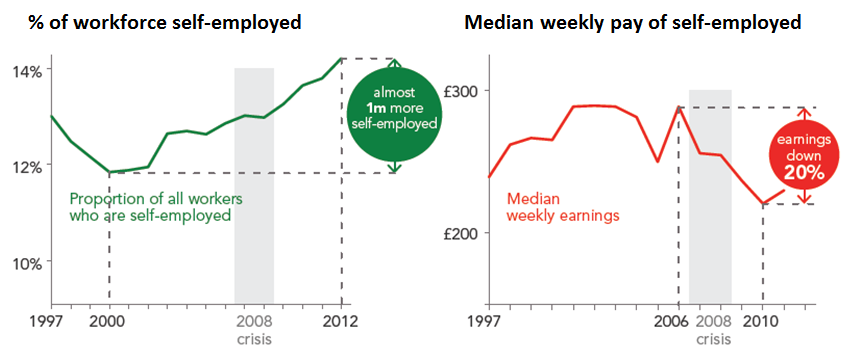
Other factors include the severity of the recession, and the aftermath that that has had on behaviours in the labour market. The increase is coincident with a rise in self-employment - much of which appears to be involuntary, since earnings of the self-employed have been falling. Despite the recent signs of recovery, fear appears to be an important factor, with people feeling they must demonstrate that they are working harder in order to keep their jobs.
An important implication of the figures released by the TUC is that, since the extent to which hours worked are underreported has risen over time, the stagnation of productivity (which is calculated as output divided by hours worked) has been even more pronounced than we had thought heretofore.
Monday, February 24, 2014
The Office for Fair Trading is calling for a full inquiry into competition in the university sector. It has legitimate concerns about applicants to undergraduate programmes being able to apply for only five universities and about the bar on them applying both to Oxford and Cambridge.
A further concern is the level of tuition fees, which are set by most institutions at the maximum of £9000. The OFT considers this to be evidence that universities are operating in collusion with one another. That, however, reflects a lamentable misunderstanding of the way the funding mechanism works.
Students take out loans to pay their fees, and these loans are repaid on an income-contingent basis once the students graduate. Any part of the loan that is not repaid after 30 years gets written off, and is paid by the taxpayer. This means that students do not know how much they will ultimately pay for their tuition - a rise in the 'ticket price' of that tuition is not tantamount to an increase in the amount that they will ultimately pay. Consequently, students prefer the certainty offered by bursaries that they might be offered while they are studying. This means that the best way for universities to attract students is to charge the full fee, and spend as much as they can of the revenues on bursaries. This being so, the fact that universities almost always charge (home undergraduates) £9000 is a million miles away from being evidence of collusion - it is simply the logical outcome of the funding mechanism that is in place.
None of the above is rocket science. If - as newspaper reports suggest - the OFT has indeed failed to grasp it, one wonders whether it is has the competence to advise on the inquiry.
Tuesday, February 11, 2014
Economic forecasters have received a rough ride in the media, often for good reason. The Great Recession was not well predicted by many economists - though there are some notable exceptions. In general GDP growth was overestimated both at the onset of the recession and over subsequent years - only more recently, in the UK, have the forecasts (very markedly) underestimated the extent of growth.
The OECD has produced an evaluation of their own forecasts over this period. Two findings are of particular note. First, forecasts for economies that were particularly open to external shocks were relatively prone to large errors. The impact of contagion of the financial crisis was underestimated. The global interlinkage of financial markets is a feature of the microeconomy that macroeconomic models - even those (maybe particularly those) with strong microfoundations - were not particularly well equipped to handle. This implies that forecasters need to learn a lesson about this aspect of their models (and to some extent they have already done so).
Secondly, forecasts were unusually error prone in economies that, before the recession, had more rigid regulation in their product and labour markets. In such economies, rigidities generate more extreme variations in employment and output than in economies where prices can bear the brunt of economic fluctuations. The modelling of such impediments to the free movement of prices calls for quite detailed understanding of institutional arrangments within the economies under study, and it is clear that this understanding needs to be improved if forecasters are to better their performance.
It should, however, be borne in mind that - while many observers like to judge economists on the basis of their forecasting ability - forecasting is far from the be all and end all of economics. Understanding the past and present is arguably more instructive (and - given the uncertainties that the future inevitably brings - more achievable) than accurately reading the statistical tea leaves.
Friday, February 07, 2014
The latest forecasts from my neural network model, using data to December of last year and forecasts for the next 2 years, are shown below.

The current recovery is starting to look a lot like the recovery of the late 1960s, with a sharp spike in growth followed by more moderate growth over an extended period. In the 1960s, the spike was stimulated by the November 1967 devaluation of the pound. The current increase in output has not been stimulated by such a discrete policy intervention - but the acceleration in consumer spending (that started in the last quarter of 2012 and which has continued since) has been remarkable.
Wednesday, February 05, 2014
The Institute of Fiscal Studies and Oxford Economics document to which I have referred in an earlier post contains an estimate of the magnitude of the output gap - the gap between current levels of output and the levels that would obtain were the economy working at full capacity. This estimate suggests that currently output is running at 5% short of its potential level.
This figure may be contrasted with that produced by the Office for Budget Responsibility - which is just 2.2%. The difference is important. If the output gap is, as the OBR suggests, small, then the economy is already operating near capacity and the bulk of the government's budget deficit is structural. If, on the other hand, the output gap is relatively large, relatively little of the deficit is structural, and so there is less need for austerity to reduce it.
The danger of excessive retrenchment is a theme that I have alluded to frequently in this blog over recent years. Fortunately policy has followed a rather more pragmatic course than the rhetoric would suggest. While the government may still claim that there is no plan B, the speed of austerity has, for the most part, suggested otherwise - and that it has been pursued. Good.
Falling real wages have been the topic of much debate in recent months, but forecasts recently produced by Oxford Economics and the Institute of Fiscal Studies suggest that the corner will soon be turned. Their prediction is that 'the combination of strengthening earnings growth and low inflation should be sufficient to ensure that real wages begin to increase again by the middle of this year'.
There are good reasons to suppose that this forecast is close to the mark - to be sure inflationary pressure is currently low. Moreover the sharp upturn in the economy has brought about increased employment in relatively high wage sectors such as finance.
However, stagnant productivity continues to present a challenge. Structural change was not a primary cause of the collapse of productivity in the first place - it fell in some industries (notably finance and pharmaceuticals) more than others, but it's these falls within industries rather than switching activity between industries that have proved problematic. A lasting cure will require us to address the innovation deficit - exemplified by a startling decline in patents issued in the UK in several key industries over recent years. Successful innovation requires a little luck, but also a lot of design. It is crucial to strike the right balance between beneficial regulation (such as patent protection) and harmful regulation (stifling creativity - might high marginal tax rates be an example?). Successful innovation also requires a context within which thinking big, and capturing the public imagination, is encouraged. In that, there is a role to be played by both private and public sectors.
Wednesday, January 22, 2014
The unemployment rate has been falling fairly steadily since its peak in the last quarter of 2011. Until the last three months of last year, this fall was unspectacular; at its peak the unemployment rate was 8.4%, and as recently as the three month period to last September it was still as high as 7.6%. The latest figures released today show that, in the three month period to November, the rate fell to 7.1%.
The latest data on GDP growth pertain to the third quarter of last year, and suggest a quarter-on-quarter growth of 0.8%. This is high - it suggests an annualised growth rate of 3.2%, well above the consensus forecast. In that quarter, growth within the construction sector was particularly striking. With GDP growth now apparently above the trend rate, it is not altogether surprising that unemployment should fall.
Yet questions remain about the source of this growth. Business investment grew in the third quarter of last year, but this only partially made up for a fall in the previous quarter, and the total level of such investment remained below the figure realised a year earlier. Investments in dwellings and other buildings likewise accelerated in the third quarter, but this only partially made up for recent falls. Consumer expenditure, meanwhile, has been rising steadily since the depths of the recession in 2008, and has accelerated sharply since the beginning of 2013.
The fall in unemployment and rise in output both represent very welcome news. As more people find jobs, the increase in consumption becomes more sustainable and the recovery becomes more secure. A key challenge that remains, however, is to raise productivity back to pre-recession levels and hence to restore real wage growth.
Monday, January 20, 2014
The ITEM (Independent Treasury Economic Model) club (supported by Enrst and Young) have issued their latest forecast for the UK economy. They conclude that growth in 2014 will accelerate to 2.7%, but caution that the recovery is very much led by consumer spending and that, until real wages rise, interest rates should be held at their current low level.
It would be hard to disagree with the ITEM club - at least as a short term forecast. Their predictions for the years beyond 2014 show the reversion to a steady state growth rate of around 2.5% that is characteristic of models of the type that they use - and recent experience suggests that we should be sceptical of that.
But the note of caution that is sounded here, suggesting that the recovery is fragile while it remains so heavily dependent on consumer spending, is well made. If growth does indeed accelerate to 2.7% this year, an outcome in 2015 of 2.4% (which is what the ITEM club is currently predicting) would be a rather better outcome than I would expect.
Wednesday, December 04, 2013
The recent surge in output in the UK has been noted by many commentators. Indeed, it seems quite remarkable.
The latest forecasts produced by my neural network model, using the most recently available data (up to September) suggest that a spike in output growth is likely - though the magnitude of the spike is moot - with the rate of growth falling back quickly to (much) more modest levels as we move into 2015.

Clearly much will depend on policy. Even though the output gap is still substantial, growth of the kind being predicted above is unlikely to last long without a build up of infationary pressure as workers seek to recover the lost ground of recent years. This could provoke an interest rate hike sooner rather than later - and that could bring output growth down sharply.
Thursday, November 21, 2013
Jim Heckman and Tim Kautz have provided an intriguing analysis of ways in which individuals' characters influence their economic outcomes, and of how character can be changed by various interventions. They view character as something that can change over time, something that is shaped by the individual's environment, and something that can be developed by interventions.
Opportunities for such interventions exist at many points over the life cycle, but are particularly rich during the early stages of life. Non-cognitive skills are developed at this stage, but this does not mean that character is fixed thereafter - describing these soft skills as personality traits is therefore misleading, and they are better described as skills. Skills can be honed over time.
The importance of such skills in the labour market is clear. Conscientousness, extraversion, emotional stability, agreeableness and openness - in that order - are known to be positively correlated with job performance. The evidence on the ability of interventions to affect character, and thence subsequent attainment, comes from a variety of sources, but one of the most persuasive concerns the effects of the Perry preschool programme.
These are important findings. The way in which various options affect the characters of stakeholders needs to be addressed in the design and subsequent evluation of policies.
Monday, November 04, 2013
The Confederation of British Industry has estimated that the net benefit of the UK's membership of the European Union amounts to somewhere between £62 billion and £78 billion per year - that is between 4% and 5% of Gross Domestic Product. This benefit comes from access to European markets, the dismantling of tariffs and other barriers to trade, and the consequent realisation of economies of scale. Further benefits come from the improved access to sources of finance that arise from EU membership, and from increased investment from outside the EU from firms wishing to locate within the common economic area.
The figures cited by the CBI are almost completely meaningless. To evaluate the benefits of membership of the EU, it is necessary to have an idea of what non-membership would look like. Were the UK to leave the EU, for example, it would most likely do so on a basis that retained freedom of trade. So to include the impact of free trade in any calculation of the benefits of the EU seems strange.
There is, of course, a case for staying in the European Union. But exaggerating the numbers does not serve to strengthen that case.
Thursday, October 24, 2013
New work by Pablo Brañas-Garza, Antonio Espín and Shoshana Neuman examines the effect of religiosity on the extent to which people's behaviour is pro-social. Based on games frequently used in experimental economics, the results, based on quite large samples of individuals, are striking. Active participation in religious activities appears to be strongly associated with more altruistic behaviour. Looking into the future, as adherence to faith declines, so (in the absence of countervailing measures) might the extent of pro-social activity.
The mechanism underpinning this finding is complex – it is likely to be partly the direct result of religious teaching, but partly also the result of the development of a sense of community that is engendered by frequently meeting neighbours at a religious institution. The latter should be seen alongside other developments – such as the growth of home entertainment – that together may reduce social cohesion.
Altruism, it seems, needs institutions. If our society lets the old institutions go more quickly than it lets go of its need for altruism, then new institutions will need to develop to plug the gap. These new institutions may be virtual – social networking, for example. But it remains to be seen whether the connection between the virtual world and the real world is sufficiently strong to serve the need.
Tuesday, October 22, 2013
In a fascinating study of the impact of corporate culture on company performance, Luigi Guiso, Paola Sapienza and Luigi Zingales have found a strong positive effect of managerial integrity and ethics. This should not be surprising, but it is immensely reassuring. In competitive markets, bad behaviour should be competed out of existence.
Subscribe to:
Posts (Atom)