Wednesday, May 11, 2016

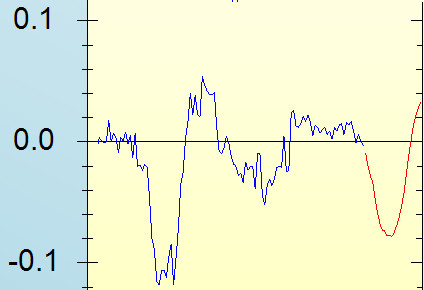
Industrial production rose slightly from February to March, but the higher baseline figure from a year ago means that output in this sector has nevertheless fallen over the past year, by some 0.3%. The March data confirm that, for the second successive quarter, production has declined. This means, in effect, that the industrial sector is in recession. My forecasting model (see graph below) suggests that the slowdown is likely to continue for some time.

Manufacturing comprises most of the output in the production industries, and has been in the doldrums for some considerable time. Output in this sector is now some 2.2% below the level achieved at its post-recession peak at the beginning of 2012 - and is indeed no higher than was achieved in April 1989. The recovery remains dangerously unbalanced.

Monday, April 25, 2016

The rapid increase in life expectancy has led to ageing being regarded as one of the major policy challenges facing governments. Policies to encourage savings include Individual Savings Accounts (ISAs), and the new Lifetime ISA and Help to Save initiatives. At the same time, auto-enrollment in pensions schemes is being rolled out so that, by 2019, pension contributions amounting to 8% of salary will be made on behalf of all employees (unless they opt out). This 8% is widely believed to be too low a figure.

As well as providing incentives to save more, policy has been aimed at lengthening working lives. The age at which workers qualify for the state pension is being raised gradually, and in 2011 the concept of a default retirement age was scrapped.

These two solutions - saving more and working longer - are often seen as the only two options available in paying for the increased burden of an ageing population. But there may be a third.

If productivity were to rise, the additional output produced by those in work could be used to pay for some of the extra cost burden - in terms of both care and pensions - implied by ageing. In the long run, this could be done through private savings and insurance. In the short and medium term, however, it would involve some redistribution from the generation of working age people to that of retirees. That would need to be done through the tax system. (That is a transitory and technical requirement, not an expression of a preference for solutions from the political left.)

Suggesting increased productivity as a solution may appear curious at a time when the economy is still suffering from a stagnation in productivity - the so-called productivity puzzle. But there is reason to believe that productivity growth might come back.

If ageing is one challenge that society has to learn to face, another is the rapid advance of technology. Some researchers predict that almost a half of all jobs are at risk of becoming defunct owing to the steady march of the robots. If true, adapting to that is certainly a challenge - though past experience suggests that jobs morph as technology advances. What is certain is that rapid technological advance should bring about massive changes in productivity - why else would the technology be adopted?

We certainly need to plan for longer lives through saving more and working longer. But, faced by the two challenges of ageing and rapid technological change, we might just find that one can become a solution to the other. And - to reiterate - fully to take advantage of this opportunity when it comes, we must be lithe in our thinking around what is acceptable in the arena of taxation and redistribution.

Monday, April 18, 2016

The Treasury has published an analysis of the economic costs associated with Brexit. A range of estimates is given, with different values attached to different assumptions about the nature of trading arrangements made with other countries after the United Kingdom leaves the European Union. The central estimate that has attracted most media interest is a prediction that the costs will amount to 6.2% of Gross Domestic Product. This is a substantial figure - huge in relation to other analyses such as those undertaken by Open Europe which estimated a los of 0.8% of GDP on the most plausible scenario. This warrants further interrogation.

The Treasury investigates three options for the post-Brexit world. One is for the UK to negotiate a Norway-style arrangment whereby free trade with the EU is maintained but, while no longer being a member state, the UK continues to make payments to the EU. The second is the the UK to negotiate a Canada-style Comprehensive Economic and Trade Agreement with the EU. This does not cover services - which represent some 80% of UK output - and would not allow the benefits of free movement of labour. The third option considered is a 'clean break' where no special arrangement is made between the UK and EU, but trade continues under World Trade Organisation rules. The estimated loss, as a percentage of GDP, for each of these options is 3.8%, 6.2% and 7.5%. It is the 3.8% estimate that most closely corresponds to Open Economy's 0.8% figure - and clearly the gap between the two is large.

The key question that emerges from consideration of these figures, then, is this: why are the figures, particularly those for the first option in which free trade with the EU in both goods and services is maintained, so much larger than other estimates in the literature? The Open Europe analysis is based on a Computable General Equilibrium (CGE) model. This type of modelling approach examines comparative statics - in essence it compares an equilibrium position 'before' and 'after' a change - and is calibrated using estimates of key parameters that the received literature suggests are plausible. This is good for providing a long run comparison, but it is likely to understate costs that are due to adjustment between the 'before' and 'after' positions. By way of contrast, the Treasury approach employs a statistical analysis based on a gravity model. In this framework, pairs of countries that are both members of a trading partnership such as the EU can be identified using dummy variables, and the importance of such joint membership vis-a-vis, say European Economic Area (EEA) membership, can be assessed. Since there are few observations for countries that are in EEA but not in the EU, there is likely to be some imprecision in the estimates of the costs associated with the 'Norway option'.

The uncertainties surrounding any predictions of this kind are substantial. But the main message to come out of the various exercises should not be minimised. The long run costs of Brexit, even under the kindest assumptions about what regime will follow, are large albeit not prohibitive. The costs of getting from here to there are larger. Those advocating that the UK should leave the EU need to be aware that the years following Brexit would be a bumpy ride, that even in the long term there are non-negligible costs, and that they therefore expect people to value really highly whatever gains they are seeking - just how highly, they need to spell out. At this stage, it is not clear that the Leave camp is offering much beyond bluster.

Friday, April 08, 2016

The latest data on industrial production show a drop of 0.5% over the year to February. This is further evidence of an economic slowdown. While overall growth is still positive, this is entirely due to expansion in the services sector - and we know that confidence in that sector too has fallen sharply in recent months.

I have, for several years, used the industrial production data in a neural network forecasting model. The latest forecasts of this model, updated to include the data released today, appear below. They continue to indicate that the next year will be challenging for the production sector, with continued falls in output.

Thursday, April 07, 2016

Two news stories have made reference to a trend for people increasingly to shop 'little and often'. One is the rising sales figures of the Co-op supermarkets, and the other is the decision by Sainsbury's to scrap its brand match scheme (which requires customers to purchase at least 10 items in order to claim the refund).

The 'little and often' trend is evidenced by the rapid growth of convenience stores vis-a-vis larger supermarkets in recent years. This may be partly demand led, following changes in consumer habits during and after the recession, but issues on the supply side are likely to have played a part too. Smaller convenience stores with less than 280m2 of floorspace face less stringent Sunday trading restrictions, for example, and the proliferation of such stores has much to do with legal considerations of this kind.

Whether the demand for 'little and often' reflects a permanent shift in customer behaviour remains to be seen. If new technology lowers further the fixed costs of shopping (with automated tills reducing queueing time, for example), 'little and often' becomes more appealing. Likewise, the squeeze on space imposed by high property prices in London (especially) makes 'little and often' an appealing strategy, particularly in connection with bulky low-value items (such as toilet rolls, for example).

Is there, then, a future for the larger stores? Certainly if trading restrictions were eventually to be lifted, they would be able to compete on a more level playing field. And, particularly in parts of the country where space is less of a consideration for consumers, they should remain well placed. The 'little and often' trend is not necessarily a permanent feature - and, like so much of what we see around us, it has its underpinnings in the economic forces of supply and demand.

Friday, March 18, 2016

The June 1978 conference at the Federal Reserve Bank of Boston has attained legendary status in the economic profession. The revolution that has transformed macroeconomics into an area of research that is solidly built on microeconomic foundations – with optimising agents making decisions that are consistent in the context of an intertemporal setting – is said to have taken place then. Certainly, the language in the paper presented by Robert Lucas and Thomas Sargent, and in the response by Robert Solow, brings to mind a coup.

While Lucas and Sargent represented a new broom, the revolution turned out to be a slow burner. Finn Kydland and Edward Prescott published their seminal work on aggregate fluctuations in 1982. This built on earlier work by Lucas in its emphasis on microfoundations, but introduced for the first time a method – calibration – whereby empirical flesh could be built upon the theoretical bones. Calibration met with some initial scepticism within the profession. In its crudest forms, it has a back-of-the-envelope quality about it. But, as a slow burner, the methods became increasingly refined over time. The early real business cycle models developed into modern dynamic stochastic general equilibrium (DSGE) models.

These models initially had a market clearing orientation – economic theories often do because it’s easier to model things that way. Inevitably, however, as the research agenda matured, mechanisms were found to incorporate more realistic scenarios. One of these, due to Jordi Gali, is an imperfectly competitive setting in which endogenous fluctuations in market power lead to sustained variation in prices and output over time. Other models have built upon developments in the theory of pricing by Guillermo Calvo and Julio Rotemberg . An example is provided by Michael Woodford (in chapter 3 of his classic book). The variety of DSGE models that incorporate rigidities and other market imperfections provide a suite of New Keynesian (NK) approaches to modern macroeconomic modelling.

These models are at the ‘rocket science’ end of economics. Consumers (who are also workers) and firms are modelled in as simple a way as possible by focusing on ‘representative agents’ – the optimising behaviour of one typical consumer and one typical firm is modelled rather than taking into account the heterogeneity that we see around us in the world. Nevertheless the optimising problems that the analyst needs to solve on behalf of these agents are complex – they must choose the actions that maximise their dynamic returns over a time horizon, rationally forming their expectations of future prices and outcomes, where these are determined both by their own time paths of decisions and those of the other actors in the model.

These theories have emerged alongside massive improvements in computational capacity. The development of open source software - Dynare - has helped make DSGE models accessible to large numbers of macroeconomists, allowing standard models to be tweaked and also allowing empirical evaluation, and surely accounting in large measure for the popularity of the new techniques. DSGE models came to be widely used in central banks during the late 1990s, initially alongside traditional macroeconomic forecasting models, and arguably before the models were sufficiently mature to be used in a policy-making context. Indeed, it was only in the early part of the last decade that it became clear amongst academic economists that the methods introduced by the revolution had indeed become the new core of macroeconomics.

While their use has become the norm in the context of macroeconomic analysis, DSGE models are not very useful in other settings. As a labour economist, I am interested in unemployment, discrimination and inequality. Representative agent models are not equipped for analysing any of these, since they assume all workers to be identical. So ‘unemployment’ in these models takes the form of (all) workers voluntarily choosing to work fewer hours in some periods rather than others as they substitute effort intertemporally in order to take advantage of changing incentives. As a definition of unemployment, that is, frankly and obviously, ridiculous. Indeed, the representative agent model has been widely criticised for this. Recent developments with heterogeneous agents might help, but DSGE still looks far from being the tool of choice to analyse labour markets.

As they have grown in sophistication, it has become clear that confronting these models with the empirics is essential. Complicated models may have the advantage of taking more of the features of the world in which we live into account, but they tend to lead to no conclusion without empirics – anything goes, and there are circumstances where counterintuitive results are possible. At some point, indeed, these models lose sight of what it is to be a model – a model should be simple, it should be unrealistic, it should exist to help us understand, not to obfuscate.

Given these changes in how we do economics, teaching beginning students of macroeconomics has become a considerable challenge. Modern macroeconomic models are not things that beginning students are equipped to face – they draw on difficult concepts of dynamic optimisation and expectations formation, where these are exercised by numerous agents simultaneously. While they can be expressed in the form of a ‘dynamic IS curve’ and a ‘Phillips curve’, it is only with some hesitation and reservation that one would draw an analogy between these and the IS curves and Phillips curves of the theory pre-revolution. Perhaps an understanding of the old approaches to macroeconomics are a prerequisite for understanding the new. But it seems perverse, and potentially confusing to students, to teach economics using methods that, later in the curriculum, we then criticise – yet build the new on what might be the shaky foundations of the old. On the other hand, beginning with the traditional models of ISLM and aggregate supply / aggregate demand would have the advantage of offering a ready reckoner – one that, for all the arguments of the revolutionaries, still has considerable merit.

I have as yet no answers to this dilemma, and, from my examination of new initiatives in economic pedagogy (such as CORE) I’m not persuaded that anyone else does either. Here is a space to be filled.

Wednesday, March 09, 2016

Output in the production industries bounced back in January, growing by 0.2% over its level a year earlier. This follows a 0.1% fall a month earlier. The forecast shown below suggests that the series is likely to return to negative territory soon, however.

Further evidence that the production sector has entered, and is likely to remain in, a period of slowdown comes from examination of the baseline data - in 2015, the value of the production index for most months over the spring and early summer was somewhat higher than in January of that year, and this means that it will be difficult for industrial production in the first half of 2016 to match that observed in 2015.

While the performance of the production industries - and in particular manufacturing - has been muted over recent months, the service sector - which of course accounts for around 80% of the UK's Gross Domestic Product - has been growing at a reasonably healthy pace. We are nevertheless likely to be nearer the next recession than the last one, and sustaining the current rate of growth into 2017 and beyond is a challenge. The Chancellor of the Exchequer should give this serious consideration in framing the fiscal stance for next week's Budget.

Wednesday, February 10, 2016

The latest data on industrial production show a dip, year on year, in output to December 2015. This amounts to -0.3% across all production industries, but the fall is particularly pronounced in manufacturing - at 1.8%. As observers of my forecaster of this series will know, this downturn has been on the cards for some time.

The latest forecast is reproduced below. It looks ahead 24 months, and suggests that the production industries will not recover quickly.

There are clearly many uncertainties facing the economy at present - these include the prospect of Brexit raised by the upcoming referendum on EU membership, but also weaknesses in the global economy with China, in particular, facing an unfamiliar problem of sluggish growth. In the UK, the (dominant) services sector has been growing at a steady pace for some time, but confidence there is showing some signs of fragility. While many will be hoping for a soft landing rather than a return to full blown recession, the signs are that a significant slowdown has already begun.

Tuesday, January 12, 2016

The latest industrial production statistics indicate continued growth in production. Compared with a year earlier, production in November 2015 was a little under 1% higher. This is, however, in spite of a large fall of 1.3% in manufacturing - the largest component of industrial production. This fall was compensated for by a substantial increase in other sectors, notably including oil and gas extraction.

I have regularly used these statistics to provide forecasts using a simple neural network programme. The latest forecasts, with the red line looking ahead 24 months, appear below. They continue to evidence some fragility in the production sector, with a dip in overall output over the coming period looking increasingly likely.

Wednesday, December 16, 2015

The labour market statistics released today present a very rosy picture of the continuing recovery. Unemployment is down sharply, by 110000, to 5.2%. The gains in employment have been spread across various groups - with marked increase in the numbers of full-time employees (up 80000), part-time employees (up 66000) and full-time self-employed workers (up 75000). The largest gains have been in construction (up 77000 over the three months to September), but there have also been large gains in professional, scientific and technical services, and in administrative services.

After a subdued period earlier in the year, vacancies are now once again on the rise. This provides further evidence of a reinvigorated labour market.

On pay, the story remains subdued, however - indeed, increasingly so. Total pay in October averaged just 1.9% higher than a year earlier, this figure being down from 2.1% in September. In construction, however, reflecting the recent rapid expansion of the sector, pay has continued to steam ahead - at a remarkable 6.6%.

The overall picture, then, indicates healthy development. The main question mark surrounds how pay can be nudged up so that workers feel the benefit of recovery. The hike in the minimum wage will, at least in a mechanical way, help, but the real issue remains one of improving productivity.

Thursday, December 03, 2015

Recent debate surrounding the UK's participation in the Syrian conflict has brought to the surface some interesting views about the motives of politicians making key decisions. Some argue that politicians have a vested interest in fostering conflict and hence boosting the defence related industries. 'Follow the money' has become a favourite phrase of the cynics.

Serious literature of relevance to this has produced ambiguous findings, but most reliable estimates range from a negative through a negligible effect of military spending on economic growth. So the view that, as a general rule, a politician might vote for war if standing to benefit from ownership of defence related companies ignores the fact that the same politician would be better off owning a broad portfolio and voting against conflict.

There has doubtless been much wrong about the way in which the West has dealt with the situation in the Middle East. For sure, the web of alliances that has been woven is tangled indeed. But some of the wilder and more cynical views currently doing the rounds belong in the world of conspiracy theories - and as such are much less convincing than cock-up as explanations of what we observe.

Thursday, November 26, 2015

The Chancellor of the Exchequer has been widely lauded for pulling rabbits out of a hat in his Autumn Statement. For sure, the familiar conjuring trick requires admirable sleight of hand, and the Statement has evidence aplenty of that.

The headlines in today's newspapers suggest that austerity has ended. The figures do not quite align with that view, but the extent of cutbacks at least appears to have moderated somewhat. The Chancellor's largesse, or what some have termed 'less awfulness', has been enabled by four things.

First, he has been helped by a forecast boost to the public finances. The £27 billion windfall is spread over a 5 year period and therefore represents a relatively small proportion of the gap that the Chancellor wishes to close. In any event, economic developments over the coming period may make the saving somewhat softer than it at first appears.

Secondly, the implementation of the welfare cap - part of the Chancellor's famous and ill-conceived fiscal charter - has been delayed in order to reverse the decision to cut tax credits.

Thirdly, several charges best interpreted as stealth taxes have been introduced. This includes a levy on businesses to pay for apprenticeships and the introduction of a scheme that will allow local councils to raise their taxes by 2% to pay for costs of social care. These things are certainly desirable, and the changes are welcome inasmuch as they secure continued services - but the Chancellor has nonetheless shifted the cost from central government to other payers. As far as the public is concerned, this takes with one hand what is given with the other.

Fourthly, the Chancellor has coonverted several grants schemes - in the areas of business support, health training, and further and higher education - into loans schemes. Again this may allow central government taxes to stay low, but the costs must nevertheless be paid.

In sum, therefore, this was a very clever Autumn Statment. The Chancellor certainly did succeed in pulling rabbits out of hats. But a wise audience knows that - just as is typically the case with magicians - he has made liberal use of smoke and mirrors.

Wednesday, November 11, 2015

The latest labour market statisitcs paint something of a puzzling picture. There has, over the last quarter, been a substantial fall in unemployment - the figure for July through September is 103000 lower than in the previous three months. That is clearly good news.

But when we come to look at where the gains have come, the picture is distinctly mixed. There has been a huge increase of 177000 in employment. Most of this, however, some 145000, is in part-time jobs. The age distribution of the gains in employment is also a feature of the data - all the gain is observed in the older age group, 50 years of age and above. Consistent with the employment gains being concentrated in part-time work, average hours worked have continued to fall.

The news on pay is also indicative of a market that has started to slow. Comparing weekly earnings in September 2015 with those a year earlier, pay growth slowed to 2.0% (from 3.2% last month). It is difficult to attribute this to any sector-specific factors - the slowdown appears to be fairly even across industries.

In sum, the news on the unemployment rate is, at first blush, something that should offer good cheer, but the underlying figures offer very little comfort.

Friday, November 06, 2015

The latest statistics on industrial production have been released, and confirm that output in the production industries has continued to grow in the year to September. The forecasts of my neural network model for this series continues, however, to suggest that caution is warranted in interpreting recent growth as a harbinger of continued expansion. A dip is due. That may not carry over into the (much larger) part of the economy that is based in services, but, particularly at a time when global demand appears to be weakening, we should be wary of overoptimism.

Wednesday, October 07, 2015

The latest industrial production statistics have been released, and show growth of 1.9% over the year to August. The seasonally adjusted figures also show an increase of almost 1% over the month. This seems very encouraging.

Applying my neural network forecasting model to these data suggests that the recovery in industrial production may continue for a few months, but there are warning signs that it may not be sustained beyond that.

The model on which these forecasts are based is very simple and does not include information about policies that are known to be in the offing. We know, however, that fiscal retrenchment is set to toughen over the coming period. These forecasts suggest that the economy, looking ahead, is somewhat more fragile than it has been over the last year, and that caution should be exercised in judging the desirable speed of further fiscal contraction.

Friday, August 14, 2015

The political aftermath of this year’s general election looks set to be played out over an extended period. However this point, 100 days after the election, seems to be an appropriate time to provide an early analysis of the economic dimension of the new administration’s performance. The election confirmed the positions of many key players – David Cameron and George Osborne are still in residence in Downing Street – but the change from coalition to majority Conservative rule has freed the government of some constraints. In many respects, then, this is indeed a new government.

The economic importance of this political change was evidenced by the second Budget of the year. The Chancellor took the opportunity to introduce a new wave of government spending cuts, many of which would have been difficult to implement within a coalition. His plans to reduce the deficit sharply were blown off course after 2012, and this year’s Budgets have provided renewed impetus to the austerity drive. The March Budget was criticised for its rollercoaster properties - implying as it did a severe downswing in government spending before a pre-election upswing. In the Summer Budget these fluctuations were smoothed out, and the period over which the deficit is to be removed was extended. These are welcome developments, restoring some sense to the time profile of fiscal retrenchment. But the impact on growth of the spending cuts that will be imposed over the next couple of years will need to be monitored carefully, and policy should be adjusted in line with this impact if need be.

The broader macroeconomic context has continued to develop reasonably favourably, with output growth looking to be on course for around 2.5% over the year. Meanwhile, inflation has been subdued. This has been largely the result of falling oil prices (nothing to do with the government), and the short period earlier this year when, on average, prices were falling does not look set to trigger a harmful and sustained deflation. Indeed this period of low price inflation has allowed real wages to rise for the first time in several years.

Whether this increase in earnings reflects a much needed upturn in labour productivity remains to be seen. Shortly after the Summer Budget, the government published Fixing the Foundations, its plan to restore productivity. This contains some good ideas around employer-led training, the role of universities in developing human capital and innovative capacity, transport, digital infrastructure, and housing investment. It is certainly the case that investment is needed across the full range of economic activities in the country in order to secure productivity gains. Business investment is critical, and encouraging such investment requires a stable environment which is difficult to guarantee in present circumstances – given in particular the recent trauma of the Eurozone centred on Greece and the uncertainty surrounding a British referendum on continued membership of the EU.

While the commitment to supporting investment in infrastructure is welcome, less pleasing has been the government’s ability to turn this commitment into reality. Major investments in upgrading the rail network have been ‘paused’, leading many to fear that they might ultimately be scrapped. In the North of England, in particular, this has severely challenged the government’s own concept of the Northern Powerhouse, and some considerably clearer thinking around this (and indeed around other aspects of regional devolution) is urgently needed.

Economic opinion is divided about whether the cuts announced in the Summer Budget come at a better time for the UK macroeconomy than did those introduced in 2010. But whatever one’s view on that, it is certainly the case that the microeconomic effects of the current round of cuts will attract attention. In particular, the distributional effects will need monitoring closely, with large cuts being made to the welfare budget. This being so, it is highly regrettable, indeed shameful, that the Treasury will no longer publish a distributional analysis of the effects of policy. This is a step back. An important future measure of this government’s economic performance will be how the poorest have fared – and it is too early yet to come to any conclusions on that.

For a variety of reasons, there has been an increased concentration of low wage workers in the UK. Most significantly, technology is leading to a polarisation of jobs, with concentrations at the top and bottom ends of the skill and wage distribution. Many lower skill workers have been employed at wages below the Living Wage, and this has imposed costs on the welfare system. The Chancellor’s announcement in the Summer Budget of a new Living Wage (at a level between the existing national minimum wage and the Living Wage) should encourage employers to address the issue of productivity amongst their lowest paid workers, and should reduce the burden imposed on the welfare state by low pay. Whether this alone can be sufficient to address the large trends that have caused the problem of low pay in the first place is, however, moot. The impact of technology on the labour market, just like the impact of the ageing workforce, requires some big thinking, not just in government. That has yet to surface.

Returning to the overall macroeconomic picture, the Chancellor’s imposition, in normal times, of a ‘fiscal lock’ – limiting his own room for manoeuvre in spending and tax decisions – is unfortunate. It seems to reflect a view on the government’s part that its primary economic objective should be to balance its own books. Over the long run, it is certainly important that the government should not accumulate debts that are unsustainable. But, as someone once observed, in the long run we are all dead, and in the shorter run it is vital that the government should retain for itself discretion over all the levers of influence on the economy. Maybe, though, the definition of what makes for normal times will turn out to mean that the fiscal lock amounts to little beyond the hype. The early abandonment of 2018-19 as the target date for clearing the deficit certainly suggests as much. As he showed in 2012 when easing back on austerity, the Chancellor’s practice is generally markedly more sensible than his rhetoric.

Overall, then, the first 100 days have seen quite a lot of action in the economic sphere. The government’s policy will evolve, surely, as events unfold. There have been positives – smoothing out the rollercoaster, the new Living Wage – but there remain some very real concerns, particularly around the distributional impact of policy and the climate of uncertainty surrounding a possible Brexit. When all is said and done, 100 days is just that. The horizon over which these policies will ultimately be judged is much longer.

Thursday, August 06, 2015

The latest statistics on industrial production show a dip in output over the month to June of this year. Nevertheless, inputting these data into my neural network forecaster indicates that year-on-year movements in this series can be expected to be somewhat more positive than forecasts have indicated in the past. The rate of growth can be expected to slow, but the imminent danger of this series turning into negative territory appears to be receding somewhat.

Friday, July 24, 2015

If, as it did, the recent general election presented the electorate with a dismal choice, the sense of dismay has only been exacerbated by the process of choosing the next leader of the Labour party. Having lost two consecutive elections, Labour is now in complete disarray, having apparently lost all sense of identity. Of the four candidates for the leadership, three offer moderation - a sense of drift that places them somewhere to the left of the Conservatives, but bereft of any true mission. The other offers a return to a left wing agenda that fails to address the issues of the day, and that fails to offer any prospect whatsoever of gaining power.

Some of Labour's grand ideas of the past have been implemented, have proved successful, and have been appropriated by other parties. The minimum wage was initially met with great hostility by the Conservatives, but with the recent announcement of a national living wage the idea of a wage floor has become uncontentious. The National Health Service is another example of a great Labour idea that has come to be 'owned' by all parties. For Labour to have fought the last election largely on a fancied Conservative threat to the health service appeared patently absurd to impartial observers. These are big ideas that succeeded. They were tried out, came through, and - backed by the evidence - they became depoliticised and are now part of the fabric of the country. Some other ideas, for example, nationalisation, were not so successful. In those cases, backed by the evidence, the trials were reversed, and, though there may be arguments about the detail of how privatisations were conducted, few people would argue in favour of a wholesale return. With the evidence that comes from trying things out, some issues leave the political arena and become essentially technocratic. We move on.

But while we move on, the values on which grand political movements are constructed remain the same. I shall focus on three such values that have, across the generations, characterised the Labour party.

The first concerns aspiration and social mobility. My parent's generation was the first to have access to a full secondary education, and the first (without access to parental wealth) to be able to progress to a higher education. This enabled them to break through economic and social barriers in a way that was simply not possible for previous generations. This is something with which the Labour movement has been associated from its early days. The modern union movement in the UK can be dated to the creation of the Trades Union Congress at Manchester's Mechanics' Institute in 1868. The Mechanics' Institutes typified a range of organisations that promoted adult education amongst working people. This was a business-friendly approach - indeed the Institute was set up by business leaders who noted the gains to their own companies that would arise from a better trained workforce. But it was also one that enabled social mobility, allowing workers from humble backgrounds to aspire to great things. It ensured the best for the country by enabling the best for each individual. The modern Labour party retains its commitment to help those who are disadvantaged, but has become less focused than it once was on answering the question: help to do what? The answer, surely, has to be: help to develop, to transform and to succeed. And the leadership candidates should all be asking themselves, and answering, questions about how the education system can be reinvigorated so that social mobility and aspiration are once more fostered. Today's Sutton Trust report suggests that current policy does not always help. So much remains to be done. There should be no tension between individuals' aspirations and business success; and Labour should find ways of promoting both.

The second area in which Labour values are pertinent is that of ownership. This is a difficult area for the party because ownership of the means of production has been such a totemic issue in the past. There is a natural aversion to wealth endowment arising from accidents of birth, not least because it hinders the kind of social mobility to which I alluded earlier. But the large nationalised industries of the past demonstrated that concentrating ownership in the hands of the state was disadvantageous in other respects; governments, as the owners of state industries, do not necessarily serve their peoples as best they might. And monopoly power begets inefficiency, whether that power is concentrated in the hands of capitalists or the state. Thatcher's dream of a property owning democracy, where the major privatisations led to large numbers of share owning individuals, had merit in spreading wealth widely. But inevitably many shareholders were passive, and many others sold their stocks so that once again ownership became concentrated. Clearly public ownership is not a panacea, but equally a free market in the ownership of companies has delivered problems. Will Hutton has identified the early sale of embryonic businesses, often to overseas investors, as a major impediment to the realisation of benefits from innovation. Solutions to the problem of ownership, ensuring that all stakeholders maintain an interest in business, perhaps involving various kinds of golden share arrangement, need exploring. While not returning to tried and failed solutions in this space, the Labour party thus has much to offer in the general arena of ownership. In a week in which the Financial Times has been acquired by Nikkei, it is easy to focus minds on how important this issue of ownership can be.

Thirdly, social protection is another area that has been central to Labour values. This has proved to be a highly controversial issue in the last week, with the party's leadership facing rebellion over its demands that MPs should abstain in a parliamentary vote about welfare cuts. Protecting the poor while ensuring that aspiration is rewarded is fundamental. Less fundamental should be the means by which this is done. A number of shibboleths therefore need, at minimum, to be opened up to debate. So, for example, most observers would agree that people who are unemployed through not fault of their own should receive some support. Whether this should be done through the tax and benefits system or through a system of compulsory private insurance (with no claims discounts to finesse moral hazard issues) is another matter. Likewise, few would argue against a universal health service, but whether this is paid for through the tax system or through a private insurance system is not - or at least should not be - fundamental. The important thing is surely that those with few resources receive sufficient support to ensure that they can insure themselves. The basic income proposal is radical, and in pure form might not be affordable, but with modification it might provide one possible avenue for welfare reform that deserves investigation. At the very least, it poses a question that deserves to be asked.

The whole issue of benefits is made more difficult by the fact that the current system is clearly broken. In-work benefits essentially supplement the earnings of many workers, distorting the operation of the labour market. The current government has regarded this as a latent subsidy to firms, allowing them to pay low wages, and it has responded by hiking the minimum wage. It is easy to sympathise with the government's frustration, but it remains the case that the minimum wage is a very blunt tool to use in the alleviation of poverty, since poverty affects households and not the individual recipients of (minimum) wages. Moreover, the ageing population presents challenges to the current system that successive governments have swept under the carpet. There is an opportunity for radical thinking to address this. In a nutshell, prospective Labour leaders should not be so defensive about the current system of welfare support that they fail to recognise the need for a root and branch review.

All of the above areas concern core Labour values. They are areas where we should not be thinking of returning to old, tried, tested (and proven or not) ideas, but where we seek solutions for today. It is profoundly depressing that most of the Labour leadership candidates are offering what is essentially a Tory-lite prospectus. People will only vote for that if they become disillusioned with the competence (as opposed to the underlying philosophy) of the real thing; that seems a ludicrous gamble to take. The fourth candidate at least has the merit of offering the electorate some choice - even though it is a choice they will not find appealing. The contest - and, possibly, the electorate of 2020 - is crying out for some ideas that define an identity for the Labour party, and for the country, of today and tomorrow. It can be done. It just needs someone who has the qualities of a leader. And, unfortunately, that looks like being someone outside the current group of contestants.
Monday, June 29, 2015

The recent events in the Greek saga have been remarkable by any standards. A week ago, it looked as though a deal had been reached – bar dotting and crossing of is and ts – that would have released the last tranche of bailout money, enabling Greece to repay loans due at the end of this month. The Greek government had produced proposals that appeared to meet the requirements of the Troika (composed of the European Commission, the European Central Bank and the International Monetary Fund). These proposals entailed: further substantial fiscal retrenchment, with a budget surplus gradually rising to 3.5% in 2018; pension reform, with strong disincentives for early retirement and a raising of the retirement age to 67; VAT and other tax increases; and some privatisation. Markets responded favourably, with the spread on Greek 10 year bond yields falling sharply.

Following encouraging noises, the Troika rejected the Greek proposals, concerned that they rely too heavily on tax hikes and not enough on spending cuts. The prevarication of the Troika is, of course, understandable given its composition. The Greek government is seeking to negotiate with a group of three separate bodies, which is tough enough in itself, but the European Commission serves as representative of the 27 member states of the Union (excluding Greece itself). Negotiating with a coalition of this complexity presents a unique set of hazards, particularly in an age when a raised eyebrow is enough to go viral in the twittersphere.

The Troika’s concern about tax hikes versus spending cuts is, in itself, interesting, and it is likely to come from two sources. One is the influential work of Alberto Alesina, who presented a case to European Finance Ministers some 5 years ago arguing that government spending cuts can (in contrast to tax hikes) stimulate an economy. This doctrine of ‘expansionary contraction’ has been largely discredited since, notably in work done by the International Monetary Fund and also in Alesina’s own further investigations. Nevertheless, the ideas seem to be sticking in people’s minds, possibly because (in spite of all the evidence) the fantasy that deficits can be removed without pain is superficially appealing. The second source of the Troika’s concern is perhaps more serious, in that it has a more rational foundation. It is a deficit of trust. Based on track record, there is simply too much scepticism that Greece will succeed in bringing in the extra tax revenues. It is difficult to see how that trust deficit can be closed, at least without entailing a fundamental loss of Greek sovereignty.

Following the Troika response to the Greek proposals, Greek Prime Minister Alexis Tsipras announced a referendum to be held on Sunday. This is, of course, after the date at which the loan repayments are due and means that these repayments will be, at least, deferred. The Greek government is advocating a ‘no’ vote in the referendum – that is, a rejection of the austerity measures that the Troika is seeking to impose. Such a vote would likely lead to loss of support from the European Central Bank, forcing Greece out of the Eurozone and (surely?) also out of the European Union. A ‘yes’ vote would compromise the ruling Syriza party, generating considerably political uncertainty.

With Greece outside the Eurozone, it would have to set up its own currency – a new drachma. The value of this currency would quickly depreciate, leading to inflation in Greece as imports become more expensive. The inflation would erode the value of the Greek debt, in effect representing a partial default on that debt. In addition, it is possible (likely, even) that there would be an explicit default on some part of the amount that Greece still owes to its creditors.

The Troika has been reluctant to discuss debt relief as part of the deal it has been seeking to negotiate with Greece, but the reality is that some relief, in one form or another, is inevitable. There is no real reason not to discuss it. For sure, there are moral hazard issues – debt relief on one occasion makes recalcitrant behaviour in the future more likely – but we are where we are, and the negotiators need to acknowledge and respect that.

The impact of the last week’s events on the markets has been noteworthy. The yield on Greek 10 year bonds fell sharply when a deal looked imminent. When, with the announcement of the referendum, it became clear that talks had broken down, the yield rose sharply again. This is a textbook case of how news affects market returns.

A major concern for countries in Europe other than Greece is the extent to which a default (of whatever form) would have adverse effects on other economies within the Union. Creditors may have insulated themselves from excessive exposure to a default, at least to some extent, over the last couple of years. The response of yields in Italy, Portugal and Spain (below) is not altogether encouraging, however. The degree of contagion may be less than it would have been in 2012, but the potential is still there for Greek default to have a severe impact on economies whose recovery from severe economic recession remains vulnerable.

Meanwhile, over recent weeks people have been withdrawing their money from Greek banks, concerned by several possibilities – including the imposition of restrictions and also the possibility that their safe currency (euros) might be replaced by a new local currency (drachmas) of lower value. Such action, while perfectly rational, rapidly becomes a self-fulfilling prophecy. Consequently Greek banks will be shut for the whole of this week, at least, and restrictions have been imposed on ATM withdrawals. Times are tough, and the liquidity that is needed for the normal functioning of an economy is seriously restricted now.

To come so close to reaching a settlement and then to fail betrays some pretty dismal negotiating skills on both sides. The Troika is particularly to blame for its intransigence – though this comes partly from its own cumbersome composition. It has succeeded in appearing willing to trample over democracy in order to achieve technocratic solutions, and this can only have an adverse effect on the way in which EU institutions are regarded in the wider European community. Meanwhile, while the Greek government has made all the compromises, they have failed to acknowledge and address the trust deficit, failing also to recognise and allow for the Troika’s intransigence; put simply, they have misjudged their own position in the negotiation.

Last night it appeared as though President Obama was working behind the scenes to secure a solution – pressing Angela Merkel to ‘make every effort to return to the path that will allow Greece to resume reforms and growth within the Eurozone’. Such a statespersonlike intervention was sorely needed, and it is to be hoped that the President’s intervention can help the negotiators on both sides see this through.

Wednesday, June 10, 2015

In the run-up to the recent General Election, the Conservative Party announced that it would legislate to ban increases in income tax, VAT and national insurance over the course of this parliament. The new government is now announcing that it intends also to legislate so that governments, during ‘normal’ times, must balance their budget.

To stipulate that, over the course of an economic cycle, the government should (at least approximately) balance the budget is not controversial. Gordon Brown introduced the ‘golden rule’ for fiscal stability in the 1998 Finance Act - though he subsequently demonstrated that such rules can be finessed. What is new about George Osborne’s plan is that a lock on borrowing now accompanies a lock on taxation. The co-existence of both locks implies that the government will retain no discretion to vary government expenditure.

Fiscal policy will thus be locked. With interest rates at the zero lower bound, abstracting from unconventional measures, monetary policy is – for the time being – locked too. Hence the whole of demand management policy is locked. Subject to interpretation of the word ‘normally’ (and what a wonderful word that is), the Chancellor has wrapped himself and the rest of the country in chains. Mr Osborne is, normally, a very astute politician – this may be smart politics, putting the opposition on the back foot. But, normally, it is also daft economics.

For a wise Chancellor keeps his or her options open. And that is where the interpretation of ‘normally’ comes back in. The years around 2007-09 were not, by any stretch of the imagination, normal. The lock on the government budget would not have applied then, and would not have saved the UK from the accumulation of a large fiscal burden. Quite right too – the desperate nature of the period called for action using all available policy levers.

One might hope that the Chancellor and his successors will be able to tell the difference between what is normal and what is not. For at least a couple of years before the financial crisis, Gordon Brown demonstrated that the problem with Chancellors is that they are human; they suffer from human nature and believe the hype that suits them. Rules have the benefit of offering the rest of us some protection from this, but at the end of the day there are times when such rules ought to be broken, and that inevitably involves a call of human judgement.

At best, the lock on demand management policy is silliness – a rule that can be broken at will. At worst, it could seriously harm the ability of the government to respond appropriately to what Harold Macmillan called ‘events, my dear boy, events’ – and in this eventuality it would look like crass foolishness.

And at any point in between, the policy lock could have adverse implications for economic growth and employment. It should be remembered that these, not the deficit, are the legitimate objectives of policy, and that the regulation of borrowing should be but a means to meeting those ends.