The ring fence around retail banking that has been proposed by the Independent Commission on Banking should serve to protect the sector in future from the type of meltdown that occurred in 2007-08. By effectively separating out retail banking from highly leveraged activity in the investment banking sector, the risks generated by the latter sector remain largely within that quarter. This should help ensure that any future crises would necessitate salvage by the taxpayer only of the (now easily identifiable) retail banking arm of each banking company.
Some representatives of the banks have argued vociferously against the proposed reforms. Since the proposals serve to limit their degrees of freedom, this is not surprising. They argue that the proposals will lead to an increase in their costs - which they would pass on to their customers thereby jeopardising the economic recovery. The extent to which the banks could shift the burden of the new legislation onto their customers in this way depends on the extent of competition within the sector. The Commission's proposals for enhancing competition therefore deserve somewhat more comment than they have thus far received in the media. These are that mechanisms should be devised to make it easier for consumers to switch between banking accounts (through automatic transfer of information about direct debits etc.) and that the newly created Financial Conduct Authority should adopt a pro-competition stance. The Commission also notes that the divestitures currently planned and ongoing, respectively, in the Lloyds Banking Group and the Royal Bank of Scotland should serve to promote competition. These proposals are somewhat anaemic - where they go beyond a commentary on what is already going on they are vague - and they may need strengthening as they pass through the legislative process.
Subject to that caveat, there is much to commend about the Banking Commission's report. It should be welcomed.
Monday, September 05, 2011
The speed of the budget deficit reductions in the UK has been a matter of much debate since before the last general election. Extracts from Alistair Darling's new book, published over the weekend, highlight the middle path that he advocated. Now the argument for the government to ease back on the brakes comes from another, and rather surprising, source - Bill Gross, of Pimco, has argued that the austerity package needs adjusting in order to ensure that growth is delivered, and has suggested that this can and should be done without damage to the UK's credibility in the eyes of the markets.
The Chancellor claims that he has no Plan B; but Plan A can of course be morphed. As the economic outlook becomes increasingly worrying, and as the clamour for change increases, expect to see policy adjust sooner rather than later.
The Chancellor claims that he has no Plan B; but Plan A can of course be morphed. As the economic outlook becomes increasingly worrying, and as the clamour for change increases, expect to see policy adjust sooner rather than later.

Friday, August 05, 2011
The last 24 hours have been dramatic on the world markets. News of the widening spread between Italian and core European rates generated alarm that Italy now looks likely to default on its national debt. Later in the day, Spain cancelled a planned sale of bonds scheduled for later this month - a sign that the Spanish authorities are concerned about their own ability to manage their debt. Subsequently stock markets tumbled. The economic outlook looks grave indeed.
Default is an emotive term. There are many ways in which a debt can fail to be repaid in full - complete default is at one extreme, but there are other measures such as restructuring, partial repayment, and abnormal levels of inflation that can be used to reduce the scale of the liability. It is now inevitable that a significant number of economies in Europe (at least - let's keep America out of the discussion for now) will, in some form or another, default.
The easy money that has flowed in from the rapidly developing economies will no longer be so easy - investors in these emerging economies will have diminished confidence in the developed economies. In the medium term, it will become harder for the developing economies to live with debt. This further limits the wiggle room that governments in these economies have to manage the transition to a more stable path. We're in for some turbulent, and pretty horrible, times.
Default is an emotive term. There are many ways in which a debt can fail to be repaid in full - complete default is at one extreme, but there are other measures such as restructuring, partial repayment, and abnormal levels of inflation that can be used to reduce the scale of the liability. It is now inevitable that a significant number of economies in Europe (at least - let's keep America out of the discussion for now) will, in some form or another, default.
The easy money that has flowed in from the rapidly developing economies will no longer be so easy - investors in these emerging economies will have diminished confidence in the developed economies. In the medium term, it will become harder for the developing economies to live with debt. This further limits the wiggle room that governments in these economies have to manage the transition to a more stable path. We're in for some turbulent, and pretty horrible, times.
Tuesday, July 19, 2011
In 2008, output per worker fell by 0.8 per cent. In 2009, this same measure of productivity declined by a massive 3.1 per cent. This is not normal during recessions, where the shake-out of labour typically causes productivity to rise. Following relatively minor dips in 1980 and 1989, productivity rose during the recessions of the early 1980s (substantially) and 1990s.
One reason for the perverse figures observed in the recent past may be the very severity of the recession: real wages fell in 2009, and this may have enabled firms to retain workers that would otherwise have been shed, despite stagnation in output. With price inflation continuing at above 4 per cent over the year, there is still a lot of downward pressure on real wages.
This suggests that the simple relationship between changes in unemployment and the rate of output growth which underpins Okun's analysis is misspecified - consideration also needs to be taken of movements in wages. In this respect, the true relationship may be closer to what Tom Hyclak and I once dubbed the 'Fisher curve' - in honour of Irving Fisher's work in the 1920s.
Over the long run, technological progress determines change in productivity. The decline in productivity will be temporary and we will see a return to growth in both productivity and real wages. When this happens, we can expect the Okun relationship to be restored.
Johnes, G. and T.J. Hyclak (1995). The determinants of real wage flexibility Labour Economics, 2 (2), 175-185 DOI: 10.1016/0927-5371(95)80052-Y
One reason for the perverse figures observed in the recent past may be the very severity of the recession: real wages fell in 2009, and this may have enabled firms to retain workers that would otherwise have been shed, despite stagnation in output. With price inflation continuing at above 4 per cent over the year, there is still a lot of downward pressure on real wages.
This suggests that the simple relationship between changes in unemployment and the rate of output growth which underpins Okun's analysis is misspecified - consideration also needs to be taken of movements in wages. In this respect, the true relationship may be closer to what Tom Hyclak and I once dubbed the 'Fisher curve' - in honour of Irving Fisher's work in the 1920s.
Over the long run, technological progress determines change in productivity. The decline in productivity will be temporary and we will see a return to growth in both productivity and real wages. When this happens, we can expect the Okun relationship to be restored.
Johnes, G. and T.J. Hyclak (1995). The determinants of real wage flexibility Labour Economics, 2 (2), 175-185 DOI: 10.1016/0927-5371(95)80052-Y
Monday, July 11, 2011
The graph below shows the unemployment rate series for three European countries - the UK, Germany and Spain.
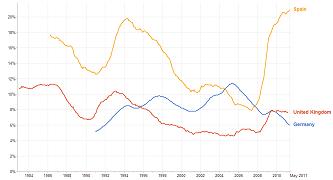
In the aftermath of the Great Recession, it is clear that unemployment has fallen in Germany while it has risen in the other countries - most severely so in Spain.
An interesting explanation for the relative success of Germany comes in a recent paper by Michael Burda and Jennifer Hunt. They argue that working time accounts - which allow employers to avoid paying overtime by averaging individuals' hours worked over a relatively lengthy period - have resulted in less hiring during the upturn and less firing in the downturn. This interesting finding suggests that such accounts are an institution that might be worth introducing elsewhere.
Thursday, June 23, 2011
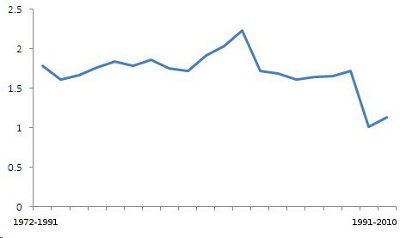
My last post on this blog concerned Okun's law. In the graph below, I report on the level of growth that is needed to maintain stable unemployment, calculated using 20 year windows from UK data from 1972-2010 and based on the model referred to in my earlier post. Over most of this period growth has needed to be just a whisker under 2 per cent per year to ensure that unemployment does not rise. In the last two periods illustrated on the graph, this has fallen dramatically - to just a little over 1 per cent.
It is not clear why, and it is certainly not clear that this drop represents a permanent shift.
It is not clear why, and it is certainly not clear that this drop represents a permanent shift.
Thursday, June 16, 2011
In 1962, Arthur Okun wrote his famous article about the relationship between the change in the unemployment rate and the growth rate of real output. This included the statistical estimation of an equation that relates changes in the unemployment rate to the growth rate of GDP. With some rearrangement of the terms in this equation, it is straightforward to evaluate the extent to which the economy needs to grow in order to ensure that unemployment does not rise. This relationship has come to be known as Okun's law - and it indicates that, in Western economies, somewhat over 2 per cent growth per annum is needed just to keep the unemployment rate steady. In the absence of such growth, advances in productivity will mean that output can be produced with fewer labour resources than were previously required.
Recent data to emerge from the UK suggest that this law is being repealed. Output has been flat in recent months, but unemployment (far from rising, as Okun's law would predict) has been falling. In some respects this is easy to explain: workers are accepting wage settlements that are below inflation, so that the brunt of adjustment appears in the form of falling real wages rather than rising unemployment. Several factors may account for this: communication about the extent of the global readjustments required may have given workers a hefty reality dose; the union legislation of the 1980s, now really being tested for the first time, may have proven itself to be effective.
Increased union militancy challenges this last possible explanation. And however strong the reality dose might be, it is more likely than not that at some point resistance to real wage cuts will strengthen. Okun's law has been one of the more durable statistical regularities in economics over the years, and growth remains the most promising way of avoiding large increases in unemployment.
Recent data to emerge from the UK suggest that this law is being repealed. Output has been flat in recent months, but unemployment (far from rising, as Okun's law would predict) has been falling. In some respects this is easy to explain: workers are accepting wage settlements that are below inflation, so that the brunt of adjustment appears in the form of falling real wages rather than rising unemployment. Several factors may account for this: communication about the extent of the global readjustments required may have given workers a hefty reality dose; the union legislation of the 1980s, now really being tested for the first time, may have proven itself to be effective.
Increased union militancy challenges this last possible explanation. And however strong the reality dose might be, it is more likely than not that at some point resistance to real wage cuts will strengthen. Okun's law has been one of the more durable statistical regularities in economics over the years, and growth remains the most promising way of avoiding large increases in unemployment.
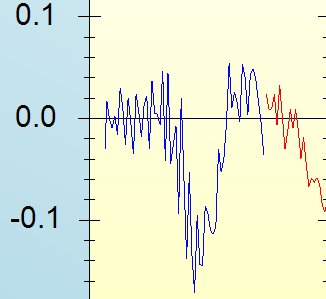
I have, from time to time, posted on this blog forecasts of the UK economy that come from a neural network model using monthly index of production data. The latest forecast - based on data up to April of this year - appears in the red line of the graph below. The blue line are historic data, while the forecast looks ahead 24 months.
This forecaster has, for many months now, consistently predicted a dip in economic activity towards the end of this summer. Like any economic forecasts - indeed more so than most, given its simple nature - it comes with a 'health warning'. While some economic indicators - most recently the drop in the unemployment rate - provide welcome news, there is still some way to go before we can be confident that growth has been restored.
This forecaster has, for many months now, consistently predicted a dip in economic activity towards the end of this summer. Like any economic forecasts - indeed more so than most, given its simple nature - it comes with a 'health warning'. While some economic indicators - most recently the drop in the unemployment rate - provide welcome news, there is still some way to go before we can be confident that growth has been restored.
Monday, June 06, 2011
The International Monetary Fund has reported on its mission to the UK. The report argues that the 'curent settings of fiscal and monetary policy remain appropriate in the central scenario', but that 'risks and uncertainty around this central scenario are significant'. In particular, if growth remains weak and if unemployment remains high, the automatic stabilisers that are built into fiscal policy - including lower tax take and higher spending on benefits - should be allowed to operate freely.
As early as May of last year, there were signs that the government intended to be flexible in the way in which it implemented the fiscal retrenchment. The Chancellor of the Exchequer has made much of the idea that there is no plan B, But the rhetoric is now changing - a plan B seems to be embedded within a plan A that is more permissive than the government's own rhetoric has often implied. For the sake of those who bear the brunt of this ever-so-slow recovery, let's hope so.
As early as May of last year, there were signs that the government intended to be flexible in the way in which it implemented the fiscal retrenchment. The Chancellor of the Exchequer has made much of the idea that there is no plan B, But the rhetoric is now changing - a plan B seems to be embedded within a plan A that is more permissive than the government's own rhetoric has often implied. For the sake of those who bear the brunt of this ever-so-slow recovery, let's hope so.
Wednesday, June 01, 2011
In the beginning, there were real business cycle models of the kind pioneered by Kydland and Prescott. These attempted to provide a rationale for the existence of smooth business cycles by examining how rational, utility maximising economic agents respond to random shocks by redistributing their activity over time. Eventually these models developed into what we now call dynamic stochastic general equilibrium (DSGE) models. These models initially adopted the market clearing assumptions made in the original real business cycle models. More recently, models have become more general and have introduced the notion of staggered price adjustments. The latter models are often referred to as new Keynesian variants, and the work of Michael Woodford is typical of this endeavour.
All of the models referred to above are designed to build up a story of macroeconomic behaviour using a strong set of microeconomic foundations. They are based on individual economic agents that are acting rationally. By drilling right down to the preferences of agents, the macroeconomic behaviour of the models is supposed to finesse the problem raised by the Lucas critique - the notion that, since a change in policy might change the way in which people respond to policy, models based on these responses cannot be used as forecasting tools. (But since people's preferences don't change in response to policy - only their behaviour does - models built on what we know about people's preferences are deemed to be robust.) In consequence, DSGE models have attracted much interest amongst central bankers.
But DSGE models are difficult to work with. Studying individual decision making in a dynamic environment - where attention has to be given to the way in which people form, and respond to, expectations about the future as well as how they respond to the past - involves a lot of complicated analysis. Simplifications have to be made. This being so, early DSGE models have focused on output and prices. While results from some of the models have been encouraging, many economists - myself included - have been underwhelmed by the general approach. This is because the models have failed to consider a world in which some people are unemployed. In other words, they have failed to consider anything that looks, even remotely, like the real world.
All that is set to change. Jordi Galí, one of the pioneers of new Keynesian DSGE models, has recently published work that accommodates the existence of unemployment. This has been built upon in further work done in collaboration with Frank Smets and Rafael Wouters. It's still early days, but the promise of DSGE modelling looks as though it may well be realised.
Galí, J. (2011). THE RETURN OF THE WAGE PHILLIPS CURVE Journal of the European Economic Association DOI: 10.1111/j.1542-4774.2011.01023.x
Kydland, F., & Prescott, E. (1982). Time to Build and Aggregate Fluctuations Econometrica, 50 (6) DOI: 10.2307/1913386
Lucas Jr, R. (1976). Econometric policy evaluation: A critique Carnegie-Rochester Conference Series on Public Policy, 1, 19-46 DOI: 10.1016/S0167-2231(76)80003-6
Woodford, M., & WALSH, C. (2005). INTEREST AND PRICES: FOUNDATIONS OF A THEORY OF MONETARY POLICY Macroeconomic Dynamics, 9 (03) DOI: 10.1017/S1365100505040253
All of the models referred to above are designed to build up a story of macroeconomic behaviour using a strong set of microeconomic foundations. They are based on individual economic agents that are acting rationally. By drilling right down to the preferences of agents, the macroeconomic behaviour of the models is supposed to finesse the problem raised by the Lucas critique - the notion that, since a change in policy might change the way in which people respond to policy, models based on these responses cannot be used as forecasting tools. (But since people's preferences don't change in response to policy - only their behaviour does - models built on what we know about people's preferences are deemed to be robust.) In consequence, DSGE models have attracted much interest amongst central bankers.
But DSGE models are difficult to work with. Studying individual decision making in a dynamic environment - where attention has to be given to the way in which people form, and respond to, expectations about the future as well as how they respond to the past - involves a lot of complicated analysis. Simplifications have to be made. This being so, early DSGE models have focused on output and prices. While results from some of the models have been encouraging, many economists - myself included - have been underwhelmed by the general approach. This is because the models have failed to consider a world in which some people are unemployed. In other words, they have failed to consider anything that looks, even remotely, like the real world.
All that is set to change. Jordi Galí, one of the pioneers of new Keynesian DSGE models, has recently published work that accommodates the existence of unemployment. This has been built upon in further work done in collaboration with Frank Smets and Rafael Wouters. It's still early days, but the promise of DSGE modelling looks as though it may well be realised.
Galí, J. (2011). THE RETURN OF THE WAGE PHILLIPS CURVE Journal of the European Economic Association DOI: 10.1111/j.1542-4774.2011.01023.x
Kydland, F., & Prescott, E. (1982). Time to Build and Aggregate Fluctuations Econometrica, 50 (6) DOI: 10.2307/1913386
Lucas Jr, R. (1976). Econometric policy evaluation: A critique Carnegie-Rochester Conference Series on Public Policy, 1, 19-46 DOI: 10.1016/S0167-2231(76)80003-6
Woodford, M., & WALSH, C. (2005). INTEREST AND PRICES: FOUNDATIONS OF A THEORY OF MONETARY POLICY Macroeconomic Dynamics, 9 (03) DOI: 10.1017/S1365100505040253
Thursday, May 19, 2011
Much applied work in economics concerns the problem of which came first: chicken or egg. In a recent paper, Michael Hilmer and Christina Hilmer consider this problem as it applies to the context of PhD students. They investigate the early success of PhD graduates in publishing their work, and ask whether this is due to the eminence of their supervisor - or rather is it the case that supervisors with good reputations tend to attract intrinsically more able students?
In this example, the direction of causality can be inferred by examining the relative performance of students studying with different supervisors in the same doctoral programme, and by examining the relative performance of students who share the same supervisor where the supervisor works in more than one programme (usually in different institutions).
The results suggest that success is due more to the individuals' innate abilities than to the supervisors. Good supervisors tend to attract good students, but the early career publishing performance of a given supervisor's students is higher in doctoral programmes with a higher quality (that is, in programmes which likely attract more able students).
For universities, therefore, getting the programme right - attracting the right students - is a clear prerequisite for success. Understanding which comes first - chicken or egg - is crucial.
More broadly, the chicken and egg question is key to understanding a wide range of policy issues. Which causes which: class size or scholastic performance? risky behaviours of depression? investment or output?
Hilmer, M., & Hilmer, C. (2011). Is it Where You Go or Who You Know? On the Relationship between Students, Ph.D. Program Quality, Dissertation Advisor Prominence, and Early Career Publishing Success Economics of Education Review DOI: 10.1016/j.econedurev.2011.04.013
In this example, the direction of causality can be inferred by examining the relative performance of students studying with different supervisors in the same doctoral programme, and by examining the relative performance of students who share the same supervisor where the supervisor works in more than one programme (usually in different institutions).
The results suggest that success is due more to the individuals' innate abilities than to the supervisors. Good supervisors tend to attract good students, but the early career publishing performance of a given supervisor's students is higher in doctoral programmes with a higher quality (that is, in programmes which likely attract more able students).
For universities, therefore, getting the programme right - attracting the right students - is a clear prerequisite for success. Understanding which comes first - chicken or egg - is crucial.
More broadly, the chicken and egg question is key to understanding a wide range of policy issues. Which causes which: class size or scholastic performance? risky behaviours of depression? investment or output?
Hilmer, M., & Hilmer, C. (2011). Is it Where You Go or Who You Know? On the Relationship between Students, Ph.D. Program Quality, Dissertation Advisor Prominence, and Early Career Publishing Success Economics of Education Review DOI: 10.1016/j.econedurev.2011.04.013
Wednesday, April 27, 2011
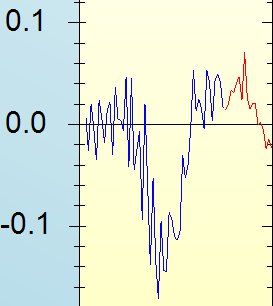
I have occasionally on this blog referred to a neural network forecasting model of the UK economy that I like to use. I most recently reported on forecasts from this model in January of this year. At that time, the model was predicting a fall-off in growth towards the end of summer of this year. The most recent experiments that I have run with this model use data up to February 2011, and they still indicate that growth will falter towards the end of summer.
The caveats surrounding this model are many: it's based on industrial production data (since this is available monthly), and doesn't include information about other variables - notably policy. But for a simple model it has a rather good track record. While the pessimism in the model's forecasts may not be widely shared, these figures do serve to emphasise just how fragile is the recovery.
The graph below shows the actual data back to just before the downturn - the forecasts are at the right of the graph (where the line turns red) and look forward 18 months.
The caveats surrounding this model are many: it's based on industrial production data (since this is available monthly), and doesn't include information about other variables - notably policy. But for a simple model it has a rather good track record. While the pessimism in the model's forecasts may not be widely shared, these figures do serve to emphasise just how fragile is the recovery.
The graph below shows the actual data back to just before the downturn - the forecasts are at the right of the graph (where the line turns red) and look forward 18 months.
The growth figures announced today indicate that the UK's economy grew by 0.5% over the first 3 months of this year. In the last 3 months of last year, it fell by 0.5%. So we are not yet quite back to where we were in the third quarter of 2010. (A fall of 5% followed by a rise of 5% nets out as a fall of 0.25%, not zero, because the second 5% is calculated from a lower base.) The contraction in the last quarter of 2010 was, we were told, due to poor weather. If that were really the case (and the evidence suggests that, in part at least, it was), then the improvement in the first quarter of this year is surely due to the absence of poor weather - and nothing more fundamental than that. As the Chancellor of the Exchequer said yesterday, 'we are not out of the woods yet'; the recovery, such as it is, remains very fragile.
That said, from this low base, there are now some signs that offer encouragement. It remains essential for the government, in its zeal to attack the budget deficit, to pay heed to the impact that its policies has on growth.
That said, from this low base, there are now some signs that offer encouragement. It remains essential for the government, in its zeal to attack the budget deficit, to pay heed to the impact that its policies has on growth.
Thursday, April 21, 2011
Are we seeing some signs of life? Consumer confidence up,retail sales up, unemployment down...
One would hope so. But the improvement in these statistics is slight, and in each case the data follow on from very bad figures in the previous month. If indeed we are seeing the first indications of recovery, that recovery remains very fragile. Whatever one's views might be about the speed with which the budget deficit is being cut, the policy shock that still has to be played out is likely to result in a bumpy ride over the coming months.
One would hope so. But the improvement in these statistics is slight, and in each case the data follow on from very bad figures in the previous month. If indeed we are seeing the first indications of recovery, that recovery remains very fragile. Whatever one's views might be about the speed with which the budget deficit is being cut, the policy shock that still has to be played out is likely to result in a bumpy ride over the coming months.
Wednesday, April 06, 2011
Many observers have noted that the financial situation facing the UK is different from that in Greece, Ireland, or Portugal. The rates of interest which the latter countries have had to offer in order to sell their Treasury bills illustrate this. While six month T bills can be sold by the UK at an interest rate of around 0.7%, Portugal has today auctioned off six month T bills at a mammoth 5.1%. This figure makes the terms of any prospective bail-out attractive to the Portuguese authorities, and such a bail-out is now surely inevitable.
Wednesday, March 23, 2011
The revisions made to the Office for Budgetary Responsibility's growth projections, released to coincide with today's Budget Statement, are in a downward direction, with 2011 growth now anticipated to be 1.7%. This still looks a touch optimistic.
The Chancellor of the Exchequer described his Budget as a Budget to fuel growth, but beneath the hype there does not appear to be much fuel in the tank. To some extent this is unsurprising as the Chancellor has already used the Comprehensive Spending Review to tie his own hands. Even so, further - and more accelerated - redistribution towards those on lower incomes would have done at least something to improve the multiplier effect of what measures are in place to support the economy. The £600 rise in the personal allowance on income taxation does not kick in until April of next year - too little and too late to help an economy that is shrinking now. And a shrinking economy makes it all the more difficult for the government to meet its targets with the public finances.
The Budget has been accompanied by something called a 'Plan for Growth'. This aims to increase the competitiveness of the tax system, to encourage the creation and development of businesses, to rebalance the economy through investment and export activity, and to provide a more educated workforce. The headline ambitions suggest that the government's aim is to produce a raft of microeconomic policies that could help improve competitiveness and hence provide the right context within which economic growth can take place. So far, so worthy.
When we turn to the detail of the Plan for Growth, remarkably little involves a financial commitment by the government. There is reference to an additional £100 million to repair potholes, and one or two other things. But the (uncosted) words 'encourage', 'support', and references to reducing 'burdens' occur frequently. In other words, it's a 'do it yourself' plan for growth - much as the expenditure cuts were a 'do it yourself' exercise (a huge proportion of these cuts being shifted onto local authorities). The plan - inasmuch as it is a plan rather than a hope - is for a Thatcherian resurgence in enterpreneurship. We should wish for this to be successful. Whether or not it will be so will depend in large measure on the detail of the microeconomic policies that are introduced. And for that, we'll have to wait and see.
The Chancellor of the Exchequer described his Budget as a Budget to fuel growth, but beneath the hype there does not appear to be much fuel in the tank. To some extent this is unsurprising as the Chancellor has already used the Comprehensive Spending Review to tie his own hands. Even so, further - and more accelerated - redistribution towards those on lower incomes would have done at least something to improve the multiplier effect of what measures are in place to support the economy. The £600 rise in the personal allowance on income taxation does not kick in until April of next year - too little and too late to help an economy that is shrinking now. And a shrinking economy makes it all the more difficult for the government to meet its targets with the public finances.
The Budget has been accompanied by something called a 'Plan for Growth'. This aims to increase the competitiveness of the tax system, to encourage the creation and development of businesses, to rebalance the economy through investment and export activity, and to provide a more educated workforce. The headline ambitions suggest that the government's aim is to produce a raft of microeconomic policies that could help improve competitiveness and hence provide the right context within which economic growth can take place. So far, so worthy.
When we turn to the detail of the Plan for Growth, remarkably little involves a financial commitment by the government. There is reference to an additional £100 million to repair potholes, and one or two other things. But the (uncosted) words 'encourage', 'support', and references to reducing 'burdens' occur frequently. In other words, it's a 'do it yourself' plan for growth - much as the expenditure cuts were a 'do it yourself' exercise (a huge proportion of these cuts being shifted onto local authorities). The plan - inasmuch as it is a plan rather than a hope - is for a Thatcherian resurgence in enterpreneurship. We should wish for this to be successful. Whether or not it will be so will depend in large measure on the detail of the microeconomic policies that are introduced. And for that, we'll have to wait and see.
Monday, March 21, 2011
This week's budget needs to include policies aimed at the promotion of growth. There is a wide range of options open to the government, but one that is in line with the policies of one of the coalition partners (the Liberal Democrats) would be to raise the personal allowance (or 'disregard') on income tax. For the coming year this is set to be £7475. A substantial increase in this would raise disposable incomes - especially those of the people on the lowest incomes. Since the latter group tend to spend the largest proportion of their incomes, the knock-on ('multiplier') effects of raising their disposable income is likely to be greater than that associated with raising the incomes of other workers.
Ultimately the Liberal Democrats want to raise the personal allowance to £10000. While their more hawkish partners in government are unlikely to want to go the whole hog at this stage, it is, of course, now that the stimulus is most needed. Tax revenues fall when the economy contracts, and - while borrowing fell over most of last year while the economy was starting to recover - the more recent stagnation is doing nothing to help the public finances. Moving most of the way to the £10000 target - in a budget containing other policies to encourage growth - would be prudent.
Ultimately the Liberal Democrats want to raise the personal allowance to £10000. While their more hawkish partners in government are unlikely to want to go the whole hog at this stage, it is, of course, now that the stimulus is most needed. Tax revenues fall when the economy contracts, and - while borrowing fell over most of last year while the economy was starting to recover - the more recent stagnation is doing nothing to help the public finances. Moving most of the way to the £10000 target - in a budget containing other policies to encourage growth - would be prudent.
Friday, March 18, 2011
Consumer confidence has, according to the Nationwide's monthly survey, hit an all time low. What is particularly worrying about these figures is that consumer confidence has a track record as a very good leading indicator of the state of the economy. Confidence has clearly not been helped by the government's failure, thus far, to deliver any clear plan for growth. While the hope is often expressed that the private sector will expand to soak up the supply of labour that is shed by public organisations, this has, so far, been just that - a hope. The reality has been one of rising unemployment - with the number unemployed rising to 2.53 million in January, the highest figure for some 17 years. Meanwhile, the OECD has provided a downbeat assessment of the UK's growth prospects over the next 2 years. This anticipates growth of just 1.5 per cent this year. The OECD does deem fiscal consolidation to be 'necessary', but also describes the government's plans in this area as 'ambitious'.
Next week's budget needs to provide what has heretofore been lacking - not just a hope, not just a promise, but robust government support for growth. And if that means trimming the ambition just a little, and losing face just a little, then so be it.
Next week's budget needs to provide what has heretofore been lacking - not just a hope, not just a promise, but robust government support for growth. And if that means trimming the ambition just a little, and losing face just a little, then so be it.
Tuesday, March 15, 2011
There are some very pertinent observations about the future development of macroeconomics in this talk by Olivier Blanchard.
His nine points are:
1. In the wake of the crisis, policy making has to change, in particular with less of a focus on a single policy goal.
2. The pendulum has swung, some at least, in the direction of a recognition of an enhanced role for the state in macroeconomic regulation.
3. We previously underestimated the impact on the macroeconomy of microeconomic distortions.
4. There exists a multiplicity of macroeconomic policy tools...
5. .... not all of which are fully understood.
6. Some of these tools are difficult to employ for reasons of political economy.
7. The future research agenda for macroeconomics, with solid microfoundations, is exciting.
8. There should exist a multiplicity of policy goals. But moving from a model of inflation targeting to one where multiple goals are targeted is difficult.
9. We should not hope for too much.
Recent developments in macroeconomics have focused on models based on dynamic stochastic general equilibrium (DSGE). These models are characterised by a set of macroeconomic relationships which are built up from consistent microeconomic foundations. Their microeconomic underpinnings are intended to finesse the criticism raised by Lucas that changes in policy beget changes in the behaviour of microeconomic agents thereby posing a challenge to economic forecasters. DSGE models come in a variety of flavours - there are classical models developed from the real business cycle literature and there are Keynesian models which build in price rigidity as an institutional feature. The models take the assumption of rational expectations as given. Large scale variants of these models are used as a tool for policy making and evaluation in central banks.
In recent work, Georg Weizsäcker has produced compelling evidence that - contrary to much of the economic orthodoxy of the last 40 years - people do not form their expectations rationally. It takes particularly strong evidence to disturb someone's expectation away from their prior beliefs. If the expectations formed by an agent are approximately correct, they will not adjust them rationally. Only if they are way out will they take new evidence on board.
Weizsäcker's findings should not be particularly surprising. They suggest that a way forward in modelling may be to adopt a nonlinear approach wherein the degree of rationality used in forming expectations varies inversely with the accuracy of those expectations. Given the evidence, it is clear that our models would benefit by admitting some sort of learning mechanism - something more refined than the assumption that we always achieve rationality.
Weizsäcker, G. (2010). Do We Follow Others when We Should? A Simple Test of Rational Expectations American Economic Review, 100 (5), 2340-2360 DOI: 10.1257/aer.100.5.2340
In recent work, Georg Weizsäcker has produced compelling evidence that - contrary to much of the economic orthodoxy of the last 40 years - people do not form their expectations rationally. It takes particularly strong evidence to disturb someone's expectation away from their prior beliefs. If the expectations formed by an agent are approximately correct, they will not adjust them rationally. Only if they are way out will they take new evidence on board.
Weizsäcker's findings should not be particularly surprising. They suggest that a way forward in modelling may be to adopt a nonlinear approach wherein the degree of rationality used in forming expectations varies inversely with the accuracy of those expectations. Given the evidence, it is clear that our models would benefit by admitting some sort of learning mechanism - something more refined than the assumption that we always achieve rationality.
Weizsäcker, G. (2010). Do We Follow Others when We Should? A Simple Test of Rational Expectations American Economic Review, 100 (5), 2340-2360 DOI: 10.1257/aer.100.5.2340
Wednesday, March 09, 2011
In recent work, Atish Ghosh, Enrique Mendoza and Jonathan Ostry have developed a means of evaluating the 'fiscal space' of an economy. This is a measure of the flexibiltity that the authorities have to engage in expansionary fiscal policies given the levels of national debt. The measure is calculated by reference to the maximum level of national debt that (given that interest payments need to be made on the debt) is sustainable at the economy's GDP. If the national debt were to rise above this point, then interest payments will serve to ensure that it would rise forever more, and so default would become inevitable.
The results are instructive. Unsurprisingly, Iceland, Greece and Portugal are amongst the countries with very little headroom. Italy and Japan are also in this group. Spain and Ireland (surprisingly, perhaps), are somewhat better placed. The UK is (perhaps also surprisingly) in a relatively comfortable zone, keeping company with countries such as France and Germany.
The results are instructive. Unsurprisingly, Iceland, Greece and Portugal are amongst the countries with very little headroom. Italy and Japan are also in this group. Spain and Ireland (surprisingly, perhaps), are somewhat better placed. The UK is (perhaps also surprisingly) in a relatively comfortable zone, keeping company with countries such as France and Germany.
Thursday, March 03, 2011
Results from the new panel dataset, Understanding Society, have been reported today, suggesting that people in the UK remained broadly optimistic at the height of the recession in 2009. At times like these, good news is always welcome. It is important, however, to note that this is a snapshot. Evidence from another source - the Nationwide survey of consumer confidence - confirms that confidence did indeed recover well during 2009. Indeed by the end of that year, confidence was not far below the levels realised in the summer of 2007, before the first signs of the credit crunch became fully apparent. However, since the end of 2009, confidence has plummeted once more and the Nationwide's index is currently close to the minimum value that it realised at the end of 2008.
The world moves fast. Understanding Society is set to be a fantastic source of data for researchers, but when analysing data we should pick horses for courses. Understanding Society is simply not up to date enough to provide useful information about consumer sentiment now.
The world moves fast. Understanding Society is set to be a fantastic source of data for researchers, but when analysing data we should pick horses for courses. Understanding Society is simply not up to date enough to provide useful information about consumer sentiment now.
Thursday, February 17, 2011
In a post on this blog last June, I expressed concerns that the Office for Budgetary Responsibility was underestimating the magnitude of the output gap in the UK. This underestimation appears to be contagious. A member of the Bank of England's Monetary Policy Committee, Andrew Sentance, has argued in a speech that the output gap is low and that maintaining historically low interest rates is stimulating the economy beyond the point at which inflation can be held in check.
The notion that, with high and rising unemployment, the output gap is low seems to be difficult to defend. There are, to be sure, reasons why prices are rising. Oil and food prices have risen internationally for reasons that have been well documented (here and elsewhere) and which are likely to be transient. Tax hikes have also contributed.
The economy shrank in the last quarter. Fiscal policy is imposing a squeeze which will inevitably increase the challenges faced in the labour market. To move too early to accompany this with a monetary squeeze - and to do so on the basis of price statistics that are probably blipping - would be dangerous. Yes, we need to keep an eye on inflation, but, no, the price increases we have seen up to this point do not suggest that inflation is a significant threat.
The notion that, with high and rising unemployment, the output gap is low seems to be difficult to defend. There are, to be sure, reasons why prices are rising. Oil and food prices have risen internationally for reasons that have been well documented (here and elsewhere) and which are likely to be transient. Tax hikes have also contributed.
The economy shrank in the last quarter. Fiscal policy is imposing a squeeze which will inevitably increase the challenges faced in the labour market. To move too early to accompany this with a monetary squeeze - and to do so on the basis of price statistics that are probably blipping - would be dangerous. Yes, we need to keep an eye on inflation, but, no, the price increases we have seen up to this point do not suggest that inflation is a significant threat.
Wednesday, February 09, 2011
Project Merlin - the initiative that has aimed at securing more bank lending to businesses by linking bankers' bonus payments to such lending - has finally, after much wrangling, delivered an agreement. The banks will raise their lending to a total of around £190 billion this year. Some 40% of this will go to small firms. The banks will also provide capital (some £200 million) for the Big Society Bank - which is intended to fund projects that are community based. There will be increased transparency in bankers' pay, but this falls short of the hope that bonuses would be contingent on banks meeting lending targets.
Lending will be monitored by the Bank of England which will provide regular reports - which presumably means naming and shaming banks that do not live up to their promises. Beyond this, it is not clear that Merlin has any teeth. Banks will lend, and they will do so at rates of interest that they themselves set. If businesses do not find these rates attractive, they will not look for loans.
In this context, it is a little disquieting to note the continued rise of LIBOR - which is now at 0.80%, some 30 points above the Bank of England's interest rate. There is still a lot of nervousness around the financial markets, and that means that lending is still not going to come cheap.
So the environment in which Merlin has been launched is not altogether promising. A little more prescription might not have gone amiss.
Lending will be monitored by the Bank of England which will provide regular reports - which presumably means naming and shaming banks that do not live up to their promises. Beyond this, it is not clear that Merlin has any teeth. Banks will lend, and they will do so at rates of interest that they themselves set. If businesses do not find these rates attractive, they will not look for loans.
In this context, it is a little disquieting to note the continued rise of LIBOR - which is now at 0.80%, some 30 points above the Bank of England's interest rate. There is still a lot of nervousness around the financial markets, and that means that lending is still not going to come cheap.
So the environment in which Merlin has been launched is not altogether promising. A little more prescription might not have gone amiss.
Wednesday, January 26, 2011
The big question to arise from yesterday's disappointing growth figures is: can it really all have been about the snow?
Occasionally over recent months, I have referred to a forecasting model that I like to use. If the slump in the last quarter of last year was indeed due to the exceptional weather, then this model should fail to predict it. Indeed my model fails to predict the final quarter slump. So snow may have played a part. (Bear in mind, though, that this is a loose test - not least because the data I use in this model are industrial production data, and we know that manufacturing did relatively well in the last quarter.)
Despite this, the model's forecasts are not all that encouraging. They are that production will show modest growth (at an annualised rate of less than 2%) up to the late summer - but then it starts to fall off.
Plenty of caveats attach to a simple model of this kind (a neural net with a hyperbolic tangent squasher, 24 months of input data, 2 hidden layers, where the data are the 12-month change in logged index of industrial production data), or indeed to any economic forecast. But, for a simple model, the track record of this forecaster is pretty good. Snow may have played its part in the last quarter of 2010, but the recovery is nonetheless far from secured.
Occasionally over recent months, I have referred to a forecasting model that I like to use. If the slump in the last quarter of last year was indeed due to the exceptional weather, then this model should fail to predict it. Indeed my model fails to predict the final quarter slump. So snow may have played a part. (Bear in mind, though, that this is a loose test - not least because the data I use in this model are industrial production data, and we know that manufacturing did relatively well in the last quarter.)
Despite this, the model's forecasts are not all that encouraging. They are that production will show modest growth (at an annualised rate of less than 2%) up to the late summer - but then it starts to fall off.
Plenty of caveats attach to a simple model of this kind (a neural net with a hyperbolic tangent squasher, 24 months of input data, 2 hidden layers, where the data are the 12-month change in logged index of industrial production data), or indeed to any economic forecast. But, for a simple model, the track record of this forecaster is pretty good. Snow may have played its part in the last quarter of 2010, but the recovery is nonetheless far from secured.
Tuesday, January 25, 2011
It's a double dip. The 0.5% contraction in the economy over the last quarter of last year represents a truly awful outcome. The government has been quick to blame poor weather towards the end of December. But that is clutching at straws.
The figures are considerably worse than the expected increase in output of around 0.4%. It represents a dreadfully weak platform on which to build the government's austerity measures. It is time for a reassessment.
The figures are considerably worse than the expected increase in output of around 0.4%. It represents a dreadfully weak platform on which to build the government's austerity measures. It is time for a reassessment.
Thursday, January 20, 2011
Figures released this week indicate an increase in the unemployment rate to 7.9% and an increase in the inflation rate to 3.7%. Both are a concern, and they bring to mind the 'stagflation' that was experienced in the 1970s.
Economics is often thought of as the 'dismal science' - when there is good news about unemployment, there is usually some bad news about inflation, and vice versa. When there is bad news about both, things get really dismal, and we really have to try hard to look for some good news. There may be some. Petrol prices have risen sharply; food prices have also increased. The price of oil does tend to fluctuate a lot (a fact not unrelated to the inelastic nature of both demand and supply in this market), and at close to $100 per barrel the price is now, if anything, above its steady state. The increase in the price of food has been driven largely by severe, but transient, weather events.
So where is the good news? As things stand, it looks as though inflation is blipping. It will rise further before falling - not least because of the effects of the January VAT increase. But as oil and food prices stabilise, the inflationary pressure should ease.
This does suppose that the inflation that we have experienced up to now will not feed through into wage increases. If it does, then stagflation indeed looms. The Bank of England's Monetary Policy Committee is sure to look closely at wage settlements over the coming months. If there were to be a general upward drift in wage settlements, then that would not be good news for inflation - wage hikes would feed through into further price hikes, and this would lead to wages and prices leapfrogging each other in an inflationary spiral. To avoid this, the Bank may need to raise the interest rate sooner rather than later - and that would further threaten the recovery. Let us hope that sense prevails.
Economics is often thought of as the 'dismal science' - when there is good news about unemployment, there is usually some bad news about inflation, and vice versa. When there is bad news about both, things get really dismal, and we really have to try hard to look for some good news. There may be some. Petrol prices have risen sharply; food prices have also increased. The price of oil does tend to fluctuate a lot (a fact not unrelated to the inelastic nature of both demand and supply in this market), and at close to $100 per barrel the price is now, if anything, above its steady state. The increase in the price of food has been driven largely by severe, but transient, weather events.
So where is the good news? As things stand, it looks as though inflation is blipping. It will rise further before falling - not least because of the effects of the January VAT increase. But as oil and food prices stabilise, the inflationary pressure should ease.
This does suppose that the inflation that we have experienced up to now will not feed through into wage increases. If it does, then stagflation indeed looms. The Bank of England's Monetary Policy Committee is sure to look closely at wage settlements over the coming months. If there were to be a general upward drift in wage settlements, then that would not be good news for inflation - wage hikes would feed through into further price hikes, and this would lead to wages and prices leapfrogging each other in an inflationary spiral. To avoid this, the Bank may need to raise the interest rate sooner rather than later - and that would further threaten the recovery. Let us hope that sense prevails.
Monday, January 10, 2011
Monday, December 20, 2010
The Conferderation of British Industry has lowered its growth forecast for the coming quarter; it now forecasts quarter-on-quarter growth of just 0.2 per cent over the period from January to March 2011. It does, however, still expect growth of 2 per cent over the coming year.
Meanwhile, the Nationwide consumer confidence index fell further in November, and is now close to the low point that it reached in January 2009. (The index stands at 45 in November; it was 43 in January of last year.)
I have, on a couple of occasions over the last few months, reported the predictions of a neural network forecasting model. Over the coming 18 months, that model is currently predicting modest growth for the UK, and suggests that the danger of a double-dip is receeding. It should, however, be borne in mind that this model is based on output data (monthly data on industrial production, to be precise); the model may not adequately allow for the threats to the economy that come from sluggish consumer spending, fragile overseas demand, and government austerity packages. Nonetheless, the model offers a little festive cheer.
Meanwhile, the Nationwide consumer confidence index fell further in November, and is now close to the low point that it reached in January 2009. (The index stands at 45 in November; it was 43 in January of last year.)
I have, on a couple of occasions over the last few months, reported the predictions of a neural network forecasting model. Over the coming 18 months, that model is currently predicting modest growth for the UK, and suggests that the danger of a double-dip is receeding. It should, however, be borne in mind that this model is based on output data (monthly data on industrial production, to be precise); the model may not adequately allow for the threats to the economy that come from sluggish consumer spending, fragile overseas demand, and government austerity packages. Nonetheless, the model offers a little festive cheer.
Thursday, December 09, 2010
The Institute for Fiscal Studies has reported on the government's proposals for student finance. Its findings cast some useful light on a debate that has been dominated by political spin. An important conclusion is that 'graduates from the poorest 30% of households would (under the government's proposals) pay back less than under Lord Browne's proposed system, but more than under the current system '. Many politicians would have you believe otherwise.
Browne's proposals, which involved a 'soft' cap on tuition fees at £6000, with universities being allowed to raise fees above that level while being subjected to a steeply rising tax, have been replaced by a 'two cap' system - where the cap is either £6000 or £9000 conditional on widening participation. Both Browne and government proposals involve a loan for tuition fees and maintenance that is repaid once the student graduates and is earning £21000 or more per year. Concessions made by the government include the annual uprating of this £21000 figure, and tuition fee discounts to students from the poorest families.
The media has portrayed this as a three-fold increase in tuition fees, indicating an expectation that many universities will pitch their fees at or near the higher cap. Indeed, it is quite possible that, by introducing the higher cap, the government will already have encouraged some institutions to set fees higher than they would otherwise have chosen. This would appear to be good for neither students not public finances, and appears to have been driven by a political need to retain a cap of some sort. Yet surely it is almost inevitable that the cap will go some day, and Browne's suggestion of protecting students and the taxpayer by imposing taxes on universities that charge high tuition fees was eminently sensible. In this respect, politics seems to have trumped common sense.
The universities, meanwhile, will suffer severe cuts to their teaching budgets from the coming tax year (which starts before the end of the current academic year), and will - if the legislation goes through - be able to charge higher tuition fees only from academic year 2012-13. They will face a more robust competitive environment, and will need to innovate rapidly - and constantly - if they are to prosper. These are interesting times indeed in higher education.
Browne's proposals, which involved a 'soft' cap on tuition fees at £6000, with universities being allowed to raise fees above that level while being subjected to a steeply rising tax, have been replaced by a 'two cap' system - where the cap is either £6000 or £9000 conditional on widening participation. Both Browne and government proposals involve a loan for tuition fees and maintenance that is repaid once the student graduates and is earning £21000 or more per year. Concessions made by the government include the annual uprating of this £21000 figure, and tuition fee discounts to students from the poorest families.
The media has portrayed this as a three-fold increase in tuition fees, indicating an expectation that many universities will pitch their fees at or near the higher cap. Indeed, it is quite possible that, by introducing the higher cap, the government will already have encouraged some institutions to set fees higher than they would otherwise have chosen. This would appear to be good for neither students not public finances, and appears to have been driven by a political need to retain a cap of some sort. Yet surely it is almost inevitable that the cap will go some day, and Browne's suggestion of protecting students and the taxpayer by imposing taxes on universities that charge high tuition fees was eminently sensible. In this respect, politics seems to have trumped common sense.
The universities, meanwhile, will suffer severe cuts to their teaching budgets from the coming tax year (which starts before the end of the current academic year), and will - if the legislation goes through - be able to charge higher tuition fees only from academic year 2012-13. They will face a more robust competitive environment, and will need to innovate rapidly - and constantly - if they are to prosper. These are interesting times indeed in higher education.
Tuesday, November 30, 2010
'Nudge' is the title of an influential book written a couple of years ago by Richard Thaler and Cass Sunstein. The thesis of the book is that small actions by government can be used to trigger large changes in behaviour amongst the population at large - government can 'nudge' people in a particular direction. The idea comes from the insights of behavioural economists who have combined research results from the disciplines of psychology and economics.
Nudge is now influential in policy circles. Indeed the new white paper on health policy, 'Healthy Lives, Healthy People', contains many ideas based on nudge. It talks of the need to harness 'the latest insights from behavioural science, and emphasises that 'top down inititiatives and lectures from central government about the risks are not the answer' to health issues.
Good. But let us hope that the solutions will be based on research, and that nudge is not used as an excuse for doing (and spending) too little when more needs to be done.
Nudge is now influential in policy circles. Indeed the new white paper on health policy, 'Healthy Lives, Healthy People', contains many ideas based on nudge. It talks of the need to harness 'the latest insights from behavioural science, and emphasises that 'top down inititiatives and lectures from central government about the risks are not the answer' to health issues.
Good. But let us hope that the solutions will be based on research, and that nudge is not used as an excuse for doing (and spending) too little when more needs to be done.
Monday, November 29, 2010
The Office for Budget Responsibility (OBR) has raised its forecast for growth in 2010 to 1.8%. This is in response to the higher than expected figure for third quarter growth. At the same time, the OBR's forecast for growth in 2011 has been cut - from 2.3% to 2.1% - following the VAT hike (from 17.5% to 20% in January of next year) and the planned cuts in government expenditure.
The outlook for the world economy remains very uncertain, with recent events surrounding the Irish economy merely serving to highlight the continued fragility of the financial sector. Weakness in the UK's main export markets continues to suggest that the risks remain on the downside. If the economy fares as well as the OBR expects in 2011, I would be pleasantly surprised; given the severity of the government's austerity measures, and the imposition of similar measures elsewhere, a growth rate of one point something seems to me to be more likely.
The outlook for the world economy remains very uncertain, with recent events surrounding the Irish economy merely serving to highlight the continued fragility of the financial sector. Weakness in the UK's main export markets continues to suggest that the risks remain on the downside. If the economy fares as well as the OBR expects in 2011, I would be pleasantly surprised; given the severity of the government's austerity measures, and the imposition of similar measures elsewhere, a growth rate of one point something seems to me to be more likely.
Thursday, November 25, 2010
The government has launched an initiative to create an index of happiness. Prime Minister David Cameron has argued that purely economic measures of prosperity, such as Gross Domestic Product, provide too narrow a metric of our wellbeing. No doubt he is right.
Composite measures of wellbeing are not a new thing. The United Nations has calculated a Human Development Index which, since 1990, has evaluated wellbeing in terms of people's educational attainment, life expectancy and income. The UK comes 26th in this ranking.
But what about happiness? A lot of recent work on happiness uses standard survey questions such as this: 'All things considered, how satisfied are you with life as a whole these days?' Respondents give a response, usually on a 5 point scale. The results correlate strongly with more objective measures of average happiness across countries - like suicide rates, addiction rates and so on. So perhaps there is something in this idea of a happiness index.
We know that stable familes, good health, active leisure time, high levels of employment, a relatively equal distribution of income, freedom and democracy all positively influence happiness. If these insights lead to the adoption of policies that are family friendly, that are health enhancing, that encourage active leisure and so on, then that is all to the good.
So far, so good. But there is an inconvenient paradox lying in wait. Much of the work that has been done on happiness indicates that happiness has not risen over time - even though we are now much richer than we were in the past. However, we also know that our happiness is determined largely by a comparison of our own income with that of other people. So if we see other countries getting richer while our own does not, we become less happy.
Like it or not, the question of economic prosperity will always come to the surface.
Composite measures of wellbeing are not a new thing. The United Nations has calculated a Human Development Index which, since 1990, has evaluated wellbeing in terms of people's educational attainment, life expectancy and income. The UK comes 26th in this ranking.
But what about happiness? A lot of recent work on happiness uses standard survey questions such as this: 'All things considered, how satisfied are you with life as a whole these days?' Respondents give a response, usually on a 5 point scale. The results correlate strongly with more objective measures of average happiness across countries - like suicide rates, addiction rates and so on. So perhaps there is something in this idea of a happiness index.
We know that stable familes, good health, active leisure time, high levels of employment, a relatively equal distribution of income, freedom and democracy all positively influence happiness. If these insights lead to the adoption of policies that are family friendly, that are health enhancing, that encourage active leisure and so on, then that is all to the good.
So far, so good. But there is an inconvenient paradox lying in wait. Much of the work that has been done on happiness indicates that happiness has not risen over time - even though we are now much richer than we were in the past. However, we also know that our happiness is determined largely by a comparison of our own income with that of other people. So if we see other countries getting richer while our own does not, we become less happy.
Like it or not, the question of economic prosperity will always come to the surface.
Tuesday, November 02, 2010
There is the deficit, and there is the debt. The deficit is a flow (like water flowing into a bath) - and it only make sense to talk of a flow as a measure of volume per period. The deficit tells us how much is being added to the debt per year. The debt, on the other hand, is a stock (like the amount of water that is actually in the bath). We pay interest on the national debt, and if the national debt rises too high we squander too much of our resource on these interest payments.
Clearly the flow and the stock are related. Keep the tap on too long and the tub overflows. The deficit does need to be reduced. But this chart, published by the Financial Times, is useful in putting things in context.
Relative to many other countries, the UK started out from a good place. Its policy response to the recession was aggressive (and, given the economy's reliance on financial services, it needed to be). We are left with a high deficit that needs to be cut. But the national debt remains in a place which gives the government some discretion (not much, but some) about how fast it should go in making the cuts.
Clearly the flow and the stock are related. Keep the tap on too long and the tub overflows. The deficit does need to be reduced. But this chart, published by the Financial Times, is useful in putting things in context.
Relative to many other countries, the UK started out from a good place. Its policy response to the recession was aggressive (and, given the economy's reliance on financial services, it needed to be). We are left with a high deficit that needs to be cut. But the national debt remains in a place which gives the government some discretion (not much, but some) about how fast it should go in making the cuts.
Tuesday, October 26, 2010
Output growth in the third quarter of this year, at 0.8%, was faster than many commentators expected. This is good news, clearly.
It is unlikely, however, that such a rate of growth could be sustained into the future - even in the absence of tough government budget cuts. While the latest data give some encouragement that the economy is stronger than we thought, the prospects for continued growth over the next couple of years remain very modest.
It is unlikely, however, that such a rate of growth could be sustained into the future - even in the absence of tough government budget cuts. While the latest data give some encouragement that the economy is stronger than we thought, the prospects for continued growth over the next couple of years remain very modest.
Monday, October 25, 2010
A few months ago, I reported the results of a simple forecasting model that I tried out on UK data, looking ahead over the next year or so. It's time for an update. There is good news and bad news: the model is no longer predicting a nosedive for late 2011. However it does predict extremely sluggish growth, barely above zero in most months and dipping slightly below zero on occasion.
This is not the type of model that allows consideration to be taken of policy announcements - it's simply based on the time series of a single variable. What we know about the likely trajectory of the economy, even in the absence of policy shifts that are themselves deflationary, is that the scope for growth is very limited.
This is not the type of model that allows consideration to be taken of policy announcements - it's simply based on the time series of a single variable. What we know about the likely trajectory of the economy, even in the absence of policy shifts that are themselves deflationary, is that the scope for growth is very limited.
Wednesday, October 20, 2010
The cuts to public spending announced in today's spending review were well heralded in advance. That said, the expectations management of the government has not been terribly sophisticated - there is no room for celebration that the cuts have turned out to be less severe than feared.
The cuts amount to £81 billion per year by 2014-15. This is in addition to £29 billion additional tax revenues that the government hopes to bring in from policies announced earlier. This will much more than wipe out the structural deficit (on any reasonable calculation of what the structural deficit is), and suggests that the government is seeking to leave itself scope for tax cuts later in the parliament. Unfortunately the economy needs the breaks (and certainly not the brakes) now, not in four years time.
The phasing of the cuts is gradual - with around £20 billion extra being taken off the total spend in each of the next four years. In view of the current fragility of the economy a more phased ramping up of the cuts would likely have been prudent. It is not clear that the patient can easily stomach the medicine in the immediate future - we should now expect growth (if indeed there is to be any growth) to be very sluggish indeed over the medium term.
Since cuts of around £80 billion were heralded in the emergency budget, none of the above is terribly new. What is new is the detail about where the cuts will come from. Of the really big spending departments, the hardest hit are to be local government and (as part of the Business, Innovation and Skills budget) the universities. For the latter, the increase in tuition fees proposed by last week's Browne report serves as a useful stealth tax. For the former, the cut will have to be managed by people outside central government. Easy targets, then, that allow the policy makers to say there is a plan when in fact the plan is to let others work out a plan.
Health spending has been protected, as (largely) has education (below the tertiary level). These would, of course, have been tough targets.
A total of almost half a million public sector jobs are set to disappear. The government hopes that the private sector will grow to compensate for this, and cites the forecasts of the Office for Budget Responsibility as evidence. It will be interesting to see if the OBR continues to be so sanguine as time unfolds. I see little reason to share their optimism.
The cuts amount to £81 billion per year by 2014-15. This is in addition to £29 billion additional tax revenues that the government hopes to bring in from policies announced earlier. This will much more than wipe out the structural deficit (on any reasonable calculation of what the structural deficit is), and suggests that the government is seeking to leave itself scope for tax cuts later in the parliament. Unfortunately the economy needs the breaks (and certainly not the brakes) now, not in four years time.
The phasing of the cuts is gradual - with around £20 billion extra being taken off the total spend in each of the next four years. In view of the current fragility of the economy a more phased ramping up of the cuts would likely have been prudent. It is not clear that the patient can easily stomach the medicine in the immediate future - we should now expect growth (if indeed there is to be any growth) to be very sluggish indeed over the medium term.
Since cuts of around £80 billion were heralded in the emergency budget, none of the above is terribly new. What is new is the detail about where the cuts will come from. Of the really big spending departments, the hardest hit are to be local government and (as part of the Business, Innovation and Skills budget) the universities. For the latter, the increase in tuition fees proposed by last week's Browne report serves as a useful stealth tax. For the former, the cut will have to be managed by people outside central government. Easy targets, then, that allow the policy makers to say there is a plan when in fact the plan is to let others work out a plan.
Health spending has been protected, as (largely) has education (below the tertiary level). These would, of course, have been tough targets.
A total of almost half a million public sector jobs are set to disappear. The government hopes that the private sector will grow to compensate for this, and cites the forecasts of the Office for Budget Responsibility as evidence. It will be interesting to see if the OBR continues to be so sanguine as time unfolds. I see little reason to share their optimism.
Thursday, October 14, 2010
After rising somewhat in August, consumer confidence in September continued its downward trajectory. This should be seen as further evidence to suggest that caution is needed before cutting back too fast on public spending.
Monday, October 11, 2010
The plethora of stories about the future of higher education funding in the UK is multiplying fast, as we await publication of the Browne reivew on 12 October. Over the weekend, it appeared that the interest rate charged on loans would vary positively with graduates' incomes. The media today are full of a somewhat simpler proposal - namely that all but those on the lowest incomes would pay a flat rate of interest.
If, as seems likely, the Browne review recommends either the removal of the cap on tuition fees or a substantial rise in the cap, then charging a flat interest rate equal to the market interest rate would be sensible. Removing the cap (or raising it substantially) gives universities the right to set their own fees for undergraduates - and, since these fees are currently paid upfront by the government with students repaying them using a subsidised loan, this has implications for government expenditure. In effect, the co-existence of a free market in tuition fees and subsidised interest rates means that government would cede control of its own spending. Given its stance on the budget deficit, the current government is hardly likely to do that.
If the cap is removed (or substantially raised) and market interest rates are charged on student loans, the problem is largely solved. To be sure, the government would need to find the money to pay the fees upfront. But, with market interest rates being charged, it could pass this problem on to the private sector. Government could bundle together individual students' debt, and sell packages of the debt to the banks. It needs to do so at a discount in order to make the package attractive, but, with a real interest rate, the discount would need to be much smaller than it is at present.
If, as seems likely, the Browne review recommends either the removal of the cap on tuition fees or a substantial rise in the cap, then charging a flat interest rate equal to the market interest rate would be sensible. Removing the cap (or raising it substantially) gives universities the right to set their own fees for undergraduates - and, since these fees are currently paid upfront by the government with students repaying them using a subsidised loan, this has implications for government expenditure. In effect, the co-existence of a free market in tuition fees and subsidised interest rates means that government would cede control of its own spending. Given its stance on the budget deficit, the current government is hardly likely to do that.
If the cap is removed (or substantially raised) and market interest rates are charged on student loans, the problem is largely solved. To be sure, the government would need to find the money to pay the fees upfront. But, with market interest rates being charged, it could pass this problem on to the private sector. Government could bundle together individual students' debt, and sell packages of the debt to the banks. It needs to do so at a discount in order to make the package attractive, but, with a real interest rate, the discount would need to be much smaller than it is at present.
Sunday, October 10, 2010
In 10 days time, we will know the outcome of the comprehensive spending review. Cuts of the order of 25% have been mooted as the government attempts to tackle its budget deficit. It is not clear where the 25% figure comes from - government spending is currently running at around £660 billion per year, and a 25% cut in this would more than wipe out the entire deficit - not just that part of the deficit that is 'structural'.
Around a half of the deficit is due to the shortfall in economic growth over the years of recession and early recovery. During downturns, the government's revenues from tax automatically fall, and government spending rises - both because benefit payments increase and because discretionary policies are put in place to stimulate the ailing economy. This bias towards deficit in a recession is not a long term problem, and that part of the deficit that is due to such factors is not part of the 'structural' deficit that the government is aiming to cut.
It seems, therefore, that the 25% figure is a rather crude attempt at expectations management. At least, one hopes so.
Around a half of the deficit is due to the shortfall in economic growth over the years of recession and early recovery. During downturns, the government's revenues from tax automatically fall, and government spending rises - both because benefit payments increase and because discretionary policies are put in place to stimulate the ailing economy. This bias towards deficit in a recession is not a long term problem, and that part of the deficit that is due to such factors is not part of the 'structural' deficit that the government is aiming to cut.
It seems, therefore, that the 25% figure is a rather crude attempt at expectations management. At least, one hopes so.
The latest noises about the reform of higher education funding in the UK suggest that the government is considering a move to charge higher interest on student loans to those graduates in higher earning groups.
A side-effect of such a scheme would be that, at a certain level of income, graduates would take home less pay if they worked more. At the trigger point for the higher interest rate, working a little more would cause higher interest to be charged, presumably, on the whole of the loan, thus making the graduate worse off. This is what is sometimes called a 'poverty trap' (though the terminology is ill-suited to the case of high earning graduates).
The government is, rightly, trying to simplify the welfare system so that such poverty traps are eradicated. It would be perverse of it to introduce a poverty trap into the student funding system.
The Liberal Democrats are concerned to ensure that student funding is progressive. As I have noted elsewhere on this blog, it is, however, the progressivity of the whole tax system that matters - not the progressivity of the student loans system alone.
A side-effect of such a scheme would be that, at a certain level of income, graduates would take home less pay if they worked more. At the trigger point for the higher interest rate, working a little more would cause higher interest to be charged, presumably, on the whole of the loan, thus making the graduate worse off. This is what is sometimes called a 'poverty trap' (though the terminology is ill-suited to the case of high earning graduates).
The government is, rightly, trying to simplify the welfare system so that such poverty traps are eradicated. It would be perverse of it to introduce a poverty trap into the student funding system.
The Liberal Democrats are concerned to ensure that student funding is progressive. As I have noted elsewhere on this blog, it is, however, the progressivity of the whole tax system that matters - not the progressivity of the student loans system alone.
Monday, October 04, 2010
There have to be cuts, and, if cuts there have to be, it is as well to introduce reforms alongside them. In my blog post of 23 June this year, I suggested that a quick win would be to limit the availability of child benefit to those parents who most need it. Today's announcement that child benefit will no longer be available to those households where there is a higher rate taxpayer is therefore welcome.
Also welcome are some of the noises about welfare reform. The government's proposals in this area remain thin on detail - and the detail will matter. But one idea that has been mooted is that benefit claimants taking on a job would be allowed to keep claiming their benefit for a fixed period in addition to their earned income. This would mean that no-one could claim to be made worse off by taking on employment. The length of the fixed period matters, of course. But this would appear to be an idea with some merit.
That said, it is not a policy that should be expected to work miracles in reducing unemployment in the short term. The recovery from recession is likely to be slow, unemployment is likely to rise, and the reason for that will be that the economy's demand for labour remains weak. The welfare reform may well improve people's willingness to supply their labour when the economy is approaching capacity constraints. But that time is quite a long way ahead of us.
Also welcome are some of the noises about welfare reform. The government's proposals in this area remain thin on detail - and the detail will matter. But one idea that has been mooted is that benefit claimants taking on a job would be allowed to keep claiming their benefit for a fixed period in addition to their earned income. This would mean that no-one could claim to be made worse off by taking on employment. The length of the fixed period matters, of course. But this would appear to be an idea with some merit.
That said, it is not a policy that should be expected to work miracles in reducing unemployment in the short term. The recovery from recession is likely to be slow, unemployment is likely to rise, and the reason for that will be that the economy's demand for labour remains weak. The welfare reform may well improve people's willingness to supply their labour when the economy is approaching capacity constraints. But that time is quite a long way ahead of us.
Monday, September 27, 2010
The International Monetary Fund has published its latest report on the UK economy. It is not clear from the report whether the authors thought that our glass is half full or half empty. The report begins with a statement that 'the UK economy is on the mend', and the view is expressed that 'the government's strong and credible multi-year fiscal deficit reduction plan is essential'. That finding should not be too surprising in light of the way these reports are compiled.
However, the report also makes the points that
'fiscal tightening will dampen short-term growth', that
monetary policy should remain expansionary and will 'need to be nimble if risks materialize', and that
'an adverse scenario where major new shocks—arising from either external forces or domestic ones—trigger another extended contraction in output cannot be ruled out.'
This, then, paints a somewhat unclear picture. The suggestion that a tough and credible deficit reduction plan is needed is not exactly news. The real debate is about how fast this should happen.
However, the report also makes the points that
'fiscal tightening will dampen short-term growth', that
monetary policy should remain expansionary and will 'need to be nimble if risks materialize', and that
'an adverse scenario where major new shocks—arising from either external forces or domestic ones—trigger another extended contraction in output cannot be ruled out.'
This, then, paints a somewhat unclear picture. The suggestion that a tough and credible deficit reduction plan is needed is not exactly news. The real debate is about how fast this should happen.
Friday, September 24, 2010
For many students of economics, an early encounter with the elegant and sometimes magical nature of the subject comes in the form of the 'multiplier'. The idea of the multiplier is that an autonomous increase in spending in an economy can ultimately bring about a change in national income that is greater than the initial stimulus. The increased spending that kicks off the whole process might come from government - either in the form of increased government expenditure, or as a result of cuts in tax that allow consumers to spend more.
The mechanism that underpins the multiplier is simple. Suppose the government increases spending by engaging in more construction projects. Builders are hired, and they earn incomes. They then spend those incomes - and these expenditures become an increase in someone else's income. And these other people spend their increases in income, thus passing added income on to yet more people. And so on. Ultimately, because we tend not to spend all of any increase in our pay, this process fizzles out, but (at least in the simple cases studied in the textbooks) not before national income has increased by more than the initial increase in spend.
People, understandably, tend to be suspicious when conjurers pull rabbits out of hats. Likewise, many are suspicious about the multiplier. It does, after all, have something of a 'money for nothing' feel about it. In many circumstances, the suspicions are well founded. If the economy is working close to capacity, then the idea of people doing more, generating more income, is misleading. You can't do more if you're already at capacity. In this case, the expansionary effect of the extra spending tends to produce not more output, but simply higher prices. This being so, then beneficial effects of the extra spending get wiped out - or at least reduced. Economists like to talk about increases in government spending being 'crowded out', and this is one form of that.
But there are times when the economy is not working close to capacity. Right now is an example. What about the multiplier at times like now? Two recent papers from the National Bureau of Economic Research - one by Alan Auerbach and Yuriy Gorodnichenko, the other by Robert Gordon and Robert Krenn - tackle this question. And both studies find, convincingly, that the multiplier is much larger during recessions than at other times. Indeed, during recessions, the multiplier may be as high as 2.5. In other words, extra government spending of £100m can generate an increase in the national income of as much as £250m. During recessions, the risk of such fiscal expansion having a detrimental effect on inflation is minimal.
All of this means that fiscal expansion is a sensible policy to follow during recessions. In a dynamic world, we have to keep an eye on the implications of the policy for our ability to pay back government debt - of course. But the evidence we now have suggests that fiscal policy is much more effective (at times like these) than sceptics once suggested.
The mechanism that underpins the multiplier is simple. Suppose the government increases spending by engaging in more construction projects. Builders are hired, and they earn incomes. They then spend those incomes - and these expenditures become an increase in someone else's income. And these other people spend their increases in income, thus passing added income on to yet more people. And so on. Ultimately, because we tend not to spend all of any increase in our pay, this process fizzles out, but (at least in the simple cases studied in the textbooks) not before national income has increased by more than the initial increase in spend.
People, understandably, tend to be suspicious when conjurers pull rabbits out of hats. Likewise, many are suspicious about the multiplier. It does, after all, have something of a 'money for nothing' feel about it. In many circumstances, the suspicions are well founded. If the economy is working close to capacity, then the idea of people doing more, generating more income, is misleading. You can't do more if you're already at capacity. In this case, the expansionary effect of the extra spending tends to produce not more output, but simply higher prices. This being so, then beneficial effects of the extra spending get wiped out - or at least reduced. Economists like to talk about increases in government spending being 'crowded out', and this is one form of that.
But there are times when the economy is not working close to capacity. Right now is an example. What about the multiplier at times like now? Two recent papers from the National Bureau of Economic Research - one by Alan Auerbach and Yuriy Gorodnichenko, the other by Robert Gordon and Robert Krenn - tackle this question. And both studies find, convincingly, that the multiplier is much larger during recessions than at other times. Indeed, during recessions, the multiplier may be as high as 2.5. In other words, extra government spending of £100m can generate an increase in the national income of as much as £250m. During recessions, the risk of such fiscal expansion having a detrimental effect on inflation is minimal.
All of this means that fiscal expansion is a sensible policy to follow during recessions. In a dynamic world, we have to keep an eye on the implications of the policy for our ability to pay back government debt - of course. But the evidence we now have suggests that fiscal policy is much more effective (at times like these) than sceptics once suggested.
Thursday, September 23, 2010
Vince Cable has, somewhat confusingly, now rejected his own graduate tax proposal as unworkable, but still wants to retain an element of progressivity in graduates' repayment of their student loans. The question is: why?
Progressivity is very laudable (now there's a value judgement for you). But surely it's the progressivity of the tax and benefits system as a whole that matters, not the progressivity of one little bit of it.
Progressivity is very laudable (now there's a value judgement for you). But surely it's the progressivity of the tax and benefits system as a whole that matters, not the progressivity of one little bit of it.
Wednesday, September 15, 2010
In his speech to the TUC today, Mervyn King provided a pretty fair assessment of the state of play. Global imbalances led to cavalier behaviour on the part of the financial institutions, which in turn led to the near collapse of the financial system, needing huge fiscal stimulus to avert a major depression - leaving us with the challenge of a large fiscal deficit.
King states that 'there is a perfectly reasonable debate about the precise speed at which to reduce the deficit. Indeed, I supported the extra fiscal stimulus to the economy provided in the immediate wake of the crisis. And there is a further question about how the deficit should be reduced - the balance between raising taxes and cutting spending. That is not for me to say; that is for you and the politicians to debate.'
It is, as King argues, 'vital for any government to set out and commit to a clear and credible plan for reducing the deficit'. The present government appears to be engaged in an exercise designed to manage people's expectations. While government departments have been asked to prepare for 25% cuts in spending, such drastic cuts far exceed what is needed in order to eliminate the structural deficit. Nevertheless, the cuts will be severe. Their phasing over the next 4 years or so is critical. The Bank of England's own forecasts do not rule out the possibility of a double dip, and the Office for Budget Responsibility forecasts are somewhat less sanguine. Given changes in the state of the US economy since these forecasts were produced, the outlook is, if anything, less favourable. So, while the time to start reducing the deficit is indeed coming up soon, caution will be needed in judging the right speed at which to go.
The plan should not only be 'clear and credible', it should be sensible too - and that means that it should not involve all guns in blazing from the off.
King states that 'there is a perfectly reasonable debate about the precise speed at which to reduce the deficit. Indeed, I supported the extra fiscal stimulus to the economy provided in the immediate wake of the crisis. And there is a further question about how the deficit should be reduced - the balance between raising taxes and cutting spending. That is not for me to say; that is for you and the politicians to debate.'
It is, as King argues, 'vital for any government to set out and commit to a clear and credible plan for reducing the deficit'. The present government appears to be engaged in an exercise designed to manage people's expectations. While government departments have been asked to prepare for 25% cuts in spending, such drastic cuts far exceed what is needed in order to eliminate the structural deficit. Nevertheless, the cuts will be severe. Their phasing over the next 4 years or so is critical. The Bank of England's own forecasts do not rule out the possibility of a double dip, and the Office for Budget Responsibility forecasts are somewhat less sanguine. Given changes in the state of the US economy since these forecasts were produced, the outlook is, if anything, less favourable. So, while the time to start reducing the deficit is indeed coming up soon, caution will be needed in judging the right speed at which to go.
The plan should not only be 'clear and credible', it should be sensible too - and that means that it should not involve all guns in blazing from the off.
Monday, September 13, 2010
The annual meeting of the Trades Union Congress takes place this week. Delegates will hear calls for an attack on the government's agenda for cuts. This attack includes the possibility of 'joint industrial action'.
The phasing of necessary cutbacks is certainly a matter of debate. I have consistently argued that the cuts should kick in around the early part of next year, conditional on the recovery being sustained, and not before (see, for example, my post on 14 February this year). Interviews with Nick Clegg and George Osborne last week suggest that there is still ongoing debate within the governmnet about this phasing. Until we know the outcome of this debate - when the spending review is announced next month - any threat of militancy looks impetuous.
The phasing of necessary cutbacks is certainly a matter of debate. I have consistently argued that the cuts should kick in around the early part of next year, conditional on the recovery being sustained, and not before (see, for example, my post on 14 February this year). Interviews with Nick Clegg and George Osborne last week suggest that there is still ongoing debate within the governmnet about this phasing. Until we know the outcome of this debate - when the spending review is announced next month - any threat of militancy looks impetuous.
Friday, September 03, 2010
A lot of media coverage has been given today to an interesting study about the effects of using a lottery in the allocation of pupils to secondary schools in the Brighton area. Lotteries have long been proposed as a means of reducing the social segregation that can result from a system of catchment areas.
Unfortunately, much of the media coverage has oversimplified the results. A curious feature of the Brighton scheme is that catchment areas (which have traditionally served to allocate pupils to schools on the basis of where, in relation to the school, they reside) have continued to exist. Alongside the introduction of the lottery scheme, the catchment areas were however redefined. So a lot of things that might affect the allocation of pupils to schools happened at once.
The evidence provided in the research suggests that the lottery scheme has led to some convergence across schools in the characteristics of pupils that they attract. This is as we would expect. The redrawing of catchment areas has, however, meant that this experience is uneven across the city, with outcomes after the reform being worse (than they would otherwise have been) for some pupils who were previously (but who are no longer) in the catchment area of a good school. None of this is terribly surprising - demonstrating that strange things get into the news during the silly season.
(To reinforce the last point, the front page headline of the Times newspaper on each of the last two days has told us the news that... apparently something didn't happen 14 billion years ago!)
Unfortunately, much of the media coverage has oversimplified the results. A curious feature of the Brighton scheme is that catchment areas (which have traditionally served to allocate pupils to schools on the basis of where, in relation to the school, they reside) have continued to exist. Alongside the introduction of the lottery scheme, the catchment areas were however redefined. So a lot of things that might affect the allocation of pupils to schools happened at once.
The evidence provided in the research suggests that the lottery scheme has led to some convergence across schools in the characteristics of pupils that they attract. This is as we would expect. The redrawing of catchment areas has, however, meant that this experience is uneven across the city, with outcomes after the reform being worse (than they would otherwise have been) for some pupils who were previously (but who are no longer) in the catchment area of a good school. None of this is terribly surprising - demonstrating that strange things get into the news during the silly season.
(To reinforce the last point, the front page headline of the Times newspaper on each of the last two days has told us the news that... apparently something didn't happen 14 billion years ago!)
Thursday, September 02, 2010
Consumer confidence continues to sink, and house prices are now once more on a falling trend. The latter, at least, is not all bad news. The acceleration in house prices up to July had been something of a puzzle since the earlier fall had not been sufficient to burst the bubble. While I have not been amongst those economists predicting a 30% or more fall in house prices from their peak, I did expect the recovery in prices to be sluggish. Initially it wasn't, raising fears of more boom and bust in that market, and in this context the slowing down that we have seen over the summer is something to be welcomed.
The news on consumer confidence is more disturbing, and I await the August figures with interest.
The news on consumer confidence is more disturbing, and I await the August figures with interest.
Friday, July 23, 2010
The rate of growth of GDP accelerated sharply in the second quarter of 2010, with output in that quarter being 1.1% higher than in the first three months of the year. This is clearly very encouraging news. If the strength of the recovery is maintained over the remainder of the year, the economy could be better placed to withstand the government's plans for deficit reduction than appeared to be the case only a short time ago.
The world remains an uncertain place, however. Simultaneous fiscal retrenchment in many countries (including some of our important trading partners), a fragile housing market, the threat of renewed ossification in the banking sector (as evidenced by a rising LIBOR) all point to downside risks that remain significant.
The world remains an uncertain place, however. Simultaneous fiscal retrenchment in many countries (including some of our important trading partners), a fragile housing market, the threat of renewed ossification in the banking sector (as evidenced by a rising LIBOR) all point to downside risks that remain significant.
Wednesday, July 21, 2010
It looks as though Vince Cable's graduate tax proposal, on which I commented in my last blog post, has been mercifully short lived. It is attractive to some because of the property that lifetime repayments rise with lifetime income. But, of course, if you want more progressivity, you can let the income tax system alone take care of that without recourse to graduate taxes.
The downside of the proposal would likely have been a cumbersome bureaucracy making controversial decisions on differential financial allocations to universities. And why, when the market could work out the appropriate resource allocations for free? To thrive, the higher education sector needs more freedom from bureaucracy, not another dose of Stalinism.
The downside of the proposal would likely have been a cumbersome bureaucracy making controversial decisions on differential financial allocations to universities. And why, when the market could work out the appropriate resource allocations for free? To thrive, the higher education sector needs more freedom from bureaucracy, not another dose of Stalinism.
Wednesday, July 14, 2010
University funding is back in the limelight. Vince Cable is to speak in favour of replacing the current system of undergraduate tuition fees with a graduate tax. In many respects, this is not a radical change - students' loan repayments are already proportional to their income. In some ways, a move to a graduate tax might even be welcome - it has the rather nice property of being progressive.
In other ways, though, a shift to a graduate tax might pose problems. Like it or not, it is difficult to see how the UK can, in future, fund world class universities without funding them differentially. It would be reasonably straightforward to achieve this with a system of differential fees - where students who attend the best universities pay a premium (which would have to be covered by a loan). Universities could set their own fees according to their perception of where they stand in the market. This is not so easy to achieve with a graduate tax. For sure, the government could fund the best universities more generously than others - but would those students attending universities that are lower down the food chain be happy to see their graduate tax payments used, in effect, to subsidise students attending universities higher up the rankings? Suddenly the tax no longer seems so progressive. It might, of course, be possible to set differential rates of graduate tax - a lower rate for students attending institutions that offer two year degrees perhaps (such degrees being another proposal doing the rounds) - but that seems dreadfully clunky. And does the government really know better than the market which are the best providers?
As ever with these mechanisms, the devil is in the detail.
It is curious that any government minister should have chosen to preempt the outcome of the Browne review at this stage. That, in itself, suggests that there is a long way still to go on the politics of this issue.
In other ways, though, a shift to a graduate tax might pose problems. Like it or not, it is difficult to see how the UK can, in future, fund world class universities without funding them differentially. It would be reasonably straightforward to achieve this with a system of differential fees - where students who attend the best universities pay a premium (which would have to be covered by a loan). Universities could set their own fees according to their perception of where they stand in the market. This is not so easy to achieve with a graduate tax. For sure, the government could fund the best universities more generously than others - but would those students attending universities that are lower down the food chain be happy to see their graduate tax payments used, in effect, to subsidise students attending universities higher up the rankings? Suddenly the tax no longer seems so progressive. It might, of course, be possible to set differential rates of graduate tax - a lower rate for students attending institutions that offer two year degrees perhaps (such degrees being another proposal doing the rounds) - but that seems dreadfully clunky. And does the government really know better than the market which are the best providers?
As ever with these mechanisms, the devil is in the detail.
It is curious that any government minister should have chosen to preempt the outcome of the Browne review at this stage. That, in itself, suggests that there is a long way still to go on the politics of this issue.
The latest consumer confidence figures from the Nationwide do not make pleasant reading. Consumer confidence has been falling since February, and the worsening state of the index on expectations is particularly striking.
In February, some 39% of respondents expected that, within 6 months, the economic situation in the UK would have improved; only 15% expected the situation to worsen. But the corresponding figures for June are 27% and 24% respectively.
These prospective indicators have a track record of predicting actual fluctuations in the economy rather well. A downturn in confidence and expectations does not necessarily foreshadow a downturn in the real economy. But these figures should give us plenty of reason to be cautious about the sustainability of the present recovery.
In February, some 39% of respondents expected that, within 6 months, the economic situation in the UK would have improved; only 15% expected the situation to worsen. But the corresponding figures for June are 27% and 24% respectively.
These prospective indicators have a track record of predicting actual fluctuations in the economy rather well. A downturn in confidence and expectations does not necessarily foreshadow a downturn in the real economy. But these figures should give us plenty of reason to be cautious about the sustainability of the present recovery.
Thursday, July 01, 2010
Olivier Blanchard and Carlo Cottarelli have published their 'ten commandments for fiscal adjustment'. These are instructive. Commandment 2, which counsels against front-loading the fiscal adjustment, is particularly pertinent to the current debate in Britain.
Tuesday, June 29, 2010
The G20 summit in Toronto has finished. The limited extent of agreement achieved at the meeting is well encapsulated by the rather novel concept of a 'growth friendly fiscal consolidation plan'. If for nothing else, the authors of the document are to be congratulated on creating the illusion of consensus.
They claim, with some justification that 'efforts to date have borne good results'. The world economy is recovering. But there may be troubles ahead in the form of the dampening impact that is sure to come from simultaneous fiscal consolidation across many countries. Indeed, the International Monetary Fund's report on the summit paints a downside picture that is far from rosy. The markets today reflect some of this gloom. Coordination of policy across countries has never been more important.
They claim, with some justification that 'efforts to date have borne good results'. The world economy is recovering. But there may be troubles ahead in the form of the dampening impact that is sure to come from simultaneous fiscal consolidation across many countries. Indeed, the International Monetary Fund's report on the summit paints a downside picture that is far from rosy. The markets today reflect some of this gloom. Coordination of policy across countries has never been more important.
Wednesday, June 23, 2010
Yesterday I wrote about the phasing of the fiscal retrenchment announced in the budget. Today I shall write about the extent of the retrenchment. For sure, a severe correction is needed - nobody questions that. Much of the debate centres around the size of the structural deficit - the bigger that deficit, the greater the consolidation has to be.
The Office for Budgetary Responsibility (OBR) has estimated the size of the structural deficit by, first, estimating the output gap (how far output is from what it would be if the economy were operating at full capacity), and then working out what the balance of government spending would be if the economy were at full capacity. Its estimate of the output gap depends in part on estimates of how much premature scrapping of capital equipment has been going on during the recession. If its estimate of this is too high (and it may well be), its estimate of the structural deficit and of the extent of fiscal consolidation that is needed will also be too high. Until we see how fast the budget deficit shrinks as the economy recovers, we will not know for sure how big is the structural deficit. This provides another reason to think that the phasing of the consolidation needs to be carefully constructed.
Yesterday's budget effectively put off a lot of the real decisions until the autumn statement on spending. But it is clear that the government is looking for 25% cuts over the next 4 years. The public sector pay freeze will go some way towards achieving this, but there will be much ground left to be recovered. There are some quick wins - why, for example, do well-off parents receive child benefit? We shall see in the autumn how economics and politics mix in determining where the cuts fall.
The Office for Budgetary Responsibility (OBR) has estimated the size of the structural deficit by, first, estimating the output gap (how far output is from what it would be if the economy were operating at full capacity), and then working out what the balance of government spending would be if the economy were at full capacity. Its estimate of the output gap depends in part on estimates of how much premature scrapping of capital equipment has been going on during the recession. If its estimate of this is too high (and it may well be), its estimate of the structural deficit and of the extent of fiscal consolidation that is needed will also be too high. Until we see how fast the budget deficit shrinks as the economy recovers, we will not know for sure how big is the structural deficit. This provides another reason to think that the phasing of the consolidation needs to be carefully constructed.
Yesterday's budget effectively put off a lot of the real decisions until the autumn statement on spending. But it is clear that the government is looking for 25% cuts over the next 4 years. The public sector pay freeze will go some way towards achieving this, but there will be much ground left to be recovered. There are some quick wins - why, for example, do well-off parents receive child benefit? We shall see in the autumn how economics and politics mix in determining where the cuts fall.
Tuesday, June 22, 2010
A week ago, the Office for Budgetary Responsibility (OBR) reckoned there was less than a 10% chance of Britain falling back into recession. Today's new estimates suggest that there is about a 20% chance of this happening by 2015. At the same time, the central growth forecast has been downgraded from 2.6% to 2.3%. This is all in the course of a week. The change is, of course, the result of the new measures announced in today's budget.
The deflationary nature of the budget has come as no surprise - expectations were well managed in advance of the event. If the OBR's forecasts are in the right ballpark, then the policies announced in the budget make a great deal of sense. By 2014-15, the government is planning to have phased in a reduction of the deficit amounting to £113 billion per year - half as much again as was planned by the previous government. In itself that may or may not be inappropriate; of course it makes sense to for the government to spend when times are tough, but rein in that spending as the economy improves. Whatever the merits of the extent of retrenchment, the way that it is phased is a matter of great debate.
The plan set by both this government and its predecessor has been to introduce the consolidation gradually, so that about one third of the total deficit reduction (that is, one third of £73 billion in Labour's case, one third of £113 billion in the case of the current government) comes in over the next two years. This means that the cuts announced by the present government over the next couple of years amount to taking £15 billion more out of the economy in 2011-12 (and £8.1 billion - most of which had already been announced) in the current financial year. That is tough medicine for an economy that is still in a fragile state.
To use Donald Rumsfeld's famous terminology, there are 'known unknowns' and 'unknown unknowns'. While one may not wish to argue too much with the central forecast, the risks from the unknowns that do not feature in the OBR model - or in the pretty fan charts - appear to be on the down side. While any budget has to be built on a forecast of how many chickens will hatch, in this particular case the risks of getting it wrong are greater than usual.
The deflationary nature of the budget has come as no surprise - expectations were well managed in advance of the event. If the OBR's forecasts are in the right ballpark, then the policies announced in the budget make a great deal of sense. By 2014-15, the government is planning to have phased in a reduction of the deficit amounting to £113 billion per year - half as much again as was planned by the previous government. In itself that may or may not be inappropriate; of course it makes sense to for the government to spend when times are tough, but rein in that spending as the economy improves. Whatever the merits of the extent of retrenchment, the way that it is phased is a matter of great debate.
The plan set by both this government and its predecessor has been to introduce the consolidation gradually, so that about one third of the total deficit reduction (that is, one third of £73 billion in Labour's case, one third of £113 billion in the case of the current government) comes in over the next two years. This means that the cuts announced by the present government over the next couple of years amount to taking £15 billion more out of the economy in 2011-12 (and £8.1 billion - most of which had already been announced) in the current financial year. That is tough medicine for an economy that is still in a fragile state.
To use Donald Rumsfeld's famous terminology, there are 'known unknowns' and 'unknown unknowns'. While one may not wish to argue too much with the central forecast, the risks from the unknowns that do not feature in the OBR model - or in the pretty fan charts - appear to be on the down side. While any budget has to be built on a forecast of how many chickens will hatch, in this particular case the risks of getting it wrong are greater than usual.
Wednesday, June 16, 2010
An interesting feature of the Office for Budgetary Responsibility's Pre-Budget Forecast concerns the calculation of the 'output gap'. This is the difference between actual output in the economy and the output that would be possible if spare capacity were fully utilised. During a recession, the output gap tends to rise - some firms reduce hours of work so that capital equipment is underutilised, some firms close down leaving premises and other resources unused. At the same time, pulling in the other direction, some capital might be scrapped. It is difficult to get a handle on how much capital scrapping takes place.
In trying to evaluate how the balance of demand and supply factors has affected the output gap over the course of the recent recession, the OBR has had to come to a judgement about (amongst other things) the reduction in capacity. This leads it to estimate that the output gap is currently around 4% of Gross Domestic Product.
This looks like an underestimate. According to the OBR's own figures, that would make the output gap smaller than it was in the 1980s recession.
Does that matter? The smaller the output gap is believed to be, the less potential is there for expansionary monetary and fiscal policies to promote economic growth without resulting in inflation. And the smaller the output gap is believed to be, the higher the proportion of the government budget deficit that is labelled 'structural' rather than 'cyclical'. Both of these are contentious issues.
In general in its report, the OBR has done an admirable job of documenting the uncertainty that attaches to its forecasts. Its estimate of the current output gap is subject to some uncertainty too, is highly policy-relevant, and - as it feeds into next week's budget - carries some danger.
In trying to evaluate how the balance of demand and supply factors has affected the output gap over the course of the recent recession, the OBR has had to come to a judgement about (amongst other things) the reduction in capacity. This leads it to estimate that the output gap is currently around 4% of Gross Domestic Product.
This looks like an underestimate. According to the OBR's own figures, that would make the output gap smaller than it was in the 1980s recession.
Does that matter? The smaller the output gap is believed to be, the less potential is there for expansionary monetary and fiscal policies to promote economic growth without resulting in inflation. And the smaller the output gap is believed to be, the higher the proportion of the government budget deficit that is labelled 'structural' rather than 'cyclical'. Both of these are contentious issues.
In general in its report, the OBR has done an admirable job of documenting the uncertainty that attaches to its forecasts. Its estimate of the current output gap is subject to some uncertainty too, is highly policy-relevant, and - as it feeds into next week's budget - carries some danger.
Monday, June 14, 2010
The newly created Office for Budget Responsibility (OBR) has produced its estimates of growth for next year. In the Budget earlier this year, the then Chancellor of the Exchequer predicted that the economy would grow by at least 3% in 2011. The forecasts released today by the OBR suggest that that was too high an estimate. Indeed the OBR expects growth of just 2.6% - well below the previous 3% estimate, albeit higher than some observers had expected.
Whether this correction reflects the fact that the forecasters were subject to political influence before the election or the possibility that they are still (whatever the rhetoric) subject to such influence now is moot. But conjecture on that issue should not hide the fact that, in many respects, the economic picture is not rosy. The austerity measures introduced in other European countries (needed though they are) do little to encourage confidence in growth over the next couple of years.
The good news (inasmuch as there is any) is that the last government did not run up as large a deficit over the last year as had been expected. To some extent this will cancel out the detrimental impact on the public finances of the slower than expected growth over the next 18 months.
A double dip should be avoidable. But the guardians of our public finances are walking a difficult tightrope. They need to be careful not to believe too much of their own political rhetoric.
Whether this correction reflects the fact that the forecasters were subject to political influence before the election or the possibility that they are still (whatever the rhetoric) subject to such influence now is moot. But conjecture on that issue should not hide the fact that, in many respects, the economic picture is not rosy. The austerity measures introduced in other European countries (needed though they are) do little to encourage confidence in growth over the next couple of years.
The good news (inasmuch as there is any) is that the last government did not run up as large a deficit over the last year as had been expected. To some extent this will cancel out the detrimental impact on the public finances of the slower than expected growth over the next 18 months.
A double dip should be avoidable. But the guardians of our public finances are walking a difficult tightrope. They need to be careful not to believe too much of their own political rhetoric.
Thursday, June 10, 2010
In a presentation given in London today, John Philpott of the Chartered Institute of Personnel and Development (CIPD) predicts that unemployment will rise close to 3 million by the end of 2012, and that it will stay at roughly that level for a further three years. This represents a marked increase in the CIPD forecast of unemployment, following the announcement of the government's fiscal deficit reduction plans.
An optimistic outlook for the next few years is for slow growth - certainly below the rate required to maintain unemployment at a steady level - so Philpott's forecasts have the ring of truth about them.
An optimistic outlook for the next few years is for slow growth - certainly below the rate required to maintain unemployment at a steady level - so Philpott's forecasts have the ring of truth about them.
Monday, June 07, 2010
If there were to be a double dip, would this be caused by fiscal retrenchment or fiscal profligacy? Curiously, a mix of both. For some countries - Greece has been the most prominent - debt is a serious issue and there have been real concerns about the prospect of those countries honouring that debt. In consequence interest rates on their debt have risen, and there has been nervousness about their ability to raise further borrowing - thereby setting in motion a viscious spiral of concern. If these countries default, their creditors in other countries will lose out. If they do not default, substantial support is nevertheless likely to be needed from other countries. Either way, the sovreign debt problems of certain countries will have an impact on the public finances of other countries, most notably on the engine rooms of the European economy. This will almost inevitably dampen growth in the major European economies over the next couple of years. Those countries that have themselves engaged in significant fiscal retrenchment may find that they are tipped back into recession by the double whammy of tight tax and spend policies alongside the fallout from the sovreign debt problems of other countries.
Where does the UK fit into this? We sit uncomfortably somewhere in the middle. Fiscal retrenchment is needed, but since government borrowing in the UK has been longer term than in some other countries, the need is not quite so immediate, and premature contractionary fiscal policy might still cause a lot of damage. We clearly cannot rely too heavily on growth in Europe helping us out. Yet if a double dip were to happen, we would be hopelessly bereft of policy options - interest rates are virtually zero, quantitative easing would do little but generate inflation, and there would be no further scope for fiscal relaxation. Better to manage a long, slow recovery - but therein lies a real tightrope walk.
Where does the UK fit into this? We sit uncomfortably somewhere in the middle. Fiscal retrenchment is needed, but since government borrowing in the UK has been longer term than in some other countries, the need is not quite so immediate, and premature contractionary fiscal policy might still cause a lot of damage. We clearly cannot rely too heavily on growth in Europe helping us out. Yet if a double dip were to happen, we would be hopelessly bereft of policy options - interest rates are virtually zero, quantitative easing would do little but generate inflation, and there would be no further scope for fiscal relaxation. Better to manage a long, slow recovery - but therein lies a real tightrope walk.
Friday, June 04, 2010
Studying time series of a single variable can be a hazardous activity - as indeed can any forecasting exercise. But a reasonable forecast of the 2008 recession could have been made using a neural network analysis of the index of industrial production. (I tried with 24 lags of the dependent variable, 2 neurodes in the hidden layer, and a hyperbolic tangent squasher, using monthly data that go back to 1968 - just in case you wanted to know.) This same model predicted the recovery quite well too. The same model shows the recovery in industrial output stalling somewhat from now onwards, staying at just above zero growth over the next 15 months. But then the forecast indicates a nasty dive in the last quarter of 2011.
One should not place too much confidence in long range forecasts that come out of such a simple model. But we know enough about the general macroeconomic environment to know that we are far from being out of the woods just yet. The growth rate of the Eurozone economies is likely to be severely dampened by the need to address fiscal deficits of the southern states - and the UK trades a lot with (and so its fortunes depend a lot on) the Eurozone. At the same time, the deficit reduction policies being implemented at home will themselves have a deleterious impact on growth. On balance, I would still expect the next few years to be characterised by a long, slow recovery. But a double dip cannot be ruled out, and is, if anything, getting to look more rather than less likely.
One should not place too much confidence in long range forecasts that come out of such a simple model. But we know enough about the general macroeconomic environment to know that we are far from being out of the woods just yet. The growth rate of the Eurozone economies is likely to be severely dampened by the need to address fiscal deficits of the southern states - and the UK trades a lot with (and so its fortunes depend a lot on) the Eurozone. At the same time, the deficit reduction policies being implemented at home will themselves have a deleterious impact on growth. On balance, I would still expect the next few years to be characterised by a long, slow recovery. But a double dip cannot be ruled out, and is, if anything, getting to look more rather than less likely.
Wednesday, May 12, 2010
In this month's Inflation Report, the Bank of England argues 'that the
recovery in economic activity is likely to gather strength over the
next year or so. But the downside risks to growth in the near
term have increased somewhat, reflecting in particular
heightened market concerns about the prospects for fiscal
consolidation' - here and around the world. Specifically in the UK context, the Bank notes that the pace of the
'recovery will be dampened by several factors: the need for a
substantial fiscal tightening; further strengthening in the
balance sheet of the UK banking sector; and the private sector’s
desire for higher savings in an environment of increased
uncertainty'. Put simply: proceed with care.
recovery in economic activity is likely to gather strength over the
next year or so. But the downside risks to growth in the near
term have increased somewhat, reflecting in particular
heightened market concerns about the prospects for fiscal
consolidation' - here and around the world. Specifically in the UK context, the Bank notes that the pace of the
'recovery will be dampened by several factors: the need for a
substantial fiscal tightening; further strengthening in the
balance sheet of the UK banking sector; and the private sector’s
desire for higher savings in an environment of increased
uncertainty'. Put simply: proceed with care.
It has taken some time for the various negotiations to come to a conclusion, but we now have a new government in the UK. The Liberal Democrats succeeded in gaining some concessions from the Conservatives, but these have overwhelmingly been in the area of political reform. On economic policy, there will now be an accelerated fiscal retrenchment, with £6bill spending reductions this year. This risks tipping the economy back into recession before the recovery gets fully under way.
For sure, the budget deficit needs to be addressed - and over the course of a parliament more needed to be done than Labour were offering. But the timing of this is potentially critical. Accelerating retrenchment by only a few months could have a major detrimental impact.
For sure, the budget deficit needs to be addressed - and over the course of a parliament more needed to be done than Labour were offering. But the timing of this is potentially critical. Accelerating retrenchment by only a few months could have a major detrimental impact.
Monday, May 10, 2010
The markets appear to like the deal that the EU and IMF have reached to prevent the debt crisis in Greece from spreading to other southern European states. The deal involves the Eurozone countries in guaranteeing 440b in loans, with a further 250b coming from the IMF. In addition, the European Commission is injecting 60b of emergency funding (some of which will, of course, come from non-Eurozone EU members such as the UK). The scale of this deal is impressive, and is a measure of the political ambition that underpins the Euro. It will involve a not insubstantial shift of political power from the weaker economies to the centre of Europe.
The numbers are big. They need to be in order to build a sufficiently secure tidal wall; this needs to resist the pressure of market forces that are speculating against the weaker economies by failing to buy their debt. The question remains: tidal wall or Cnut?
The numbers are big. They need to be in order to build a sufficiently secure tidal wall; this needs to resist the pressure of market forces that are speculating against the weaker economies by failing to buy their debt. The question remains: tidal wall or Cnut?
Friday, May 07, 2010
The economic scenario facing Greece is difficult. The country has accessed international support and its parliament has approved a tough set of austerity measures. These measures will not be easy to implement. The current government, or a different government, may be left with little option other than to withdraw from the euro. This would allow the new Greek currency to depreciate, improving competitiveness and disguising (through inflation due to higher import prices) the real impact of the austerity measures on the Greek population.
Portugal and Spain, and to a lesser extent Italy, have been identified as other Eurozone countries facing difficulties. It looks increasingly as though the Eurozone was never an optimal currency area. The northern countries might more reasonably have formed one such area while the southern countries formed another. Political aspiration ran ahead of economic reality.
In the UK, the decision to stay out of the euro was motivated by political considerations rather than economic analysis - a proper cost-benefit study was never conducted. That being so, the fact that we, unlike Greece, are not straitjacketed by the euro appears to be more a matter of good luck than good judgement.
Portugal and Spain, and to a lesser extent Italy, have been identified as other Eurozone countries facing difficulties. It looks increasingly as though the Eurozone was never an optimal currency area. The northern countries might more reasonably have formed one such area while the southern countries formed another. Political aspiration ran ahead of economic reality.
In the UK, the decision to stay out of the euro was motivated by political considerations rather than economic analysis - a proper cost-benefit study was never conducted. That being so, the fact that we, unlike Greece, are not straitjacketed by the euro appears to be more a matter of good luck than good judgement.
Tuesday, May 04, 2010
An interesting contribution to the election debate has been published by Tullett Prebon. It argues for substantial cuts in public expenditure, making the following claim:
'When anyone calls for cuts in public spending, there are howls of protest, and grim warnings that slashing spending would inflict unacceptable damage on the public services that are required by a civilised society. This is bunkum. In 2009-10, the government spent £674bn. If this were reduced by £50bn, it would remain higher than the inflation-adjusted total for 2007-08, when the public services were hardly under-funded. Even a £100bn reduction would only take real spending back to the 2004-05 level.'
This is a pretty dramatic claim. But it is spurious. To make a sensible comparison, it is necessary to adjust the figures to allow for the fact that the three years were at different points in the business cycle. Spending was high in 2009-10 precisely because the economy was in deep recession. This meant that spending on things like benefits (unemployment benefit, income support etc.) was high. And spending on projects was brought forward in order to mitigate the worst effects of the recession. Comparing this spending with that which obtained in 2004-05 is frankly ridiculous.
This does not mean that there is no scope for efficiency savings - there always is. But the Tullett Prebon report does show just how careful one has to be in reading claims made during an election period. In some measure, recovery will automatically bring about a cut in public expenditures. And in some measure a reduction of the UK's structural budget deficit is necessary. But without waiting for the recovery to take place, a £50b or £100b cut in public expenditure would cause untold damage.
'When anyone calls for cuts in public spending, there are howls of protest, and grim warnings that slashing spending would inflict unacceptable damage on the public services that are required by a civilised society. This is bunkum. In 2009-10, the government spent £674bn. If this were reduced by £50bn, it would remain higher than the inflation-adjusted total for 2007-08, when the public services were hardly under-funded. Even a £100bn reduction would only take real spending back to the 2004-05 level.'
This is a pretty dramatic claim. But it is spurious. To make a sensible comparison, it is necessary to adjust the figures to allow for the fact that the three years were at different points in the business cycle. Spending was high in 2009-10 precisely because the economy was in deep recession. This meant that spending on things like benefits (unemployment benefit, income support etc.) was high. And spending on projects was brought forward in order to mitigate the worst effects of the recession. Comparing this spending with that which obtained in 2004-05 is frankly ridiculous.
This does not mean that there is no scope for efficiency savings - there always is. But the Tullett Prebon report does show just how careful one has to be in reading claims made during an election period. In some measure, recovery will automatically bring about a cut in public expenditures. And in some measure a reduction of the UK's structural budget deficit is necessary. But without waiting for the recovery to take place, a £50b or £100b cut in public expenditure would cause untold damage.
Wednesday, March 31, 2010
The telecommunications regulator, Ofcom, has ruled that BSkyB must make two of its premier sports channels (Sky Sports 1 and Sky Sports 2) available to other distributors of television services at a reduced price. The regulator's concern is that BSkyB is abusing its monopoly position as a broadcaster of premier sports events.
In fact there is some competition. ESPN (another pay-TV operator) has the rights to certain premiership football matches, while other football competitions are broadcast by BBC, ITV and Channel 5. A reasonable amount of rugby is broadcast by BBC. Cricket's superb IPL competition is broadcast by ITV. The Hotbird satellite carries a huge amount of European sport free to air. But there is nonetheless widespread feeling that Sky does some cherry-picking. In this, Sky are supported by the sports bodies that themselves benefit from the broadcaster's financial clout.
Pricing in broadcasting is tricky. The general principle that welfare is maximised when price is set at marginal cost cannot be applied here - at least not without some modification. The marginal cost associated with a new subscriber is (virtually) nothing. If the subscription price were set at nothing, the broadcaster would receive no revenues and would not produce anything - unless, along the lines of a public service broadcaster, it were subsidised. So rules that are inevitably somewhat ad hoc have to take the place of general economic principles.
What, then, are the issues that need to be considered? The sports bodies gain from higher prices - up to a point. Much of the resultant surplus, ultimately, goes into athletes' pay. Likewise BSkyB benefits in terms of higher profits from the higher prices which, after all, it chooses to charge. Telecommunications firms that buy access to the premium sports channel in order to sell on to consumers would, however, benefit from lower charges, since this makes their package more attractive. Likewise, consumers would benefit from lower charges. Any consideration of the price that is best for society as a whole involves balancing these competing interests.
But the key is this: there are doubtless many consumers who would be willing to pay something for premium sport but who are not willing to pay current prices. If BSkyB could offer them discounted prices without alienating its current customer base, it would do so. The status quo is therefore inefficient because trades that ought to be made are not being made. This is what we call market failure, and such a situation is precisely what regulation is there to sort out.
In fact there is some competition. ESPN (another pay-TV operator) has the rights to certain premiership football matches, while other football competitions are broadcast by BBC, ITV and Channel 5. A reasonable amount of rugby is broadcast by BBC. Cricket's superb IPL competition is broadcast by ITV. The Hotbird satellite carries a huge amount of European sport free to air. But there is nonetheless widespread feeling that Sky does some cherry-picking. In this, Sky are supported by the sports bodies that themselves benefit from the broadcaster's financial clout.
Pricing in broadcasting is tricky. The general principle that welfare is maximised when price is set at marginal cost cannot be applied here - at least not without some modification. The marginal cost associated with a new subscriber is (virtually) nothing. If the subscription price were set at nothing, the broadcaster would receive no revenues and would not produce anything - unless, along the lines of a public service broadcaster, it were subsidised. So rules that are inevitably somewhat ad hoc have to take the place of general economic principles.
What, then, are the issues that need to be considered? The sports bodies gain from higher prices - up to a point. Much of the resultant surplus, ultimately, goes into athletes' pay. Likewise BSkyB benefits in terms of higher profits from the higher prices which, after all, it chooses to charge. Telecommunications firms that buy access to the premium sports channel in order to sell on to consumers would, however, benefit from lower charges, since this makes their package more attractive. Likewise, consumers would benefit from lower charges. Any consideration of the price that is best for society as a whole involves balancing these competing interests.
But the key is this: there are doubtless many consumers who would be willing to pay something for premium sport but who are not willing to pay current prices. If BSkyB could offer them discounted prices without alienating its current customer base, it would do so. The status quo is therefore inefficient because trades that ought to be made are not being made. This is what we call market failure, and such a situation is precisely what regulation is there to sort out.
Tuesday, March 23, 2010
An interesting article by Joseph Stiglitz argues against premature cutting of the budget deficit. Stiglitz suggests that 'prospects of a robust recovery are, at best, year or two away' and that at this stage 'reducing governemnt spending is a risk not worth taking'.
He notes that there is a difference between different types of expenditure, and that investment spending (on education, for instance) can lead to reductions in the budget deficit in future years. He also notes - and here is a crucial point - that the 'risks (associated with different policies on the budget deficit) are asymmetric: if these forecasts are wrong, and there is a more robust recovery, then, of course, expenditures can be cut back and/or taxes increased'.
Interestingly, Stiglitz makes specific comment on the UK: 'The UK's weaker performance is not the result of worse policies; indeed, compared to the US, its bank bailouts and labor market policies were, in many ways, far better.'
He notes that there is a difference between different types of expenditure, and that investment spending (on education, for instance) can lead to reductions in the budget deficit in future years. He also notes - and here is a crucial point - that the 'risks (associated with different policies on the budget deficit) are asymmetric: if these forecasts are wrong, and there is a more robust recovery, then, of course, expenditures can be cut back and/or taxes increased'.
Interestingly, Stiglitz makes specific comment on the UK: 'The UK's weaker performance is not the result of worse policies; indeed, compared to the US, its bank bailouts and labor market policies were, in many ways, far better.'
Subscribe to:
Posts (Atom)