Thursday, September 26, 2013

Wednesday, August 07, 2013
Also welcome is the Bank's stated intention 'not to raise Bank Rate from its current level of 0.5% at least until the ... unemployemnt rate has fallen to a threshold of 7%' (subject to certain conditions on inflation and financial stability, p.7). This should provide sufficient certainty to ensure that market rates of interest are anchored, allowing, for example, lenders to offer longer term loans at fixed, low interest rates, and thus boosting the economy.
Under such conditions of stable and low interest rates, the Bank expects unemployment to fall gradually from its current level of 7.8%, reaching 7% around the middle of 2015. It should be noted, however, that 7% remains a couple of percentage points above the Bank's own estimate of the long run equilibrium (p.29). There remains a lot of slack in the economy.
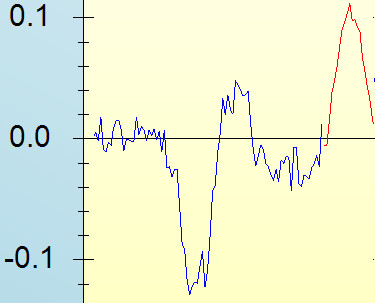
This indicates a marked recovery, indeed so marked that it will quickly be followed by a downturn. This prediction should be treated with a great deal of caution (and even scepticism). The sharpness of the recovery is probably exaggerated, and so too, therefore is the likelihood of a quick reversal. I suspect that this - and the considerably less sanguine predictions that I reported on 17 July - reflect some inaccuracies in the published data for May. At that stage, the industrial production index had remained static for four months; the June figure, alongside various other indicators, renders the figure for May suspect.
Other positive statistics released recently include the second quarter estimate for GDP growth (0.6% over the quarter) and a rapid growth of retail sales noted by the British Retail Consortium.
Added note: If the industrial production figure for May is indeed downwardly biased, then that has implications for the forecast reported here. Supposing the value of the industrial production index in May should have been 95.5 (rather than 95.3), the forecaster would still lead us to expect recovery over the coming year, but it is much more modest and short lived. This serves to reinforce the point that, while several indicators give grounds for optimism, caution is still needed in interpreting the data.
Thursday, July 18, 2013
Chart 3.14 on page 100 tells the story. The central projection shows that we can expect the net public sector debt as a proportion of GDP to rise towards 100% by the 2060s. Increasing immigration can reduce this burden quite substantially - since migrants tend to be younger than the population as a whole, and hence are more likely to be working, they generate substantial tax revenues. Reducing immigration has a severe impact on the national debt; indeed reducing net migration to zero is projected to cause the public sector net debt to rise to around 150% of GDP by the 2060s.
It is difficult to place too much credence on figures that look so far into the future. But the overall message from the Office for Budgetary Responsibility is clear: reducing the national debt without accepting an increase in immigration is likely to be an unrealistically tough ask.
Wednesday, July 17, 2013
This appears to sit alongside other recent encouraging signs - including the upgrade to the forecast produced by the International Monetary Fund, which now predicts 0.9% growth in the current year.
Other data suggest that we should remain cautious, however. Industrial production has been flatlining in recent months, and remains stubbornly lower than it was a year ago. The forecasting model that I report here from time to time, based on these industrial production data, was, until recently, predicting a modest recovery, but is now pointing to a renewed bounce along the bottom.
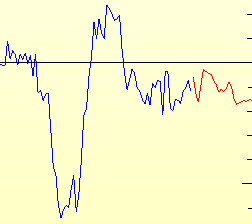
For sure, some statistics are encouraging. Overall, however, the picture remains one of fragility.
This is not an altogether straightforward issue, as the statistical evidence on the effects of minimum pricing paints a rather confused picture. Estimates of the elasticities of health outcomes with respect to the minimum price of alcohol vary widely. Much of the best evidence comes from Canada - and Canadian researchers have studied also the UK situation. However, all the serious studies of which I am aware report significant (albeit widely divergent) beneficial outcomes from the imposition of a minimum price.
The proposal for a minimum price was a great example of a 'nudge' policy that offered the prospect of remarkable social benefits - it is regrettable that it has fallen victim to politics.
Friday, June 21, 2013
The findings of their analysis may provide some observers with a surprise: they find the 'native Europeans are more likely to upgrade their occupation to one associated with higher skills and better pay when a larger number of immigrants enter their labour market'. Their detailed empirical results suggest why this might not be the general perception. In their simplest model, it takes up to four years for the beneficial impact to become apparent. In more sophisticated models, which make allowance for issues arising from the direction of causality, the effect is immediate, but becomes more pronounced over time.
It is usually, though admittedly not always, the case that free markets serve us well. The labour market is no exception.
Wednesday, June 12, 2013
Fehr, E., Herz, H., & Wilkening, T. (2013). The Lure of Authority: Motivation and Incentive Effects of Power American Economic Review, 103 (4), 1325-1359 DOI: 10.1257/aer.103.4.1325
The fall in wages has allowed unemployment to remain at much lower levels than might have been expected given the severity of the recession. The IFS attribute this flexibility of wages in part to a continued high level of labour supply - with many workers who would, in previous recessions, have quit the labour market as 'discouraged workers' opting instead to remain in the labour market this time - and in part to the effect of union legislation.
As the economy recovers, it would not be surprising to see wage pressure increase, as workers seek to recapture some of the losses they have made over the last few years. Unless such demands can be rigourously controlled, this could lead to an escalation of wages that feeds through into price inflation, and at the same time the braking force on unemployment could wither. While we now appear to be witnessing the beginnings of recovery, this could be frustrated by stagflation if discipline is not maintained.
Tuesday, May 07, 2013
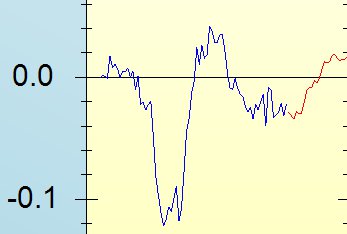
Monday, March 18, 2013
The legitimacy of any tax rests on the idea that people understand that they will be liable to pay the tax if they do certain things. If I earn income, I expect to pay income tax; if I purchase goods and services, I expect to pay value added tax, excise duties and the like. It is not usual, or fair, to introduce new taxes where the payments are made by people who can reasonably be supposed to have behaved differently had they known the tax was on the way. One might describe the tax as legalised (but not legitimate) theft.
The proposed Cypriot tax is being imposed on all deposits - including those below €100K which are supposedly protected from bank collapses. It is not, therefore, a tax primarily aimed at big Russian depositors, as has been claimed (although many of the large deposits do of course come from Russia). One might describe it as theft from the poor.
The tax sends a signal to all savers in Europe that their savings are, quite simply, not safe. One hopes that the furore that this has attracted will prompt a rethink and that small depositors will be protected. Otherwise, the authorities may well have triggered bank runs throughout southern Europe. It is not a smart move.
Wednesday, February 13, 2013
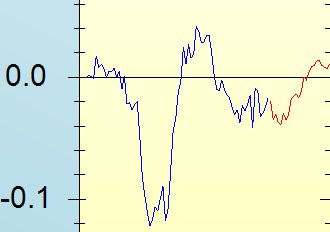
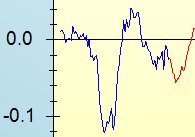
The latest results of my neural network forecaster (based on growth of industrial output) paint a similar picture of eventual recovery, although the prognosis for growth is more modest. The red line below shows the forecast to the end of next year - and suggests that growth during 2014 will be around 1.5%.
Friday, February 01, 2013
Tuesday, January 22, 2013
-student tuition fees raised to £3000 - and Conservative party plans to scrap tuition fees
-the congestion charge introduced in London (at a daily rate of £5) and the first motorway toll road opened
-the five economic tests for UK membership of the euro assessed
Inevitably, though, in looking back over the last decade, it is the Great Recession that stands out as an economic event of magnitude. The crisis, presaged in the UK by Northern Rock and reaching a climax with the collapse of Lehmans, has lasted over 5 years and output is still well below pre-crisis levels. The 6 September 2012 policy change by the European Central Bank has been instrumental in reducing interest rate spreads across the continent, and offers some hope that we may finally enter a period of sustained recovery. Nevertheless policymakers are still walking a tightrope - they must encourage growth while still attending to the fiscal deficit and guarding against inflation. The impact of deficit reduction policies, alongside the still fragile international economic environment, will mean that recovery is a slow process. So economics is, for better or worse, likely to remain interesting well into the next ten years.
Friday, January 04, 2013
Essentially, the method proposed by Gilhooly, Weale and Wieladek is designed to compensate for biases that result from the fact that the fortunes of different sectors of the economy are intertwined at any point in time. Traditional methods that are used in this context do not work well when the time period under consideration is short, but these authors finesse this problem by adopting Bayesian methods. They argue that superior forecasting properties of their model suggest that its results should be taken more seriously than those of exercises based on other methodologies.
An important question then remains: if as much as half of the drop in output has been due to a fall-off in productivity, how can this fall-off have happened? If the findings imply that, over the course of the recession, we have unlearned the lessons of how to produce efficiently, then it is reasonable to question how such amnesia can occur.
To some extent, the decline in real wages may have allowed firms to retain labour while tolerating a fall in productivity - a fall that in itself reflects a drop in demand for the firms' output. Labour hoarding of this kind is readily explained in a context where firms expect a rapid return to growth and anticipate future labour shortages. It is not clear that this is the case now.
Another explanation may be that high productivity sectors have declined for secular reasons - for example, as natural resources have been depleted, the output of the extractive industries has fallen. This might suggest that there is a more permanent element to the decline in productivity, and that we should not output to grow rapidly to its previous high level.
It is possible, therefore, to put a rationale on the findings of Gilhooly et al. that productivity decline has been an important driver of recession. More work is probably needed before it is safe to conclude that this explains as much of the drop in output as the authors suggest. But their research certainly serves a purpose in reminding us that there is work to be done on the supply side of the economy as well as on the demand side as we seek to climb out of recession.
Friday, December 28, 2012
Wednesday, December 05, 2012
A major difficulty over the last two years has been the continued weakness of the Eurozone. This has hit growth, and consequently had an adverse effect on tax receipts.
Taxpayers know that the deficit must be paid off sometime. The trick is to phase the austerity measures in such a way that, in time, they result in a reduced burden of debt, while not choking off the growth that is essential to the repayment of that debt. Current forecasts suggest that it will be the latter half of next year before any significant growth resumes, and this makes the balancing act particularly difficult. In this context it is particularly important that fiscally neutral changes in tax and government spending should be tilted to favour growth - this means that the raising of tax allowances and the investments in infrastructure are both to be welcomed.
Meanwhile, the statement points to the spending review that is to take place in the first half of 2013. The plans for deficit reduction, and specifically for government spending, in this statement indicate that the review will need to take a draconian stance. The extent to which that turns out to be feasible in practice will depend heavily on the broader macroeconomic context. If the European economy remains fragile beyond 2013, further fiscal retrenchment at home is likely to prolong still further the return to significant levels of growth. Indeed, the extent of retrenchment that is anticipated in today's statement may prove infeasible.
Thursday, November 22, 2012
The fragility of the economy in the Eurozone remains a concern - regardless of conditions within the UK itself, there are still some significant downside risks.
Thursday, November 08, 2012
(1) 'The proportion of graduates who reach the new debt write-off point of 30 years increases to 56 per cent' - in other words most graduates will never repay the full amount of their loan. Indeed, 'the average female graduate will pay back just over half of what they borrow, compared with 87 per cent for the average male graduate'. This, of course, means that many (if not most) students are indifferent about the precise level of fees that they are charged, and this in turn incentivises many universities to charge at the cap of £9000. Another implication of this is that the taxpayer ends up having to bear the burden of the unpaid debt, so that the exchequer savings of the new scheme are not as great as might have been hoped. On the assumption that growth raises graduate earnings by 1.5% per year, the exchequer savings amount to £500m per year - which represents a relatively minor reduction in the public sector deficit.
(2) The paper does not produce revised estimates of the rate of return to higher education. It does point out that the average graudate 'will in futre make repayments totalling £25830 over their lifetime - an increase of 52%' compared with the system that existed before 2012. Meanwhile, 'the average student enjoys an increase in cash support during their degree of some 12 per cent, amounting to £19580 in total'. For some students at the margin, the rate of return to higher education has presumably fallen to such an extent that the investment is no longer worthwhile.
Chowdry, H., Dearden, L., Goodman, A., & Jin, W. (2012). The Distributional Impact of the 2012-13 Higher Education Funding Reforms in England* Fiscal Studies, 33 (2), 211-236 DOI: 10.1111/j.1475-5890.2012.00159.x
Thursday, November 01, 2012